| Type | Fuzz / Distortion / Sustainer1 |
| Maker | Electro-Harmonix1 |
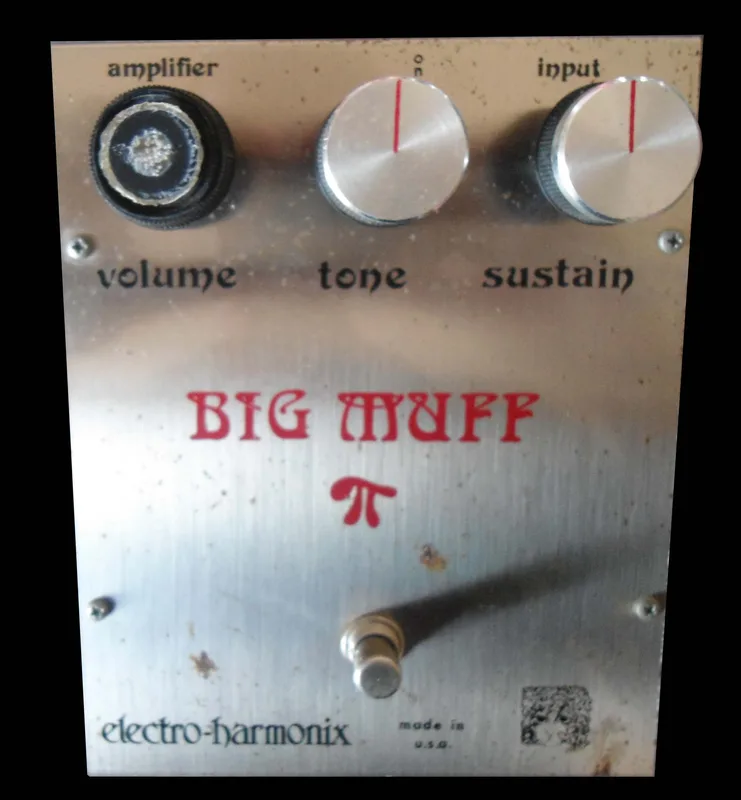
| Current [Big Muff Pi](/pedal/electro-harmonix-big-muff-pi) release date | 20001 |
| Bypass | True bypass1 |
| Power | 9V battery included; optional 9.6VDC 100mA power adapter not included1 |
| Dimensions | 5.5 x 2.95 x 6.88 in1 |
| Original circuit | Four silicon transistors3 |
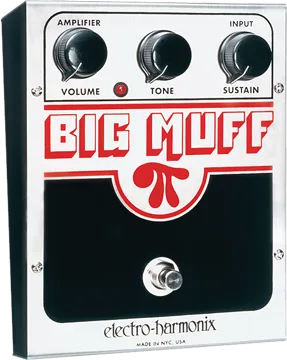
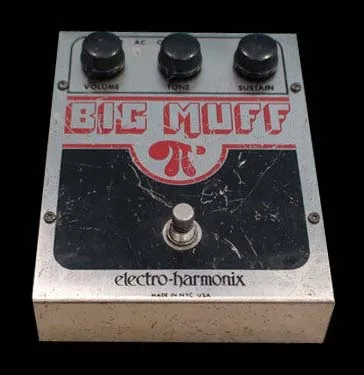
The Big Muff is a fuzz, distortion and sustainer circuit created by Electro-Harmonix in New York around 1969, and it has stayed in production in one form or another ever since. Electro-Harmonix describes the current Big Muff Pi as delivering "crushing distortion" and "singing sustain with attitude," and says it is "revered by contemporary guitarists and rock legends for its rich, creamy, violin-like sustain"1. Unlike earlier fuzz boxes such as the Fuzz Face or Tone Bender, which clip the signal with overdriven transistors, the Big Muff gets its sound by cascading gain stages into sections that are each clipped by a pair of diodes, which is what gives it its long, even sustain.
The circuit has become one of the most copied in pedal history. Mike Matthews, Electro-Harmonix's founder, once described the Big Muff circuit as "fuzz through robust filters"2. Dozens of builders, from small shops to DIY printed circuit board suppliers, build their own versions of it, and the original's many production eras, the Triangle, the Ram's Head, the op-amp models and the Russian-made Muffs, are treated by players as distinct circuits rather than one pedal.
Where the Big Muff came from
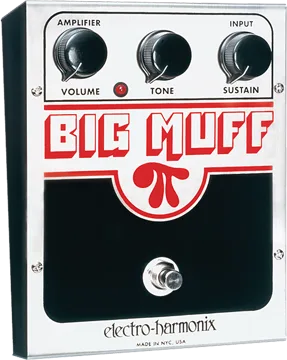
Mike Matthews and Bob Myer designed the very first Big Muff for Electro-Harmonix45. The original circuit used four silicon transistors3, a departure from the germanium transistors of 1960s fuzz pedals, and it was arranged as a series of gain stages, each followed by diode clipping and filtering.
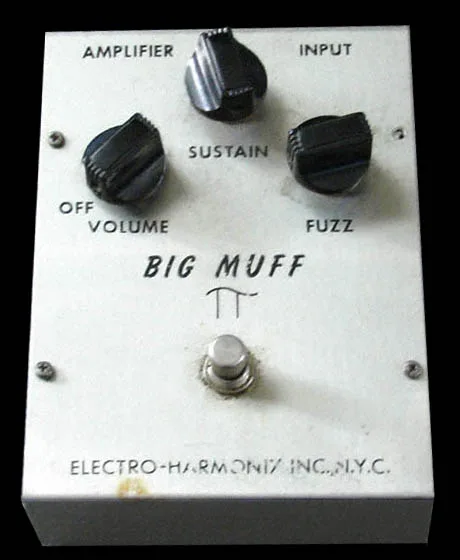
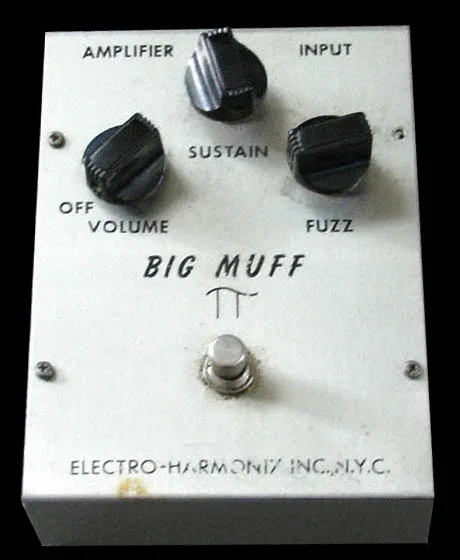
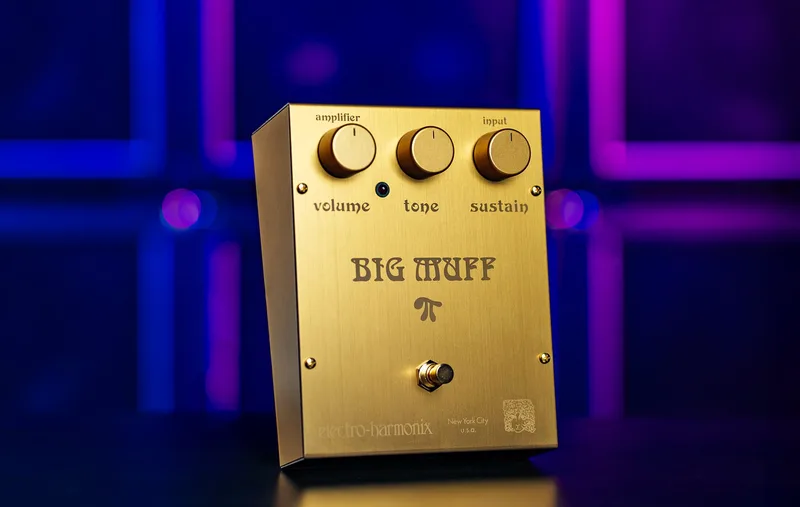
The first version is now called the Triangle Big Muff, and Electro-Harmonix explains the nickname plainly: it was "dubbed the Triangle Big Muff because of the layout of its Volume, Sustain and Tone controls," which were arranged in a triangle on the face of the box6. The company's current reissue is "a faithful re-creation of the original circa 1969 circuit," its original Version 1 Big Muff6. The Triangle model was sold until sometime around 1973, after which it was upgraded to the model called the Ram's Head2.
The name and the circuit belong to Electro-Harmonix. As Skreddy Pedals' Marc puts it on his own Muff-based pedal page, the term "Big Muff Pi" "is owned by our lovely friends at Electro-Harmonix who invented the circuit and built its worthy reputation"7.
How the circuit works
The Big Muff's design is built on repetition. As Derek See explains at Stompbox Book, the sustain that made the pedal famous "was done by cascading the circuit into additional sections, each one clipped by twin diodes," with three capacitors rolling off the highs8. In practice that means the signal passes through a chain of transistor gain stages, and after each stage a pair of back-to-back diodes clips the waveform, symmetrically, in both directions. The filtering between stages shapes the clipped signal into the smooth, violin-like sustain the pedal is known for.
That structure is why the circuit scales so easily. Mask Audio Electronics' Hot Water pedal "takes the same number of transistors normally found within a Big Muff and gets four times the amount of gain out of them"9, which shows how much headroom the basic four-transistor platform has when a builder pushes it.
The transistors themselves have varied across eras and builders. GuitarPCB's build documentation lists the types players encounter: "Transistors used in muffs include 2n5088 (our personal favorite and is widely available), 2N5133, BC550C, BC549 and many more," and notes that some are out of production10. The one big exception to the transistor design is the op-amp Big Muff, covered below.
The versions: Triangle, Ram's Head, Op Amp and the Russian Muffs
The Big Muff's history is usually divided by era, and the differences between eras are mostly component values, capacitor choices and transistor types rather than a fundamentally different schematic. The main families:
| Version | Era | What distinguishes it |
|---|---|---|
| Triangle | circa 1969 to around 1973 | Original circuit; controls laid out in a triangle62 |
| Ram's Head | from around 1973 | Early 1970s production; one of the most popular versions of the circuit1112 |
| Op Amp | late 1970s | Uses op-amps instead of transistors13 |
| Green Russian | mid-1990s | Russian-made Sovtek version; reissued by EHX14 |
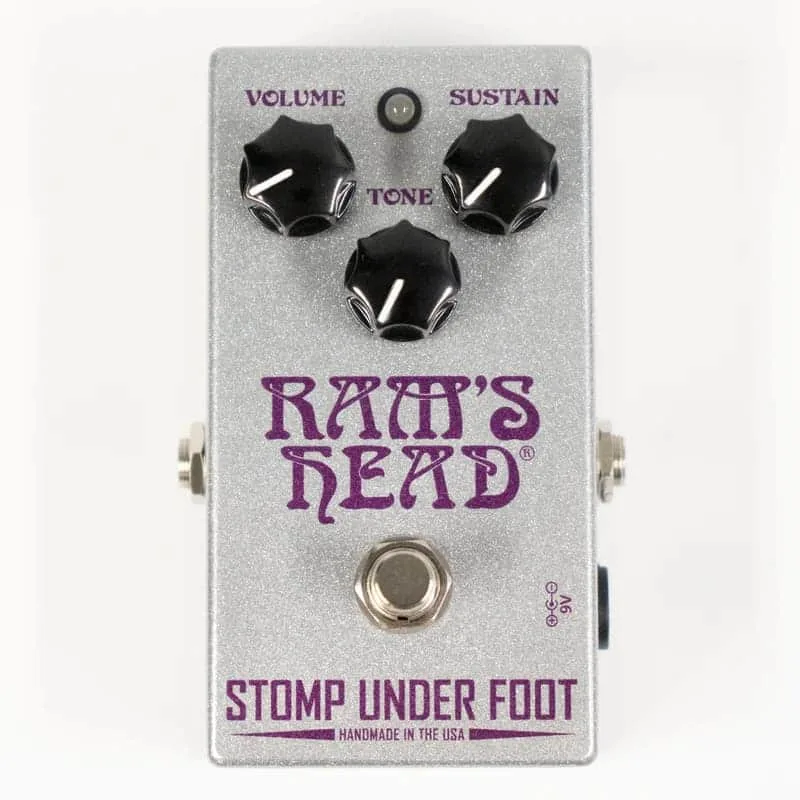
The Triangle-to-Ram's-Head changeover was not a clean break. Matthew Pasquerella of Stomp Under Foot documents rare 1972 to 1973 Triangle transition pedals that "bridge the Triangle and Ram's Head eras, possibly extending into early 1973 production," and he notes that "these transition circuits are very close to the early Ram's Head versions, including the Violet, Blue, and Black circuits," with slight capacitor differences separating them15. So a late Triangle and an early Ram's Head can be nearly the same circuit under different names.
The op-amp Big Muff is the real outlier. Mojo Hand FX describes it as featuring "op-amps instead of the traditional transistors found in every other Big Muff variant"13. It came from Bob Myer himself: as JHS tells it, "It was Bob Myer's own attempt to reimagine the original transistorized Big Muff circuit using the new cutting-edge Op-Amps" of the 1970s, drawn on a hand-drawn schematic labeled "BIG MUFF USING (2 DUAL OP AMPS)"16. Where the original delivers its "sweet violin-like sustain," JHS says Bob's two dual op-amp approach pushes into different territory16.
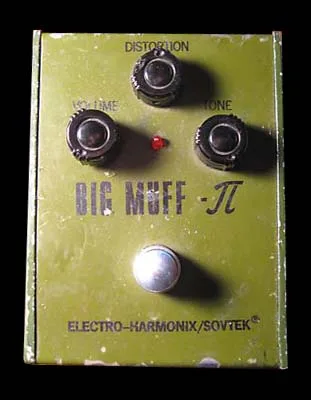
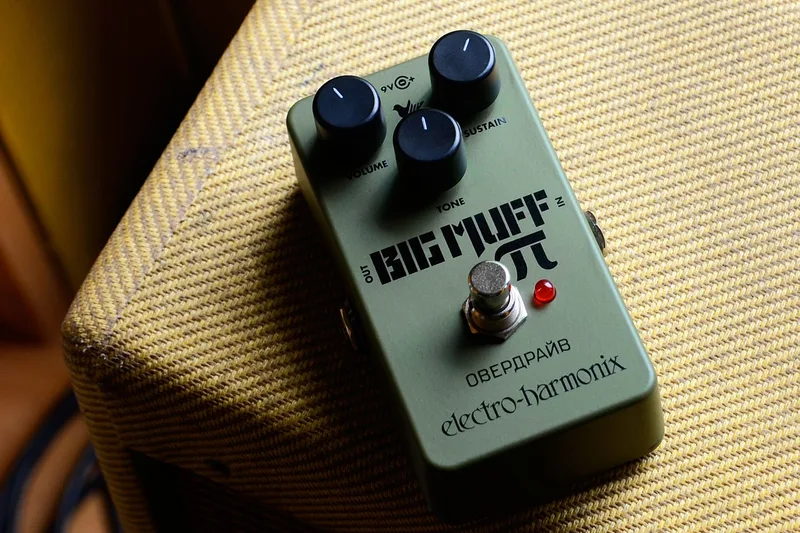
The Russian Muffs came later. The Green Russian Big Muff was first released in the mid-1990s under the Sovtek name, and Electro-Harmonix now sells "a faithful reissue of the legendary Green Russian Big Muff from the mid 1990s"14. RockBoard's take on the reissue: "The EHX Green Russian Big Muff creates a huge tone that is all its own, but is undeniably Big Muff"17.
Inside the Ram's Head years

The Ram's Head era is the most studied stretch of Big Muff history, and the most varied. Pasquerella's guide to the 1973 Ram's Head documents sixteen circuit versions, V1 through V1618. The versions differ in component values: V14, for example, keeps "the first half of the circuit the same as V6," but "the second half swaps the typical capacitor values for larger '47' caps"18. The newly documented V16, the "Ultra 47," is the basis of Stomp Under Foot's own Ultra 47 pedal, of which Pasquerella writes, "It remains one of the most impressive Big Muff circuits I have ever played"19.
The Ram's Head name also carries the most famous player association. One 1973 Ram's Head circuit is alleged to have belonged to David Gilmour and was purchased from Pete Cornish during a sale of some of Gilmour's excess gear. Pasquerella reports that "Pete was kind enough to respond to my inquiry and confirmed that it was possible, but without documentation could not verify it with certainty"18. More broadly, Mojo Hand FX notes that "when it comes to fuzz his go to unit for the majority of his career has been the legendary Big Muff," across "many incarnations and variants employed at different time periods"20.
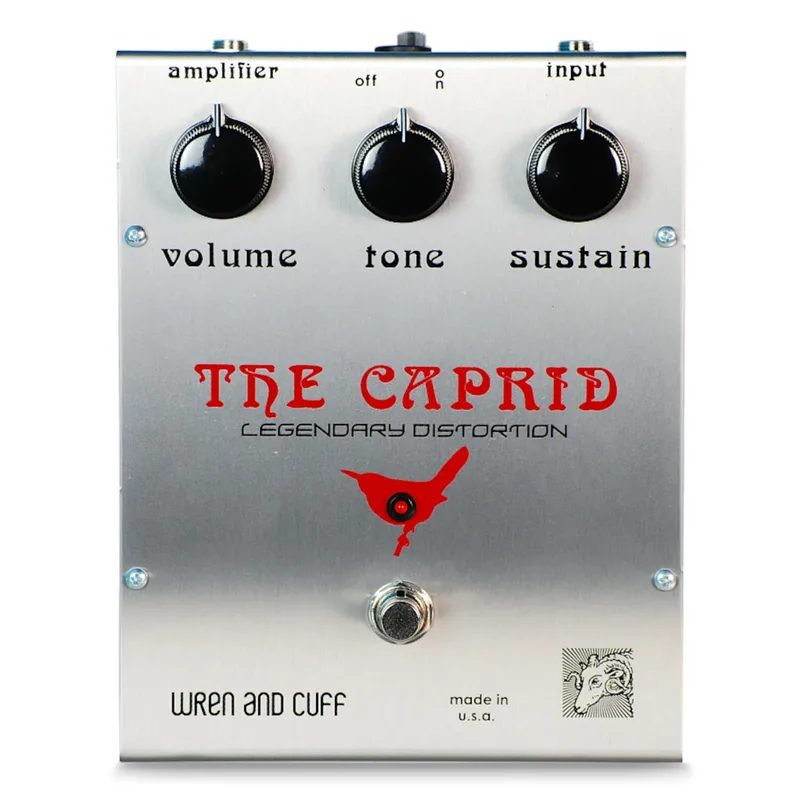
Because there was never one Ram's Head circuit, builders who recreate one have to choose. Wren and Cuff's Caprid OG is "built from the best of four different Ram's head circuits," as the company puts it: "We took the best of four different Ram's head circuits (yes there were four!)"21.
The controls: Volume, Tone, Sustain
Every Big Muff, from the Triangle to the current Pi, uses the same three controls, and the layout is where the Triangle got its name6.
| Control | What it does |
|---|---|
| Volume | Sets the output level |
| Tone | Tilts the balance between bass and treble after the clipping stages |
| Sustain | Sets the drive into the clipping stages, controlling how long notes hold |
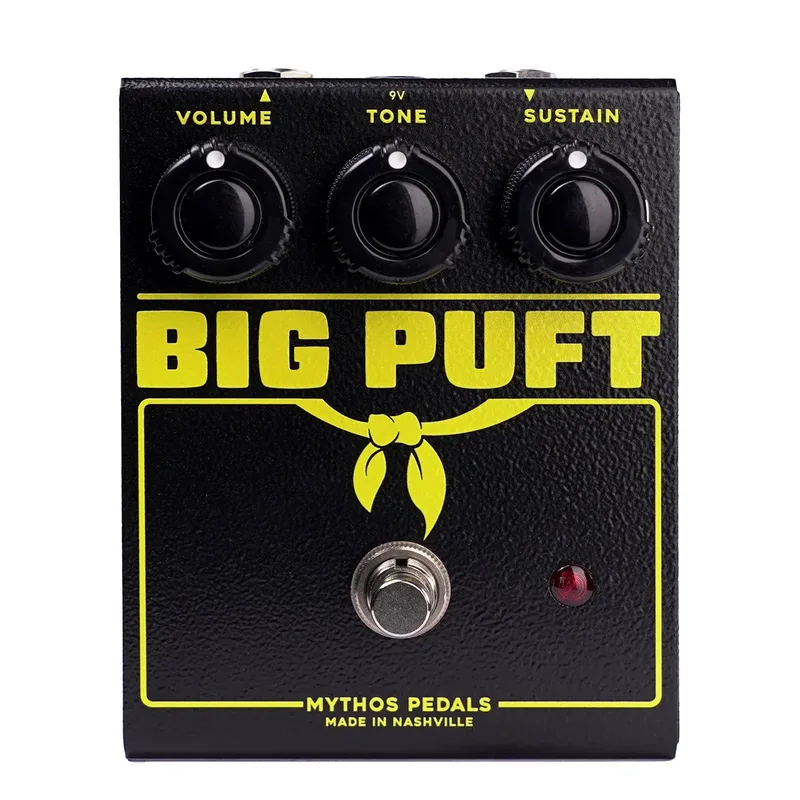
The three-knob format has been copied along with the circuit. Mythos Pedals' Big Puft Fuzz Device, a Muff-style build, lists "Volume, Tone, Sustain Controls"22, and Moskyaudio's BIG FUZZ lists "Control: VOLUME, TONE, SUSTAIN"23. That consistency across more than fifty years of copies is itself a sign of how settled the original design was.
Electro-Harmonix reissues and current Big Muff pedals
Electro-Harmonix sells several Big Muffs today, each pointing at a different era of the circuit:
- Big Muff Pi: the current production model, released in 2000, true bypass, with a 9V battery included and an optional 9.6VDC 100mA adapter1.
- Triangle Big Muff Pi: a faithful re-creation of the circa 1969 original, true bypass, 9V battery included6.
- Op Amp Big Muff Pi: a reissue of the late-1970s op-amp circuit, true bypass242526.
- Green Russian Big Muff Pi: a faithful reissue of the mid-1990s Russian version14.
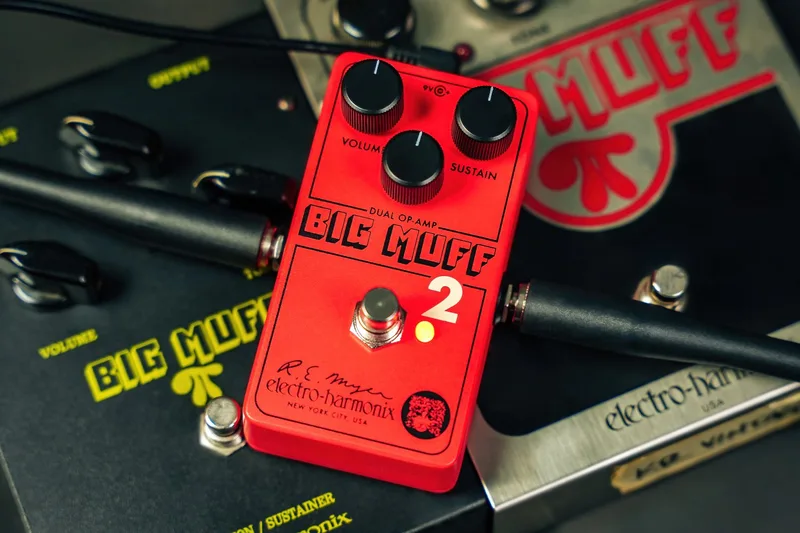
- Big Muff Pi 2: Josh Scott of JHS "went to work decoding the original schematic and resurrected the circuit" after he and EHX traced the design back to Mike Matthews and Bob Myer's first Big Muff27.
- Double Anniversary Big Muff Pi: marks 55 years of the Big Muff Pi and 50 years of the Ram's Head circuit28, and "for the first time since the 1970s" features the Ram's Head circuit in a "Big Box" full-sized chassis, with the Violet Ram's Head circuit inside282930. It is true bypass31.
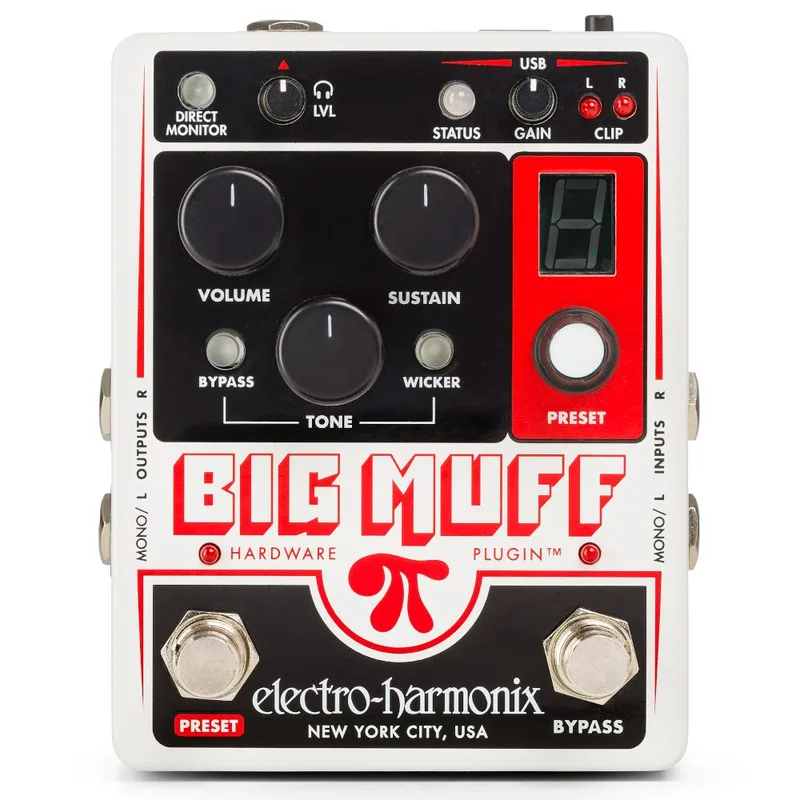
- Big Muff Pi Hardware Plugin: shares the circuit design of the 1973 Violet Ram's Head Big Muff32 but works as a hardware plugin as well. It draws 120mA, uses buffered bypass rather than true bypass, comes with an EHX 9V power supply, and can also be powered via its USB 2.0 Type B port32.
The Hardware Plugin is the one current EHX Big Muff that is not true bypass: it uses buffered bypass32. Its 120mA current draw32 is also far above what a standard transistor Big Muff needs, so plan power accordingly.
Pedals and DIY boards based on the Big Muff
The Big Muff is likely the most cloned fuzz circuit in existence, both by commercial builders and by players soldering their own. The DIY world in particular treats it as a platform.
Commercial pedals based on the circuit:
- Skreddy Pedals' Top Fuel is, in the builder's own words, "a Big Muff design"33, and the company's General Pig page acknowledges the original's ownership outright7.
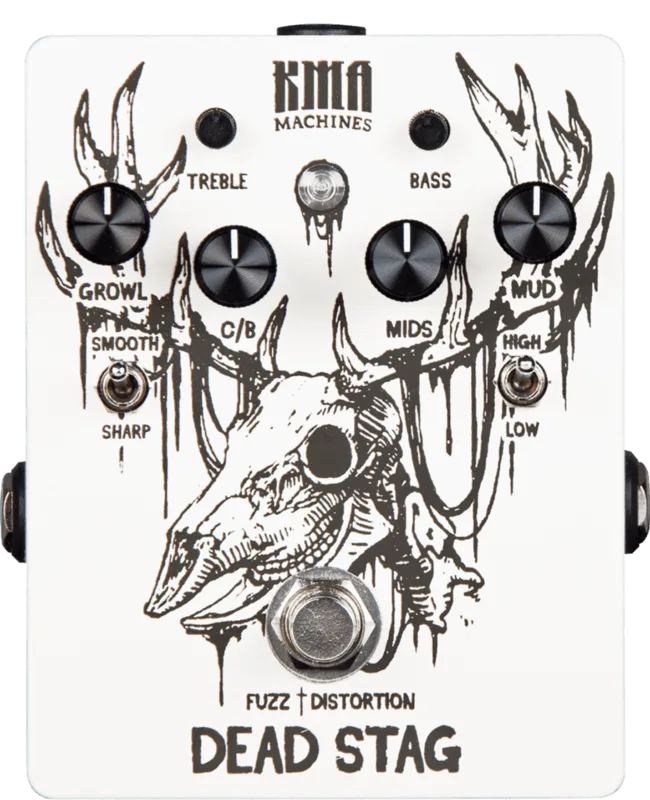
- KMA Machines' Dead Stag is "based on one of the most classic discrete fuzz/distortion circuits in pedal history"34.
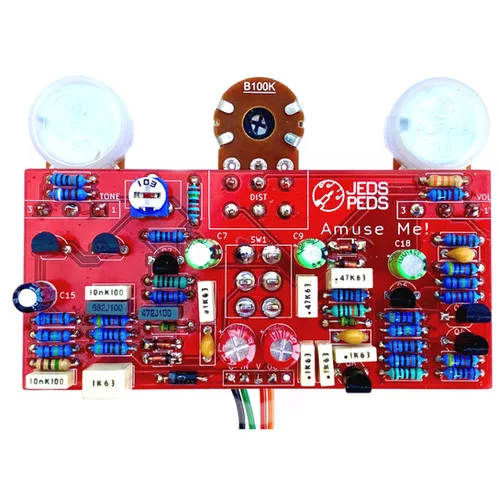
- Jeds Peds' Amuse Me "features a Big Muff at its heart with a couple of circuit tweaks"35.
- JPTR FX's Warlow is "a premium-quality OP Amp 'Big Muff' pedal that has been painstakingly rebuilt to deliver an even bigger, wider sound"36, and the Warlow mini carries the same description in a smaller box37.
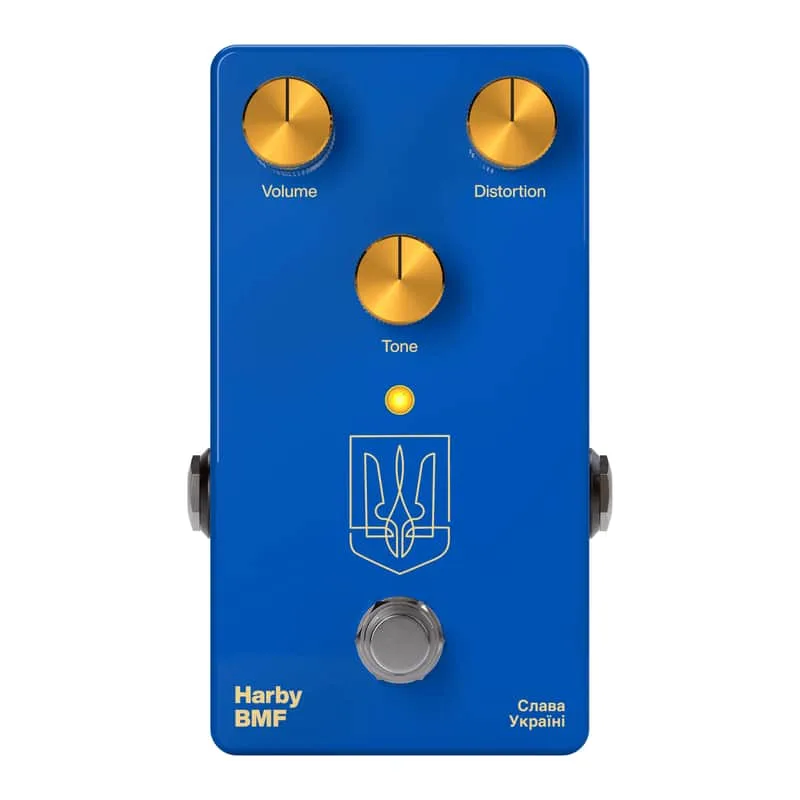
- Harby Pedals' BMF is "a modern recreation of the green Sovtek Big Muff (7B/7C models)"38.
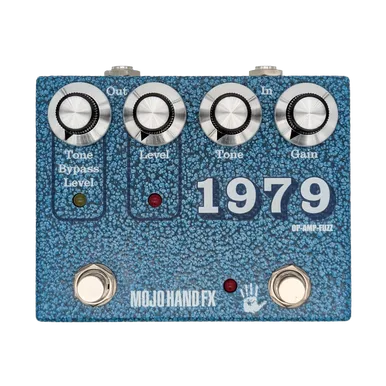
- Mojo Hand FX's Iron Bell is built around the Gilmour association with the circuit20, and its 1979 Baja Opamp Fuzz recreates the op-amp era2024.
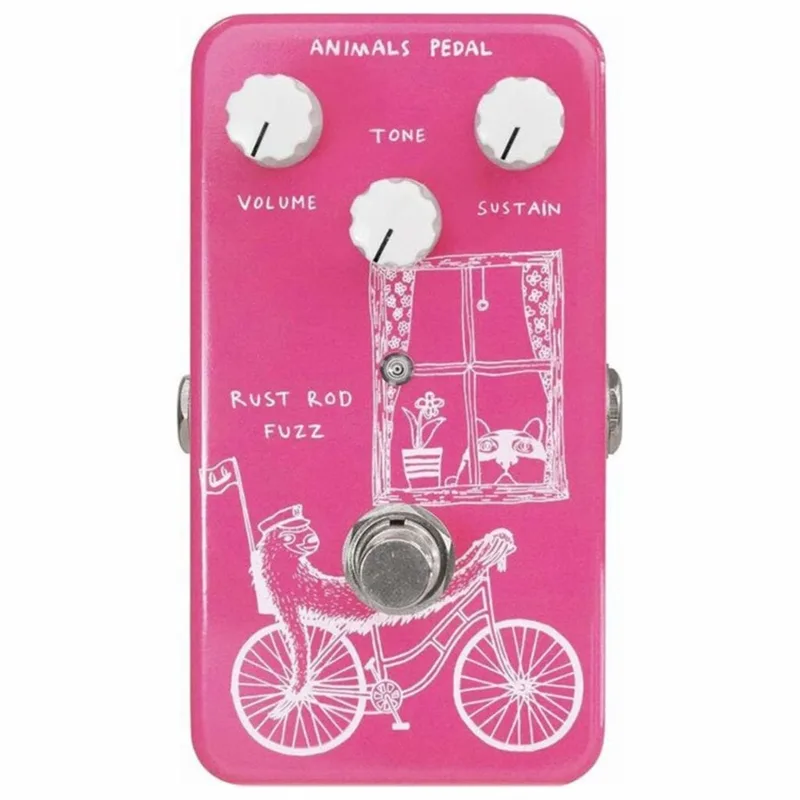
- Stomp Under Foot's Ultra 47 recreates the V16 Ram's Head circuit1918, and Animals Pedal's Rust Rod Fuzz draws on the Ram's Head variant, "one of the most popular versions of the classic circuit"11.
DIY boards and kits:
- GuitarPCB's MUFF'N v4 lets you "build any of (10) Big Muff Pi variants with the option to include (7) of the most popular Mods," covering Rams Head, Violet Ram, Triangle, 3rd Edition, Creamy Dreamer, Foxy Lady, Green Russian, Black Russian, Civil War and Mayo39. Its manual charts the variants players have recreated over "the past 40 years," including Triangle, Ram's Head, Violet Ram's Head, Russian and Creamy Dreamer10.
- General Guitar Gadgets' replica kit builds nine versions from one board: "the Triangle, Ram's Head, Violet, late-70s, Civil War, Green and Black Russian, NYC" plus a GGG-tuned version40. It runs on a 9V battery or DC jack, with the battery not included40.
- GuitarPCB's Big Muff 2 board is "based off of the Big Muff 2 circuit"41, and its Big Muff X6 bonus PCB is "based on (6) EHX Big Muff circuits"42.
- PedalPCB's Muffin Fuzz is listed for comparison to the EHX Big Muff Pi43.
For a player comparing circuits, the practical takeaway is that "Big Muff" names a family, not one sound. A Triangle reissue, a mid-1990s Green Russian, an op-amp model and a modern high-gain interpretation like the Hot Water9448 all share the cascaded, diode-clipped architecture, but they differ in transistors, capacitor values and filtering, and those small differences are exactly what players argue about.
Pedals on this page



News
Questions
Who designed the original Big Muff?
Mike Matthews and Bob Myer designed the very first Big Muff for Electro-Harmonix. Myer later drew a schematic reimagining the original transistorized circuit using dual op-amps in the 1970s, which became the basis of the op-amp Big Muff. Josh Scott of JHS later decoded the original schematic and resurrected the circuit as the Big Muff Pi 2.
What transistors are in a Big Muff?
The original Big Muff circuit used four silicon transistors. Common types found in Muffs include the 2N5088, 2N5133, BC550C and BC549, and some of these are now out of production. The op-amp Big Muff is the exception: it uses op-amps instead of the transistors found in every other Big Muff variant.
What is the difference between a Triangle and a Ram's Head Big Muff?
The Triangle, named for the layout of its Volume, Sustain and Tone controls, is the original circa 1969 circuit. The Ram's Head replaced it around 1973. Transition circuits from 1972 to 1973 are very close to the early Ram's Head versions, including the Violet, Blue and Black circuits, with slight capacitor differences separating them.
Does the Big Muff Pi take a battery?
Yes. The current Electro-Harmonix Big Muff Pi ships with a 9V battery included, and can also run from an optional 9.6VDC 100mA power adapter, which is not included. The Triangle Big Muff Pi reissue also includes a 9V battery.
Is the Big Muff Pi true bypass?
Yes. Electro-Harmonix lists the current Big Muff Pi, the Triangle Big Muff Pi reissue, the Op Amp Big Muff Pi and the Double Anniversary Big Muff Pi as true bypass. The Big Muff Pi Hardware Plugin is the exception, using buffered bypass.
How much current does a Big Muff Pi draw?
The Big Muff Pi Hardware Plugin draws 120mA, which is far more than a standard transistor Big Muff, because it also works as a hardware plugin. It comes with an EHX 9V power supply and can also be powered via its USB 2.0 Type B port.
Which Big Muff did David Gilmour use?
The Big Muff was the fuzz David Gilmour turned to for the majority of his career, across many incarnations and variants at different periods. One 1973 Ram's Head circuit is alleged to have belonged to Gilmour and was purchased from Pete Cornish, though Cornish confirmed only that it was possible, and could not verify it with certainty without documentation.
What is the difference between a Big Muff and a Green Russian Big Muff?
The Green Russian Big Muff is a version of the circuit made in Russia in the mid-1990s, sold under the Sovtek name. Electro-Harmonix now sells a faithful reissue of it. RockBoard describes its tone as huge and all its own, but undeniably Big Muff.
Sources (44)
- Big Muff Pi, Electro-Harmonix (www.ehx.com)
- BALTIC BLUE FUZZ (OC-BBFn), One Control USA
- Electro Harmonix and the Big Muff, tru-fi.com
- Electro-Harmonix Deluxe Big Muff Pi 2: The Ultimate Muff 2?, gearnews.com, 2026-07-16
- EHX Big Muff 2 Announced! The Lost Circuit Returns, gearnews.com, 2025-12-15
- Triangle Big Muff Pi, Electro-Harmonix (ehx.com)
- Big Muff variants, Skreddy Pedals
- Big Muff Pi, Stompbox Book, 2020-03-21
- Hot Water, Mask Audio Electronics
- MUFFN-v4-2022.pdf, GuitarPCB.com, 2022
- Rust Rod Fuzz by Animals Pedal, RockBoard PedalPedia, 2026
- Electro-Harmonix Ram's Head Big Muff Pi review, Guitar World, 2020-05-25
- 1979 Baja, Mojo Hand FX
- Green Russian Big Muff Pi, Electro-Harmonix
- 1972-1973 Transition Triangle, Stomp Under Foot, 2026-07-18
- EHX BY JHS, JHS Pedals
- Green Russian Big Muff π reissue by Electro-Harmonix, RockBoard PedalPedia, 2026
- 1973 Ram's Head, Stomp Under Foot, 2026-07-18
- ULTRA 47 RAM'S HEAD MUFF, Stomp Under Foot
- Iron Bell, MojoHandFX
- Caprid OG B-Stock Summer Sale, Wren and Cuff
- Big Puft Fuzz Device, Mythos Pedals
- BIG FUZZ_M-SERIES_Products_mosky pedal, moskyaudio.com
- The Big Muff History of All Versions Part 1, Kit Rae (kitrae.net), 2024-02
- Op Amp Big Muff Pi, Electro-Harmonix
- Electro-Harmonix Announces The Re-Release of Their Classic, Circa 1978 OP-AMP Big Muff PI, Bass Gear Magazine, 2017-12-12
- Big Muff Pi 2, Electro-Harmonix
- Double Anniversary Big Muff Pi, Electro-Harmonix
- NAMM 2024: “For all of the original mojo and magic craved by the true believers”: EHX's Double Anniversary Big Muff Pi delivers its first 'big box' Ramshead circuit since the 1970s, Guitar World, 2024-01-24
- The Big Muff History of All Versions Part 1, Kit Rae (kitrae.net), 2024-04
- Double Anniversary Big Muff Pi, Electro-Harmonix
- Big Muff Pi Hardware Plugin, Electro-Harmonix (www.ehx.com)
- Big Muff variants, Skreddy Pedals
- Dead Stag, KMA Machines
- Amuse Me, Jeds Peds (jedspeds.co.uk)
- JPTR FX Warlow, JPTR FX
- WARLOW mini, JPTR FX
- BMF by Harby Pedals, RockBoard PedalPedia, 2026
- Big Muff Pi, GuitarPCB
- Big Muff Pi™ Clone Kit: Triangle, Ram's Head & Russian Fuzz, General Guitar Gadgets, 2014-05-12
- EHX-Big-Muff-2-Build-Document.pdf, GuitarPCB, 2026-02
- Microsoft Word, GuitarPCB, 2025-08
- Muffin Fuzz, PedalPCB.com
- The Big Muff Pi Home Page, Kit Rae (kitrae.net), 2010