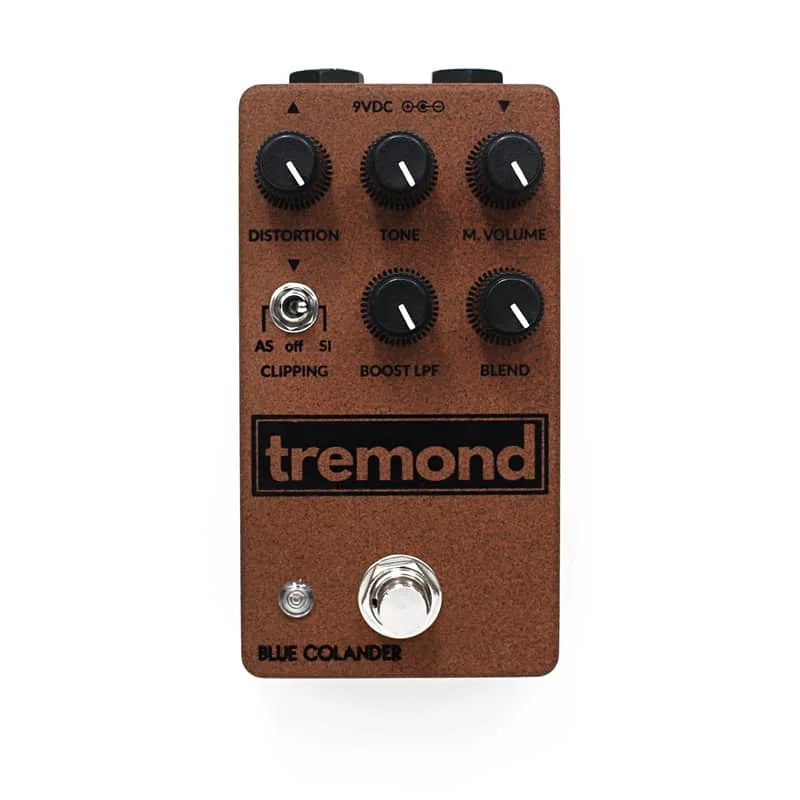


The Blue Colander Tremond is an analog distortion and overdrive pedal from Blue Colander, a one-person pedal maker based in Poland12. The circuit starts from a famous rodent pedal, the RAT, and RockBoard's PedalPedia describes it as a mix of the early big box and whiteface versions of that design, built around the LM308n integrated circuit1. A smaller Tremond mini version shares the same circuit and chip3.
RockBoard's PedalPedia says the distortion side is tuned for a consistent sound with a true vintage vibe, with creamy and juicy mids, a tight attack and a recognizable sag at high gain settings1. What sets the Tremond apart from a straight RAT clone is a second channel and a set of switching options, covered below.
The Tremond cannot run on a battery. Delicious Audio's product page states it in capital letters: "NO BATTERY OPERATION POSSIBLE WITH THIS PEDAL."2 It needs an external 9V DC center negative supply.
Controls and the two channels
The Tremond has two channels blended by one knob. The BOOST channel is a mosfet booster that Delicious Audio describes as dark: it warms up the tone, rolls off a good amount of treble, and adds compression and breakup with hot pickups or heavy playing2. The DISTORTION channel is the RAT-based side.
| Control | What it does |
|---|---|
| BLEND | Mixes BOOST (counterclockwise) and DISTORTION (clockwise) channels2 |
| TONE | Rolls off treble content when turned counterclockwise2 |
| M. VOLUME | Master volume for both DRY and WET channels2 |
| AS/off/SI | Selects the clipping mode2 |
| Brittle mode switch | Adds a tiny bit of extra treble presence to both channels, noticeable with bright or wide-range speakers2 |
Clipping modes: SI, AS and OFF
The clipping switch selects how the distortion side clips the signal, with three positions2:
- SI: stock RAT-style silicon diodes, the classic high gain tone12
- AS: an asymmetric mix of LED and germanium diodes, lower gain and brighter, great for crunch2. RockBoard's PedalPedia describes this setting as having a more crunchy, clear breakup feel, good at lower gain settings or as an additional boost at high gain3
- OFF: no clipping diodes at all, leaving a huge load of pure op-amp distorted sound32
The stock position is the silicon diode setting, which RockBoard's PedalPedia calls the classic, high gain sound1. The switch lets you replace those diodes with the LED and germanium combination or omit them entirely1.
BOOST LPF and DRY LPF versions
There are two runs of the pedal with different knob labels. Current pedals carry a BOOST LPF labeled knob, while previous units were labeled DRY LPF2. Both versions include the brittle mode switch described in the controls table, so the difference is in labeling rather than the presence of the feature.
What reviewers said
Delicious Audio's take on the Tremond was that it covers a lot of ground2:
"Classic guitar distortion and the most versatile bass tool? Here you go."
Paolo De Gregorio, Delicious Audio2
The site found it versatile enough to work as a gritty boost, a tone enhancer, a retro drive, a modern midscooped distortion and a bass tool2, which makes it worth a look for bass players as well as guitarists.
Where it sits in the Blue Colander range
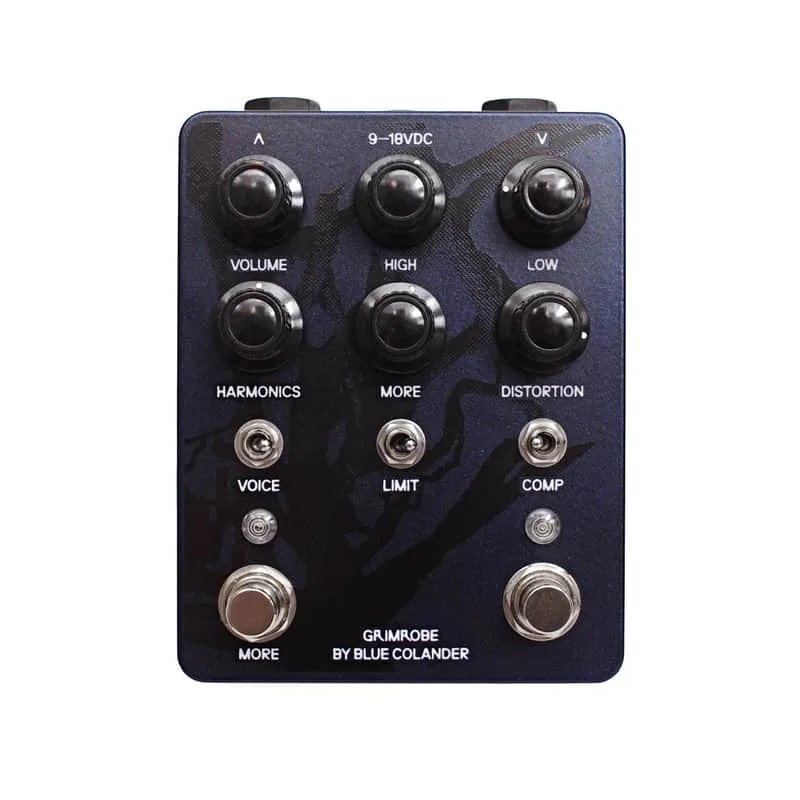
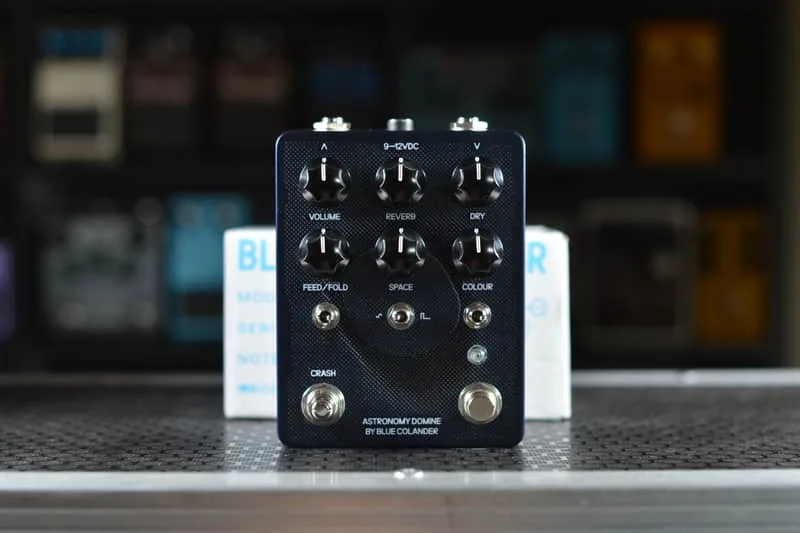
Blue Colander has since released other pedals in the same RAT-influenced territory, including the Grimrobe, a dual cascaded distortion, and the Astronomy Domine, a spring reverb plus dirt pedal with wavefolding. The Tremond remains the maker's take on the classic two-channel RAT formula.
Videos
blue colander
collector//emitter
the wetter bass
Questions
Can the Blue Colander Tremond run on a battery?
No. Delicious Audio's product page states plainly that no battery operation is possible with this pedal. It runs only from an external 9V DC power supply with a center negative plug, so it needs a spot on a pedalboard power supply rather than a battery clip.
What power supply does the Tremond use?
It takes 9V DC with a center negative plug, the standard arrangement for most modern effects pedals. That means it works with typical isolated pedalboard power supplies. Because there is no battery option, a power supply is required to use the pedal at all.
What does the Blend knob do on the Tremond?
Blend mixes the pedal's two channels. Turned counterclockwise you get more of the BOOST channel, a dark mosfet booster and overdrive that warms the tone and rolls off treble. Turned clockwise you get more of the DISTORTION channel, the RAT-based side. Master volume then sets the level of both.
What is the difference between the BOOST LPF and DRY LPF versions?
They are two runs of the same pedal with different knob labels. Current pedals carry a BOOST LPF labelled knob, while earlier units were labelled DRY LPF. Both versions include the brittle mode switch, which adds a small amount of extra treble presence to both channels, most noticeable with bright or wide-range speakers.
Which chip does the Blue Colander Tremond use?
It uses the LM308n integrated circuit, the op-amp associated with the vintage RAT distortion pedals the Tremond is based on. Blue Colander describes it as the iconic LM308n, and it appears in both the standard Tremond and the smaller Tremond mini.
Sources (3)
- tremond by Blue Colander, RockBoard PedalPedia, 2026
- Blue Colander Tremond Distortion, Delicious Audio, 2021-10-08
- Tremond (mini) by Blue Colander, RockBoard PedalPedia, 2026