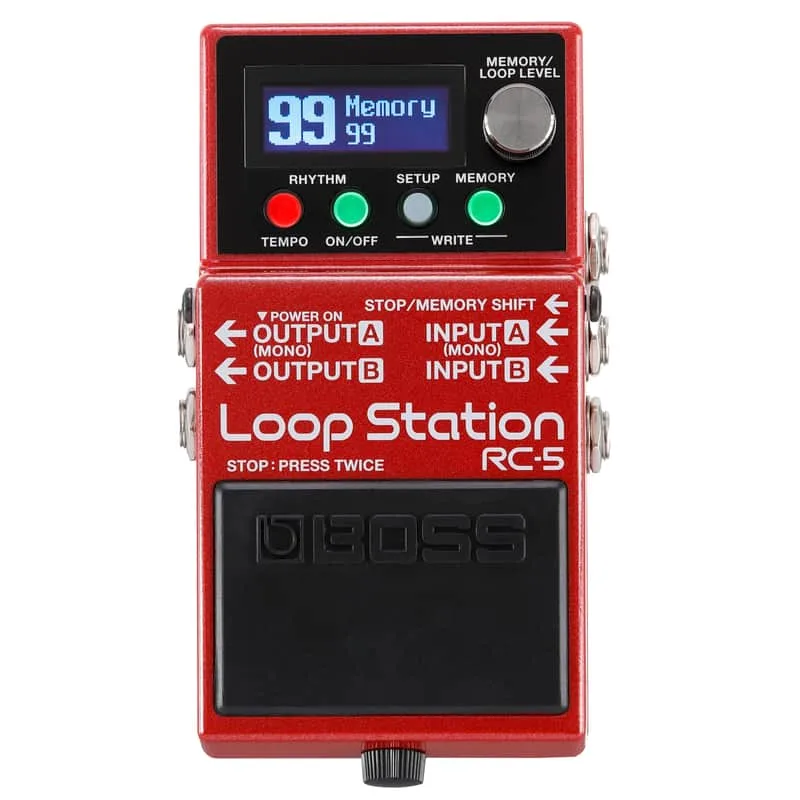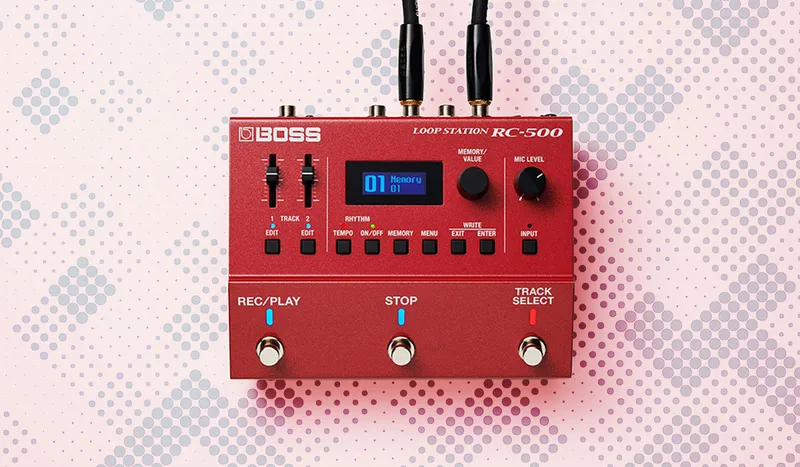


The Boss RC-500 Loop Station is a dual-track stereo looper pedal from Boss, announced in October 2020 as one of the two newest additions to the long-running Loop Station family123. It records up to 13 hours of stereo audio across 99 phrase memories, with each memory holding two tracks, multiple overdubs, and a rhythm track at the same time45. Where the compact RC-5 is a single-track design, the RC-500 adds a second track, a third footswitch, level sliders, and an XLR microphone input, which makes it a fit for vocalists as well as guitarists and bassists46.
The controls and modes
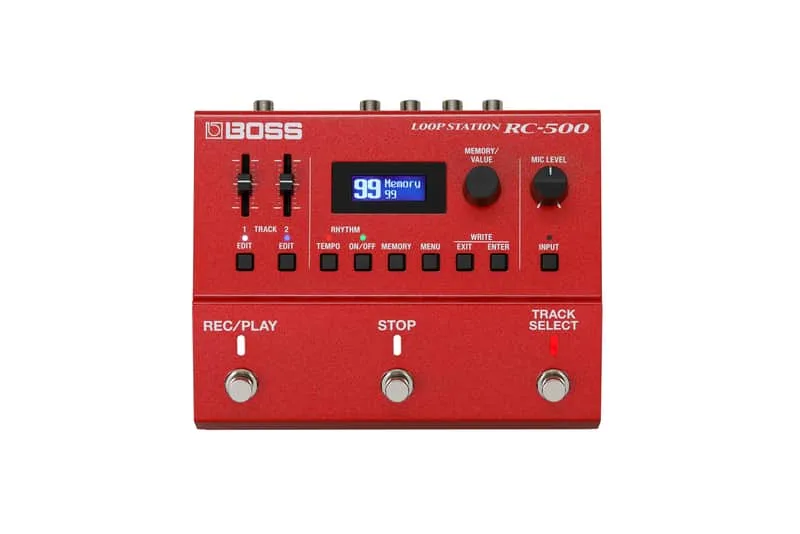
The RC-500 uses a three-button footswitch layout: record/play, stop, and track select. Performer Mag's reviewer, Chris Devine, found that "the 3-button configuration makes perfect sense out of the box, with a record/play, stop and track select footswitches," and called the format pedalboard friendly while still loaded with features4.
On the top panel there are sliders for the levels of the loops, a display showing the function or loop being played, and controls for navigating settings4. For the loops themselves, the pedal offers repeat modes that match the loop to the repeat, along with a shift function4. Both the RC-5 and RC-500 also include a reverse function2.
Two modes take a more creative approach to the recorded loop:
- Scatter mode: alters the loop with what Devine described as "destructionising quantizing"4
- Vinyl Flick mode: brings a DJ scratch approach to the loop4
"The Scatter and Vinyl Flick modes take the other road, altering the loop to what can be described as destructionising quantizing."
The RC-500 also carries a built-in drum machine with many styles and customizable patterns, according to Boss's guide to loop pedals for bass players12. Both the RC-5 and RC-500 ship with 57 onboard rhythms, each with A/B variations, and the RC-500 stores 50 user rhythms alongside its 99 phrase memories1011.
Power and connections
The rear panel sports stereo inputs and outputs, mini MIDI connections, and USB for connecting to a computer4. The full input complement is two 1/4-inch jacks (A/mono and B) plus an XLR input for a microphone5. The XLR input is the feature that sets the RC-500 apart from the RC-5 for anyone looping vocals, and Performer Mag listed it among the pedal's pros4.
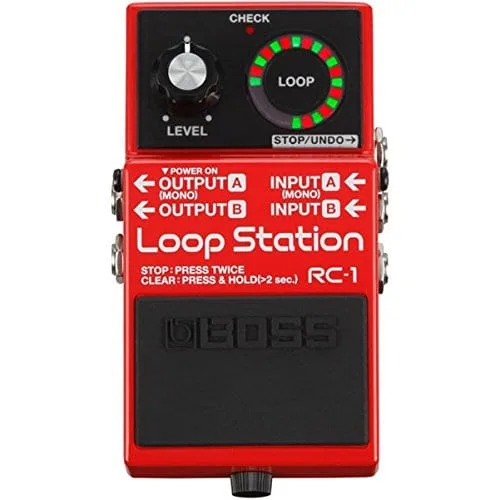
Power comes from four AA batteries or an optional AC adaptor68. Boss's own buying guide describes the battery option on the RC-500, RC-5, and RC-1 as busker-friendly, since alkaline batteries let you loop away from a wall socket11.
Unlike the flagship RC-600, which runs on mains power with an adapter included, the RC-500's AC adaptor is optional and the pedal is designed to run on four AA batteries when you are playing away from mains power611.
How the RC-500 relates to the RC-5 and RC-600
The RC-500 sits above the RC-5 and RC-1 in functionality and size, but below the RC-600 in features; Guitar World's reviewer Chris Corfield described it as "not quite as fully featured as the spaceship-like" RC-6006. The RC-5 and RC-500 were announced together in October 2020 as the latest additions to the Loop Station family, and both offer 13 hours of stereo recording and 99 phrase memories72.
| RC-5 | RC-500 | |
|---|---|---|
| Tracks | Single-track7 | Dual-track7 |
| Recording time | 13 hours stereo562 | 13 hours stereo, 1.5 hours per track75 |
| Phrase memories | 992 | 996 |
| Rhythms | 57 with A/B variations10 | 57 with A/B variations, 50 user rhythms1011 |
| XLR input | No | Yes5 |
| Price | $199 (July 2024)4 | $349 street (March 2021)4 |
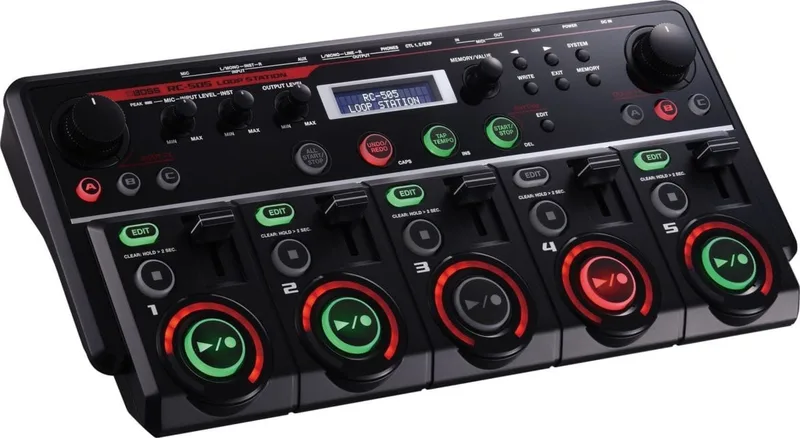
The RC-500 shares a lot with the RC-5, which Performer Mag called its "lil brother"4. The practical differences for a player are the second track, the extra footswitches, the loop level sliders, and the microphone input. Above the RC-500, the RC-600 is a larger tabletop-style unit with a backlit LCD, four navigation buttons and knobs, half-speed and reverse modes, and the same connectivity and mixing features as the RC-505mkII1314.
What reviewers said
Performer Mag's review found the RC-500 easy to use, with built-in drum patterns, looping effects, and the XLR input for vocalists listed as pros, and no cons listed overall4. The reviewer also noted that "Boss found a way to cram a lot into a small footprint with their new RC500 Loop Station"4.
Guitar World's Chris Corfield summarized the pedal as "an easy, accessible way into looping"6.
"An easy, accessible way into looping"
Boss's own materials position the RC-500 as a creative partner for players beyond guitar: the company's guide for keyboardists highlights the two-track design, 13 hours of recording time, and 99 phrase memories13, and its bass player's guide points to the built-in drum machine and customizable patterns12.
Videos
Andertons Music Co
Sweetwater
Sweetwater
Questions
Does the Boss RC-500 have an XLR input?
Yes. Alongside its two 1/4-inch inputs (A/mono and B), the RC-500 has an XLR input for a microphone, which makes it usable for vocalists and singer-songwriters who want to loop voice and instrument together. Performer Mag listed the XLR input for vocalists among the pedal's pros in its review.
Can the Boss RC-500 run on batteries?
Yes. The RC-500 runs on four AA batteries or an optional AC adaptor. Boss's own buying guide describes the battery option on the RC-500, RC-5 and RC-1 as busker-friendly, since it lets you loop away from mains power.
How many phrase memories does the Boss RC-500 have?
The RC-500 has onboard storage for 99 phrase memories. Each memory slot can hold two tracks with multiple overdubs plus a rhythm track at the same time, so a player can keep a large library of finished loops ready to recall.
How long can the Boss RC-500 record?
A single track on the RC-500 can run up to 1.5 hours, and the total memory holds up to 13 hours of stereo recording. That matches the RC-5, which shares the same stereo looper engine and 13-hour memory.
What is the difference between the Boss RC-500 and the RC-5?
The RC-5 is a single-track looper, while the RC-500 is a dual-track design with three footswitches, level sliders for each loop track, and an XLR microphone input. The RC-500 also sits above the RC-5 in size and functionality. At launch the RC-5 listed at $199 against the RC-500's $349 street price.
Does the Boss RC-500 have built-in drum patterns?
Yes. The RC-500 comes loaded with 57 onboard rhythms, each with A/B variations, and Boss's guide for bass players also notes a built-in drum machine with many styles and customizable patterns, plus storage for 50 user rhythms.
Sources (14)
- BOSS Announces RC-5 and RC-500 Loop Station Pedals, MusicPlayers.com, 2020-10-03
- New Boss RC-5 and RC-500 Loop Station pedals on the horizon, gearnews.com, 2020-10-01
- Layered Evolution: A Journey through the History of BOSS Loop Stations, articles.boss.info, 2024-05-31
- REVIEW: Boss RC-500 Loop Station Pedal, Performer Mag, 2021-03-10
- Best looper pedals 2025: My favorite loop stations, MusicRadar (www.musicradar.com), 2022-09-23
- Boss RC-500 review, Guitar World, 2023-06-07
- Boss Unveils the GT-1000CORE, RC-5, and RC-500, Premier Guitar, 2020-10-01
- Boss lifts the lid on new multi effects processor the GT-1000CORE and RC-5, flagship RC-500 Loop Station pedals, MusicRadar, 2020-10-01
- Boss Unveils New RC-5, RC-500 Loop Station Pedals, GuitarPlayer (www.guitarplayer.com), 2020-10-02
- BOSS RC-5 Loop Station, Delicious Audio, 2021-03-10
- Navigating the BOSS Loop Station Lineup: A Guide to Picking the Perfect Pedal, articles.boss.info (BOSS), 2024-04-24
- The Complete Guide to Loop Pedals for Bass Players, BOSS (articles.boss.info), 2025-04-08
- BOSS Effects Pedals for Keyboardists, BOSS (articles.boss.info), 2025-07-17
- Boss Releases Two New Loop Stations, Premier Guitar, 2021-10-14