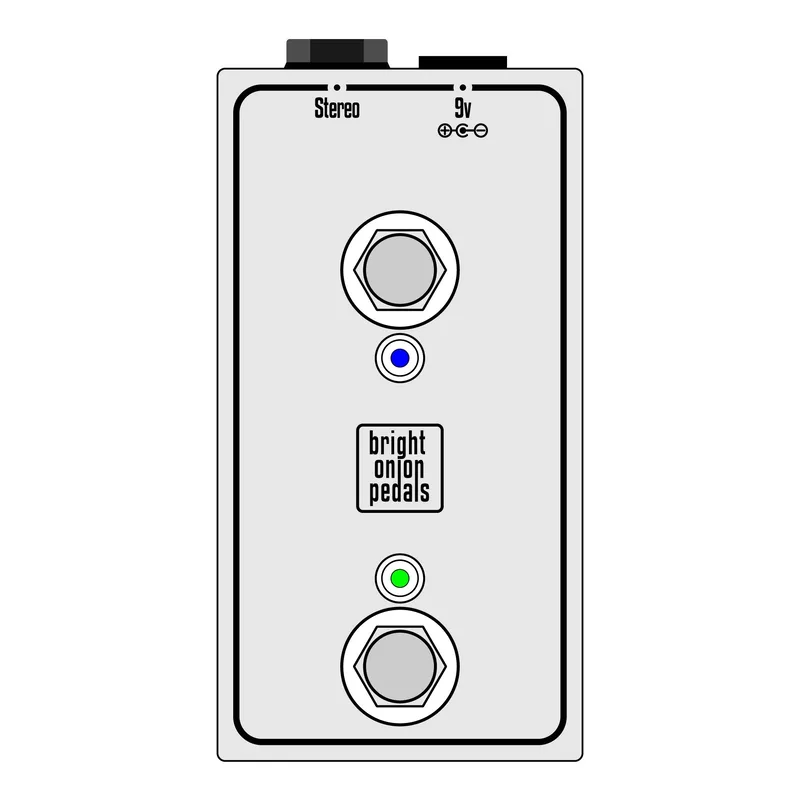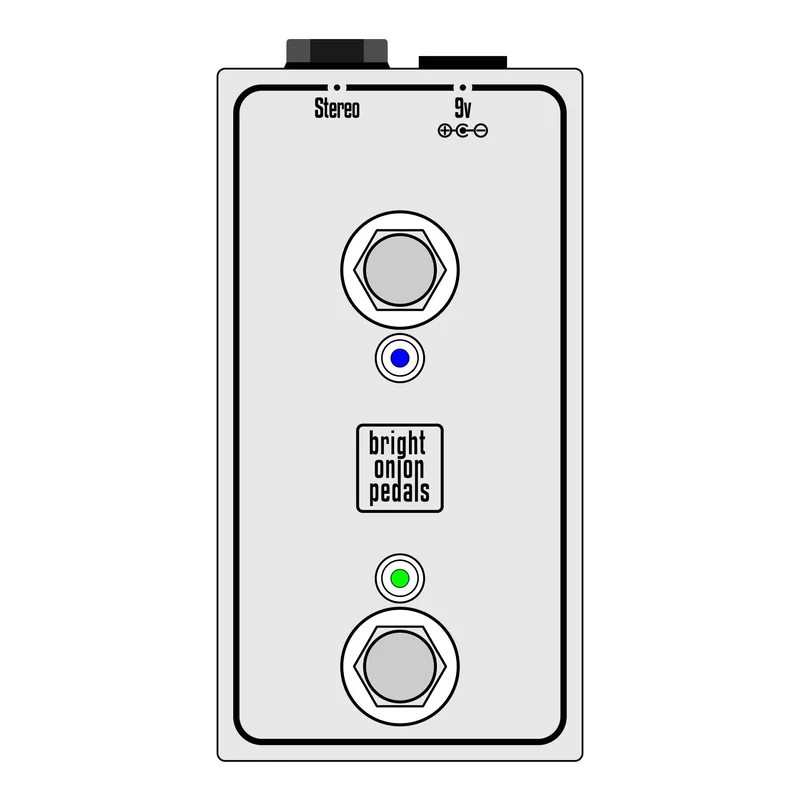
The Bright Onion Pedals Dual Latching Footswitch with LEDs is a dual latching footswitch for switching channels or effects on an amp that takes a dual latching footswitch, or for controlling additional features on compatible pedals1. It is a utility box rather than an effect: no audio passes through it, it simply opens and closes two switch contacts over a single stereo cable. Each of its two heavy duty DPDT footswitches latches, staying in its state until you step on it again, which is what channel switching on most amps expects.
The pedal comes in an enclosure measuring 110 x 60 x 31 mm1. The list price is £39.95 GBP1. It is sold by Bright Onion Pedals Limited of Brighton, with Easy Access System Europe of Mustamäe tee 50, 10621 Tallinn, Estonia named as the responsible person for EU product safety compliance1. The product carries an age restriction: it is not suitable for small children without adult supervision1.
Power and connections
The switching side of the pedal is entirely passive, so it works with no power connected at all. Power is only there for the status LEDs: the LEDs can be powered via the 2.1mm 9V DC socket, and Bright Onion can also add an internal 9V battery holder if you select this in the options when ordering1.
If the pedal is powered, use only a 9V DC center negative 2.1mm barrel power supply1. That is the same polarity convention as most guitar effect pedals, so a typical pedalboard power supply output will run the LEDs.
Connection to your amp or pedal is over a stereo TRS cable: as the maker puts it, "Just add a stereo TRS cable and you are ready to go"1. The wiring is fixed and worth knowing before you plug in:
| Connection | What it carries |
|---|---|
| Tip of the stereo TRS output | Left footswitch1 |
| Ring of the stereo TRS output | Right footswitch1 |
| Sleeve | Common ground1 |
Because both switches share one cable, a mono cable will not work; you need the stereo TRS type. If your amp's two functions are assigned to tip and ring in the opposite order, the two channels will simply be swapped, and you can plan which footswitch does what accordingly123.
Each footswitch also has an internal slider switch to let you set the LED state to the correct state for the function it is for1. In practice this means the LED can be made to light when the switched function is actually engaged, rather than showing the inverse, which matters because different amps and pedals present their switching contacts in different ways.
Bright Onion describes the pedal as needing no user maintenance, with servicing referred back to the company, and notes the products contain no batteries or lead1. Support contact is by email at james@brightonion.co.uk1.
Related footswitch versions
Bright Onion Pedals sells several footswitches in this family, and the differences between them come down to size, layout and whether the switching is latching or momentary341.
| Version | Switching | Notable differences |
|---|---|---|
| Dual Latching Footswitch with LEDs | Two latching DPDT switches | Left/right layout, LED state set by internal sliders1 |
| Portrait Dual Latching Footswitch with LEDs | Two latching DPDT switches | Portrait enclosure, front switch on tip, rear switch on ring; 9V DC center negative powers the LEDs only5 |
| Mini Dual Latching Footswitch | Two latching DPDT switches | Smaller enclosure, no LEDs, connects with a stereo cable4 |
| Mini Dual Latching Footswitch with LEDs | Two latching switches | Compact version with status LEDs; passive, works without power, left switch on tip and right on ring, same internal LED sliders2 |
| Dual Momentary Footswitch with Latching LEDs | Two momentary switches | For gear needing momentary pulses; LEDs and switching circuit require 9V DC (30mA); polarity toggle selects normally open or normally closed3 |
The choice between them is driven by what your amp or pedal actually expects. A dual latching footswitch suits amps whose channel switching inputs respond to a switch that stays closed or open; the momentary version suits equipment that wants a brief pulse, and its polarity toggle covers both normally open and normally closed wiring3. The mini versions trade the full size enclosure for a smaller footprint, and the version without LEDs drops the power requirement entirely4.
For more on this category of gear, see switching pedals.
Questions
What cable does the Bright Onion Dual Latching Footswitch need?
It needs a stereo TRS cable with a 1/4 inch stereo jack. The left footswitch is wired to the tip connection of the stereo TRS output and the right footswitch is wired to the ring, so both switches travel down the one cable. A standard mono instrument cable will not carry both channels.
Can the Dual Latching Footswitch run on a battery?
Not as standard, but Bright Onion Pedals can add an internal 9V battery holder if you select that option when ordering. The battery, like the 2.1mm DC socket, powers only the status LEDs. The switching itself is passive, so the pedal works without any power at all.
Which footswitch is wired to the tip and which to the ring?
On the Dual Latching Footswitch with LEDs, the left switch is wired to the tip connection of the stereo TRS output and the right switch is wired to the ring. On the Portrait version the front switch is on the tip and the rear switch is on the ring.
What do the internal slider switches do?
Each of the two footswitches has its own internal slider switch. It lets you set the LED state to the correct state for the function being switched, so the light shows on when the channel or effect is actually engaged rather than the opposite.
Is the power supply centre negative?
Yes. If the pedal is powered, Bright Onion Pedals says to use only a 9V DC centre negative 2.1mm barrel power supply. Power is only needed for the status LEDs; the switching is passive and works unpowered.
Sources (5)
- Latching Footswitch, Bright Onion Pedals
- Mini Dual Latching Footswitch with LEDs, Bright Onion Pedals
- Dual Momentary Footswitch with Latching LED, Bright Onion Pedals
- Latching Footswitch, Bright Onion Pedals
- Portrait Dual Latching Footswitch with LEDs, Bright Onion Pedals