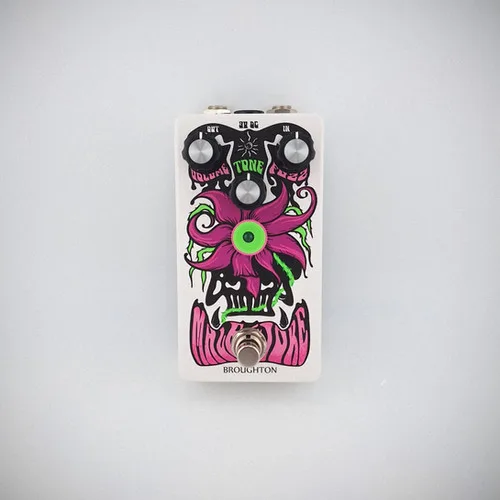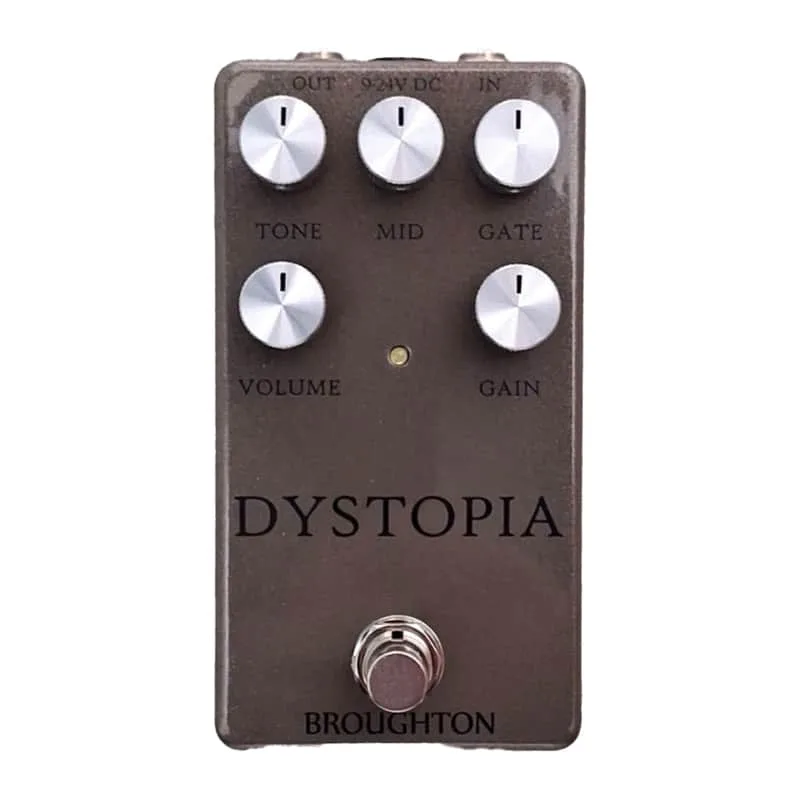
The Broughton Audio Dystopia is an original transistor fuzz pedal: the circuit is the maker's own design, not a copy of an existing fuzz1. Broughton Audio describes its range of sounds as covering "pinched and tight fuzz tones to devasting wall of sound", positioning it as a heavy fuzz option1. The pedal carries a list price of US$175.001.
The controls
The Dystopia has four main controls, each with a distinct job:
| Control | What it does |
|---|---|
| Gain | A variable input resistance, allowing for all types of guitars and basses to be used1 |
| Tone | Pans between bass (counterclockwise) and treble (clockwise)1 |
| Mid | A cut/boost of mids, most prominent with the tone control at center1 |
| Gate | Varies between open and completely choked, synthy type distortion; more prominent at higher gain levels1 |
The gain control's variable input resistance is worth understanding if you play more than one instrument: because it changes how the pedal loads whatever is plugged into it, Broughton Audio says it allows all types of guitars and basses to be used1. The tone control works as a pan between the bass and treble ends of the spectrum rather than a simple roll-off, and the mid control interacts with it, cutting or boosting mids most noticeably when the tone knob sits at center1.
The gate is the control that pushes the Dystopia into more extreme territory. Broughton Audio describes it as varying "between open to completely choked/synthy type distortion", with the effect more prominent at higher gain levels1. Players looking for that choked, synth-like character will find it by combining higher gain with the gate turned up.
"Ranging from pinched and tight fuzz tones to devasting wall of sound, the Dystopia has your heavy fuzz needs covered."
Playing dynamics
Broughton Audio also points to the instrument side of the signal chain as part of the pedal's expressiveness: use your guitar's volume control or a volume pedal to further control the dynamics and sensitivity of the pedal1. That makes the Dystopia responsive to playing technique, and pairing it with a volume pedal is a documented way to shape how it cleans up and reacts.
Power and practical details
The Dystopia accepts 9 to 24V DC with a 5 mA current draw1. That is a very light load by pedal standards, well within what a single output of a typical pedalboard power supply provides, and the wide 9 to 24V range means it can run at higher voltages on supplies that offer them. The enclosure measures 4.77" long by 2.6" wide1.
The Dystopia carries a list price of US$175.001.
Broughton Audio covers its products for one year to the original owner1.
Where it sits in the Broughton range
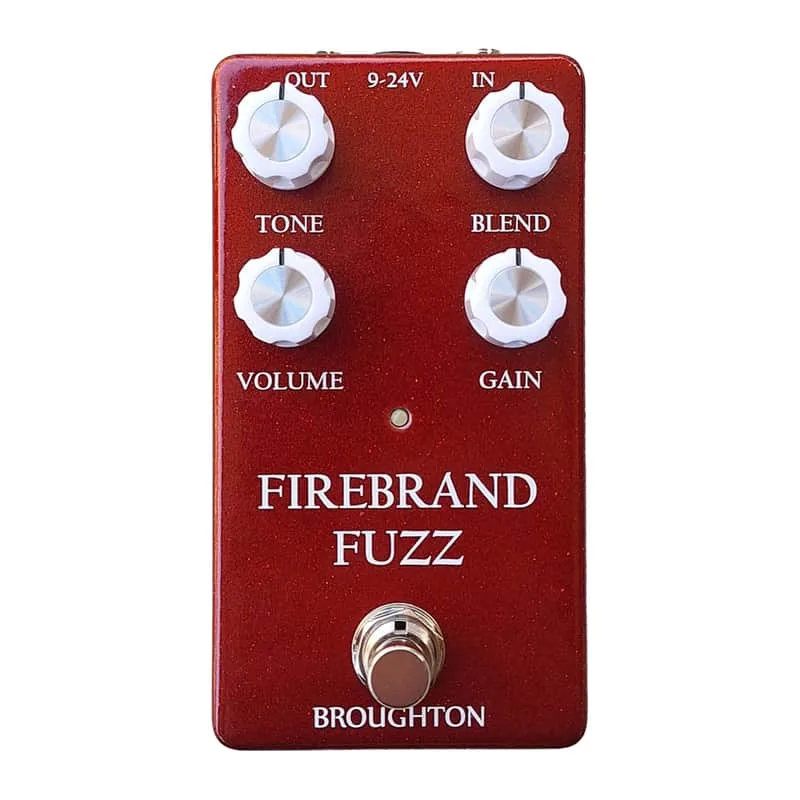
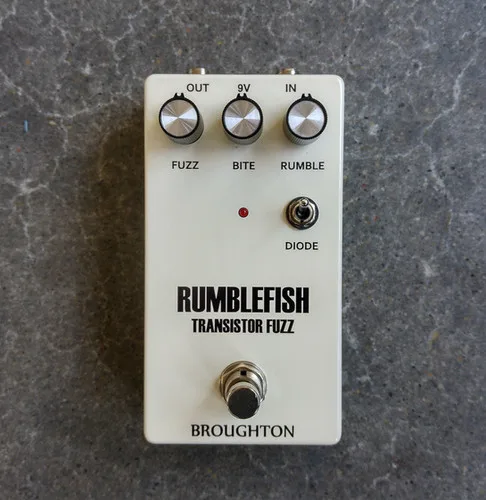
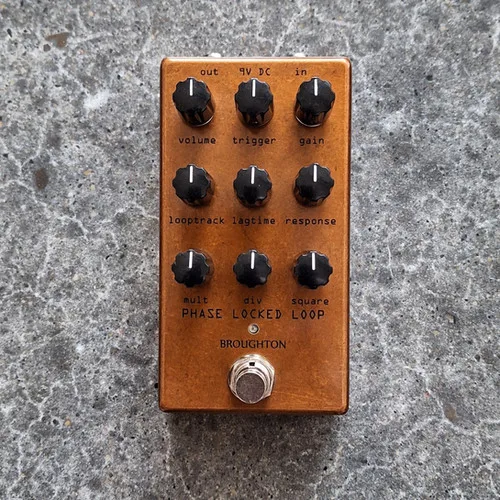
The Dystopia is Broughton Audio's original-design transistor fuzz. Players comparing it within the maker's lineup will find other Broughton designs such as the Broughton Audio Firebrand Fuzz, the Broughton Audio Rumblefish, the Broughton Audio Malfiore and the Broughton Audio Phase Locked Loop. For a wider view of the effect type, see Fuzz Pedals, or the neighboring categories Distortion Pedals and Overdrive Pedals1.
Questions
Does the Broughton Audio Dystopia work with bass?
Yes. Broughton Audio designed the gain control as a variable input resistance, which the maker says allows all types of guitars and basses to be used with the pedal. The gain control's input resistance is what lets the Dystopia pair with different pickups and instruments rather than favoring one kind of input.
Is the Dystopia a copy of an existing fuzz circuit?
No. Broughton Audio describes the Dystopia as an original transistor fuzz pedal, meaning the circuit is the maker's own design rather than a copy or clone of an existing fuzz circuit.
What power supply does the Broughton Audio Dystopia need?
The Dystopia accepts 9 to 24V DC and draws 5 mA, according to Broughton Audio's product page. That low current draw means almost any standard pedal power supply output can run it, and the wide voltage range gives players room to run it at higher voltages if their supply supports it.
What does the Gate control do on the Dystopia?
The gate control varies between open and a completely choked, synthy type of distortion, according to Broughton Audio. The maker notes that the gate effect is more prominent at higher gain settings, so it has the strongest character when the gain control is turned up.
Does the Dystopia use transistors or an IC?
Transistors. Broughton Audio describes the Dystopia as an original transistor fuzz pedal, so its gain stages are built around transistors rather than an integrated circuit chip.
What warranty comes with Broughton Audio pedals?
Broughton Audio states that its products are covered for one year to the original owner. That coverage applies to the Dystopia as well as the rest of the company's pedal range.
Sources (1)
- DYSTOPIA, Broughton Audio