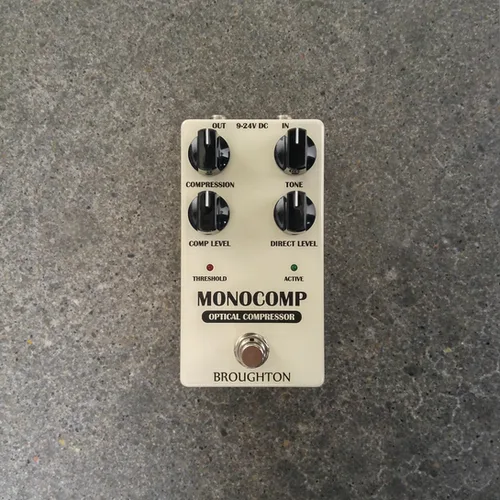

The Broughton Audio Monocomp is an optical-based compressor pedal designed to give warm, colored compression. It is an expansion of the original Monocle compressor, and it adds the ability to blend in your direct unaffected signal alongside the compressed one. According to Broughton Audio, the design is archived and is not in current production.1
How the compression works
The compression knob increases the amount of compression applied. Broughton Audio describes the optical circuit's behavior in some detail: the compression ratio is dependent on the strength of the input signal, the attack and release times are moderately fast, and continuous compression decreases the attack time and delays the release time slightly due to the light memory of the optocoupler. In an optical compressor, an internal light source and sensor (the optocoupler) control the gain reduction, which is what gives this kind of circuit its character.1
At maximum compression, the Monocomp acts as a limiter, so the same knob covers everything from gentle leveling to hard limiting.1
Controls
| Control | What it does |
|---|---|
| Compression | Increases the amount of compression applied; at maximum, the pedal acts as a limiter1 |
| Blend | Mixes in your direct unaffected signal alongside the compressed signal1 |
| Tone | Shapes the compressed signal; the direct signal is unaffected by it1 |
| True bypass switch | Takes the pedal out of the signal path when off1 |
The blend control
Alongside the compression control, the Monocomp lets you add in your direct unaffected signal. Broughton Audio notes that the direct signal is unaffected by the tone control, so the clean path keeps your original tone intact while the compressed path does the work. Parallel blending like this is a common request on compressor pedals, since it lets players keep attack and dynamics in the mix while the compressed signal adds sustain and evenness.1
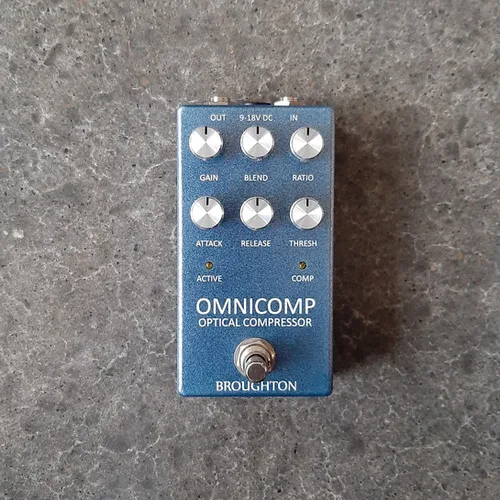
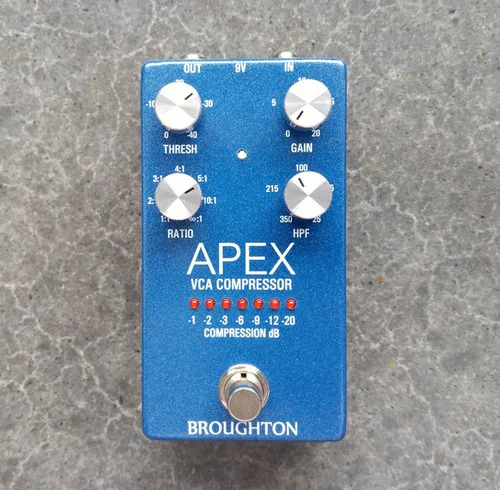
For other compressors in the maker's current range, see the Broughton Audio Omnicomp and the Broughton Audio Apex Compressor, or browse the full range of compressor pedals.
Power and specifications
The Monocomp requires a minimum of 9V DC and can accept up to 24V DC. Broughton Audio notes that increasing the supply voltage gives more headroom, which matters most for players running hot signals into the pedal.1
| Specification | Value |
|---|---|
| Power | Minimum 9V DC, up to 24V DC1 |
| Current draw | 20 mA1 |
| Input impedance | 1MΩ1 |
| Output impedance | 100Ω1 |
| Dimensions | 4.77" long x 2.6" wide1 |
| Bypass | True bypass switch1 |
The Monocomp is an archived design and is not in current production.1
Warranty and returns
Broughton Audio products are covered for one year to the original owner, and warranty repairs are handled by emailing sales@broughtonaudio.com.1
For returns, the maker's terms are:
- Email sales@broughtonaudio.com within 7 days of receiving the product1
- The buyer pays return shipping1
- A refund is issued minus the shipping cost when the product is received in new condition1
Videos
Shaggy45
Questions
Is the Broughton Audio Monocomp true bypass?
Yes. According to Broughton Audio's product page, the Monocomp has a true bypass switch, so when the pedal is off, your guitar's signal passes to the output without passing through the compression circuit.
Is the Monocomp still in production?
No. Broughton Audio states that the Monocomp design is archived and is not in current production.
What power supply does the Monocomp need?
The Monocomp requires a minimum of 9V DC and can accept up to 24V DC. Broughton Audio notes that increasing the supply voltage gives more headroom. The current draw is 20 mA.
Does the Monocomp work as a limiter?
Yes. Broughton Audio says that at maximum compression, the Monocomp acts as a limiter, so turning the compression knob to its maximum setting changes the pedal's behavior from compression into limiting.
What warranty does the Monocomp have?
Broughton Audio products are covered for one year to the original owner. Warranty repairs are handled by contacting the maker at sales@broughtonaudio.com.
Sources (1)
- Monocomp, Broughton Audio