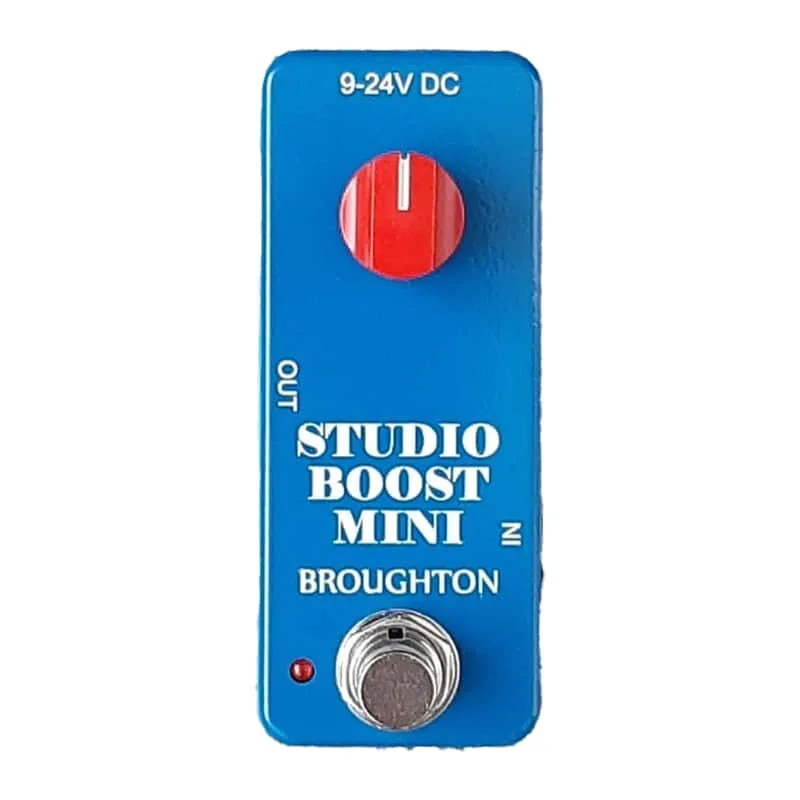

The Broughton Audio Studio Boost Mini is a compact boost pedal that puts the Neve 1073-style transistor gain stage from Broughton's Studio One preamp into a small box. Broughton Audio describes it as "the same Neve transistor gain stage used in the Studio One," capturing the same high fidelity tone in a smaller format1. It is a clean boost: one control, true bypass, and up to +20 dB of gain on tap.
The Studio One it borrows from is a high fidelity transistor preamp that, in Broughton's words, "authentically captures the character of the Neve 1073 console preamp"2. The Mini takes that circuit and strips it down to a single-gain boost for guitar or bass.
A boost built on a Neve transistor gain stage
The circuit comes from the Neve 1073 console preamp, the recording desk channel that Broughton Audio modeled in its Studio One pedal. Broughton says the Studio One "creates a warm, clear tone that is immediately noticeable" when engaged3, and the Studio Boost Mini carries that same gain stage forward in a smaller enclosure1.
For a player, this means the Mini is designed as a clean, high fidelity boost rather than a dirt pedal. The single gain control varies from -∞ (fully off) to +20 dB when using a 9V supply1, so it can push an amp or another pedal harder, or simply lift a solo above the mix. With a 1MΩ input impedance1, it presents a friendly load for passive pickups ahead of it.
Power: 9 to 24 volts
The Mini runs on a DC power supply, which is not included, and does not take a battery1.
- Voltage range: 9 to 24 volts1
- Connector: standard Boss style, center negative polarity1
- Current draw: approximately 10 mA1
The pedal requires a DC power supply (not included), so there is no battery option. The center negative, Boss style connector matches typical pedalboard power supplies.
According to Broughton Audio, "higher voltages will provide slightly higher gain and more clean headroom"1. The +20 dB gain figure is quoted at 9V, so a player running 18 or 24 volts gets a little more ceiling before the circuit runs out of room. At roughly 10 mA, the draw is light enough that it shares a power output with most other pedals without issue.
How it differs from the Studio Boost
Broughton Audio also makes the larger Studio Boost, and the two share the same family circuit. The comparison comes down to size, controls, and output stage31:
| Studio Boost Mini | Studio Boost | |
|---|---|---|
| Circuit | Neve transistor gain stage from the Studio One1 | Same gain stage, plus a transformer output3 |
| Gain at 9V | -∞ to +20 dB1 | -∞ to +15 dB3 |
| Bypass | True bypass1 | True bypass3 |
| Power | 9 to 24V DC, center negative1 | 9 to 24V DC, center negative3 |
The Studio Boost is described by Broughton as "the same transistor gain stage in the Studio One, capturing the same high fidelity tone in a smaller" package, with the transistor gain stage driving a transformer output3. Broughton's recommended starting point on the Studio Boost is Gain at 3 o'clock and Level at max3. The Mini drops the transformer and the separate Gain and Level arrangement for a single control in a smaller box, and interestingly it reaches a higher quoted gain figure at 9V, +20 dB against the Studio Boost's +15 dB13.
Warranty, returns, and availability
Broughton Audio products are covered for one year to the original owner, and warranty repairs are arranged by emailing sales@broughtonaudio.com1. Returns are handled by emailing the same address within 7 days of receiving the product; a refund is issued minus the shipping cost once the item arrives back in new condition, with the buyer paying return shipping1. Orders ship internationally via Canada Post, with the shipping cost shown at check-out1.
As of October 2026, the Studio Boost Mini is listed at the maker's store for US$150.00, with international shipping via Canada Post and shipping cost shown at check-out1.
Videos
Shaggy45
Questions
Does the Broughton Audio Studio Boost Mini take a battery?
No. The pedal requires a DC power supply, which is not included with the pedal. It uses a standard Boss style connector with center negative polarity and accepts 9 to 24 volts.
Is the Studio Boost Mini true bypass?
Yes. Broughton Audio states the Studio Boost Mini has a true bypass switch, so your signal passes through untouched when the pedal is off.
What polarity does the Studio Boost Mini power supply need?
It needs a standard Boss style DC connector with center negative polarity, the same arrangement as most modern 9V pedals, so it works with typical pedalboard power supplies.
What does a higher supply voltage do on the Studio Boost Mini?
According to Broughton Audio, higher voltages provide slightly higher gain and more clean headroom. The quoted gain range of up to +20 dB is measured with a 9V supply, so running 18 or 24 volts pushes the ceiling a little further.
What is the warranty on Broughton Audio pedals?
Broughton Audio products are covered for one year to the original owner. For warranty repairs, the owner emails sales@broughtonaudio.com to arrange service.
How is the Studio Boost Mini different from the Studio Boost?
Both use the same Neve 1073-style transistor gain stage from the Studio One preamp. The larger Studio Boost adds a transformer output and a Gain control that reaches +15 dB at 9V, while the Mini is a smaller, simpler boost reaching +20 dB at 9V.
Sources (3)
- Studio Boost Mini, Broughton Audio
- Studio One, Broughton Audio
- Studio Boost, Broughton Audio