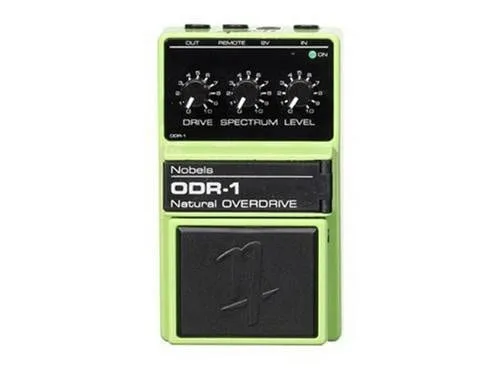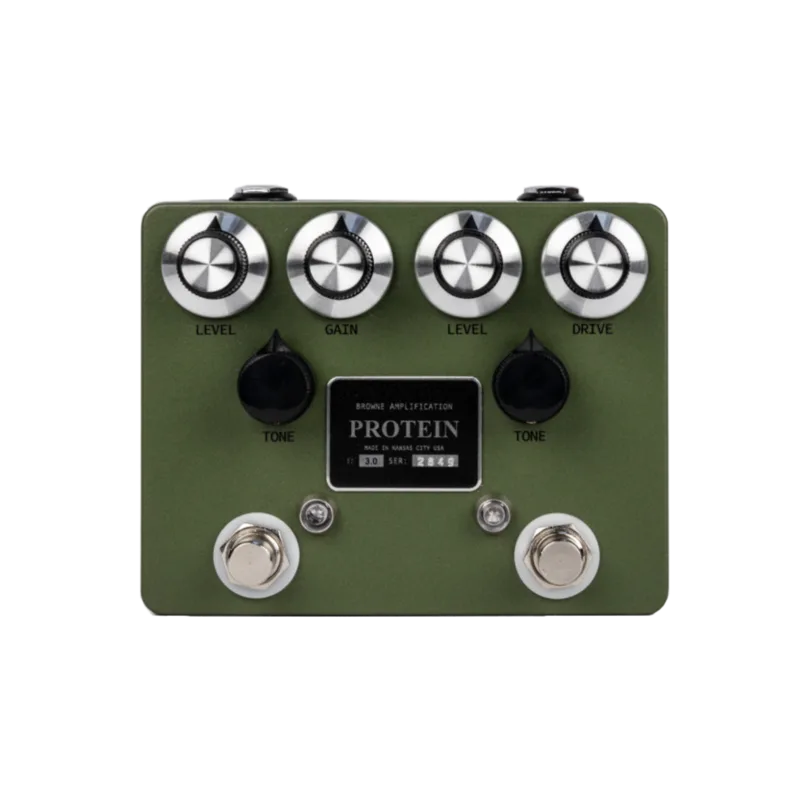


The Browne Amplification Protein Dual Overdrive is a two-in-one overdrive pedal: a blue side based on a modified Marshall Bluesbreaker circuit, and a green side inspired by the classic "Nashville" overdrive, the Nobels ODR-1. Each side works on its own, and with both engaged the green side feeds the blue side for a third, higher gain sound. Browne says the pedal was designed as "a dual overdrive that would sound great no matter what it was plugged into"1.
The pedal is a collaboration between David Brown and guitarist/producer Adam Sniegowski2, built in the USA234. The current version is the V4, listed from $299.00; the V3, from $279.00, is sold out at the maker's store5.
Two overdrives in one box
The blue side (left footswitch) is a Bluesbreaker circuit with modifications and an added output section5. Guitar World's Trevor Curwen describes it as "based on a 1990's Marshall Bluesbreaker but has a tweaked tone control and extra output"9. Browne traces its lineage to the classic overdrive heard on records like John Mayer's "Continuum"5, and the V4 manual describes it as a lower gain overdrive with lots of headroom and tons of output that stacks well with other drive and fuzz pedals2.
The green side (right footswitch) is inspired by the Nobels ODR-1, the session favorite associated with Nashville players like Tim Pierce and Jerry McPherson5. Browne says it is "more like a nobles ODR-1" than a Tube Screamer, so it is a different flavor than a TS5. The result, in Browne's words, is "a warm, punchy drive that adds low-mid 'beef' without getting muddy"5. The V4 manual calls it a slightly higher gain drive with a little more compression so it stands out well in a mix, good for leads and crunchy rhythms2.
MusicRadar's reviewers characterized the two sides this way:
"the 'blue mode' is musical and addictive, with an amp-like drive that compresses as you crank it up... the 'green mode' is the consummate low-gain overdrive, ideal for subtly adding heat to your signal, or a little more texture"
The controls on each side
Each side has three knobs and its own bypass footswitch6. The V4 adds internal and external switching options on top of the knobs.
| Side | Knobs | What they do |
|---|---|---|
| Blue | Level, Gain, Tone | Gain works like a tube amp being cranked at high volumes; turning it up also adds brightness. Tone is active and highly interactive with the pedal2 |
| Green | Level, Drive, Tone | Drive sets the amount of gain; this side has more midrange than the blue side for a grittier tone2 |
One thing to know about the green side: its level is dependent on the gain knob. With gain about two thirds up, the level sits below half for unity gain; with gain low around one third, the level needs about two thirds to three quarters for unity gain5.
The V4 adds three switching options12:
- Hi-Cut switch (blue side, external): a 3-way toggle taken from the Carbon V2 that cuts the highest frequencies. Center is off, down is a slight hi-cut, up is the most hi-cut.
- MORE CLIP switch (green side, internal): a hard clipping option giving access to a new set of hard clipping diodes that add extra bite, aggression and gain, and lower the output volume. Up is more clip, down is stock.
- ASYMMETRICAL CLIPPING switch (green side, internal): switches between stock symmetrical soft clipping and asymmetrical soft clipping, which lets the green side open up with more punch and less compression. Up is stock, down is asymmetrical.
The stock green side clipping is symmetrical soft clipping, with the asymmetrical and hard clipping options available through the internal switches2.
Stacked mode: Green into Blue
With both footswitches on, the pedal runs the green side into the blue side. Browne calls this the third "channel" of the pedal and says it delivers added gain and fullness while maintaining note clarity1. Pedal of the Day's reviewer found the same, noting it works "without sacrificing note clarity or getting that 'mushiness' that can happen while stacking some overdrives"3.
The order is fixed: the pedal runs green into blue only, with no order toggle4. For players using loop switchers, the TRS sockets facilitate independent loop switcher connection for each side6, and the V4 offers an optional MIDI upgrade that adds MIDI on/off switching of the footswitches only2.
Power
The Protein runs on a standard 9V DC adapter with negative center and negative ground, and the manual is explicit: do not use more than 9V DC2. Browne says the pedal was built to have tons of headroom at 9V, so 18V is not better5. Current draw is 130mA on the V412; the V3 draws under 100mA and the V2 under 30mA5. Browne recommends a high-quality supply that uses isolated power2. There is no battery option; power is 9V DC only8.
9V DC negative center only. More than 9V is not supported, and the maker says 18V offers no benefit since the circuit already has ample headroom at 9V52.
History and versions
The Protein has gone through several versions, including the V2, V3 and V45. The V3 added top mounted jacks and softswitching1, and the V4 introduces several key updates for more versatility and tonal control51.
| Version | Key details |
|---|---|
| V2 | Side mounted jacks, regular switches, 2 internal switches for loop mode; under 30mA; 120mm x 94mm x 48mm5 |
| V3 | Top mounted jacks and softswitching; under 100mA; sold out at the maker's store58 |
| V4 | 3-way Hi-Cut on the blue side, 3 clipping options on the green side, optional MIDI upgrade; 130mA12 |
Guitar World noted that "This fourth iteration of the Protein introduces a three-way Hi-Cut switch to the Blue side for more tonal options"7. On the earlier versions, Pedal of the Day reported that the output levels were increased and the tone slightly tweaked on the blue side while the overall circuit remained true to the original3, and that the green side's gain was lowered to make it usable through the entire sweep of the pedal3.
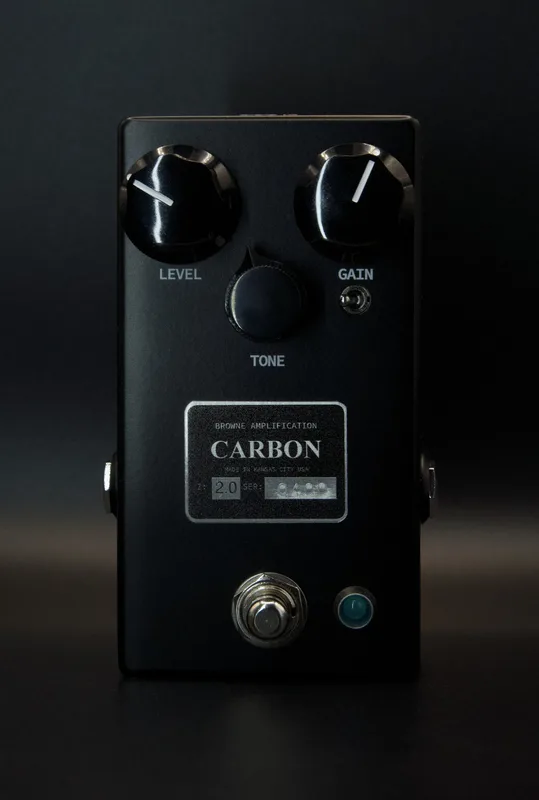
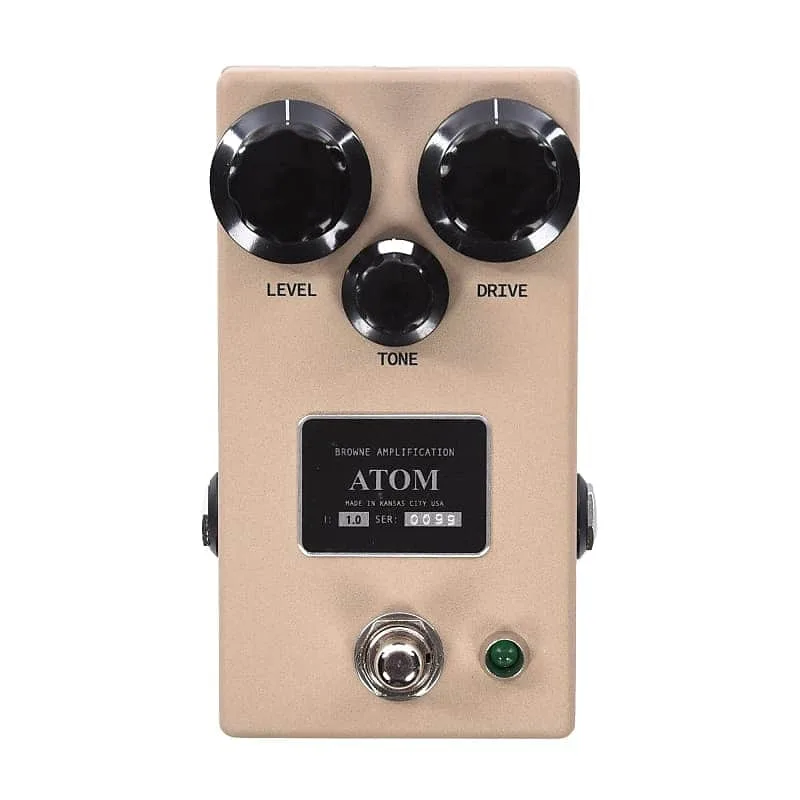
Both sides have since become standalone pedals: the blue side is available as The Carbon, which Browne says originated as the Protein's blue side10, and the green side as the Nashville-inspired Atom. Browne's V3 page describes the pedal exactly in those terms: "One side is the low gain, high headroom Carbon Overdrive. The other side is the Nashville inspired ATOM, a higher gain overdrive with beautiful singing mids"8.
The V4 is offered in a range of finishes including Gold Folded, Green, Black, White, Copper, Silver, Aqua Copper Vein, Pink/Silver Knobs, Purple, Blue and Copper-Blem5.
What reviewers said
Guitar World's Paul Riario called it "one of those raved-about overdrive pedals that always ends up on backorder because it's that good"11. Trevor Curwen, reviewing it for Guitar World, found the blue side "offers tasty amp-like drive that compresses nicely," and that the green side "certainly gives you all the low-gain, early breakup sounds you could wish for, and provides a very natural push to an amp"9.
In Guitar World's roundup of notable pedals of the 2020s, the V4 "retains a full-bodied low-end while keeping note articulation intact, and never becomes overly compressed or lifeless"7.
Pedal of the Day's verdict was enthusiastic about both the sound and the value3:
"makes this one a must-have for any overdrive fan. Each side sounds great on its own, and they sound even better as a team"
The same reviewer noted that buying the two original circuits in their original pedals would cost about $2,000 in the market at the time, and described the pedal's flexibility: "it can be an always-on pedal, a boost, an amp-pusher, a solo/lead enhancer and more"3.
Videos
Browne Amplification
Browne Amplification
Ben Neal
Questions
Can you change the order of the two sides on the Protein?
No. The pedal runs the green side into the blue side only, and there is no order toggle. The stacked mode always feeds the green (Nashville-style) side into the blue (Bluesbreaker-style) side, which Browne says adds gain and fullness without sacrificing note clarity.
What are good starting settings for the Browne Protein?
Browne's manual recommends starting with the blue side controls all at noon or straight up. On the green side, note that the level is dependent on the gain knob: with gain around two thirds up, the level sits below half for unity gain, while with gain low around one third, the level needs about two thirds to three quarters for unity gain.
Is the Protein the Carbon and Atom in one pedal?
Essentially. The blue side is the low gain, high headroom Carbon Overdrive, which originated as the Protein's blue side before becoming a standalone pedal. The green side is the Nashville-inspired Atom, a higher gain overdrive. Browne describes the V3 exactly this way on its product pages.
Can you run both sides of the Protein at once?
Yes. Both footswitches can be on at the same time, which runs the green side into the blue side. Browne and reviewers describe this as the pedal's secret third channel, adding gain and fullness while keeping note clarity and avoiding the mushiness that can happen when stacking some overdrives.
Is the Browne Protein true bypass?
Yes. MusicRadar's review lists true bypass among the pedal's features, along with green and blue LEDs for the two sides. Power is 9V DC only, negative center, and Browne says not to use more than 9V.
Sources (11)
- Protein Dual Overdrive V4, Browne Amplification
- Protein_V4_Manual, Browne Amplification, 2025-05
- Browne Amplification Protein Dual Overdrive, Pedal of the Day, 2022-01-12
- Protein_V3_Manual, Browne Amplification, 2024-12
- The Protein Dual Overdrive Pedal, Browne Amplification
- Browne Amplification Protein Dual Overdrive and T4 Fuzz review, MusicRadar, 2021-11-23
- Guitar World's 30 favorite guitar pedals from the past 5 years, Guitar World, 2025-06-02
- Protein Dual Overdrive V3, Browne Amplification
- Browne Amplification Protein Dual Overdrive review, Guitar World, 2021-11-11
- The Carbon Overdrive, Browne Amplification
- Browne Amplification The Fixer and The Carbon review, Guitar World, 2023-04-26