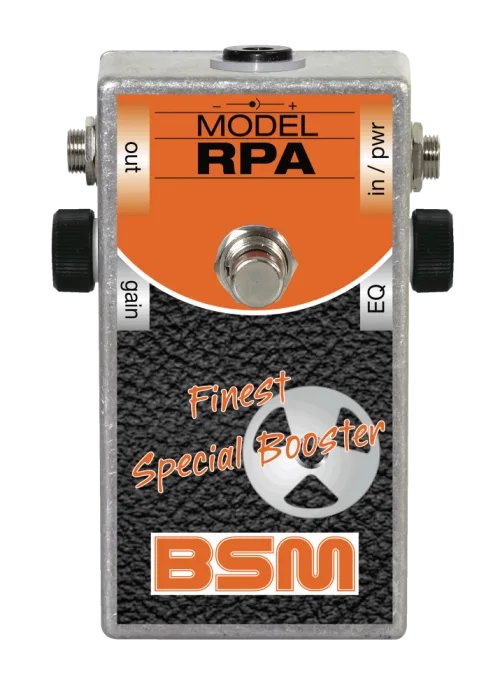


The BSM RPA Special Booster is a treble booster with a preamp stage in one stompbox, made in Germany by BSM1. Its circuit combines two pieces of Ritchie Blackmore's signal chain from the mid-1970s: the preamp stage of his AIWA TP-1011 reel-to-reel tape recorder, which he ran his guitar through, and the high-pass treble booster function from his hot-rodded Marshall Major amp2. The purpose, in BSM's own words, is "to emulate Ritchies post '74 sound with any standard amp"2.
The controls: Gain and EQ
The RPA Special has two controls, and both are there to make one circuit work with many different guitars and amps12.
| Control | What it does |
|---|---|
| Gain | Dials in the best possible balance for use with different amps and pickups1 |
| EQ | Tonal fine tuning for use with different pickups, amps and speakers1 |
The EQ control is what makes the pedal pickup-friendly. BSM says that because of it, "you can use all kinds of pickups, from the brilliant sounding low-gain Fender Custom Shop 69´ (aka 'Abigail Ybarra' pickups) up to the thundering Seymour Duncan 'Quarterpounds'"1. In other words, low-output vintage-style single coils and high-output pickups both work; you just turn the EQ to match. Depending on the pickups, BSM places the EQ control's sweet spot between 11:00 and 1:00 on the clock face1.
For the Blackmore setting itself, the maker's instruction is specific:
"with the gain pot fully opened, and the EQ control completely closed, you receive the authentical Blackmore sound from the great 'Machine Head' album or Ritchie Blackmore´s 'Rainbow'"1
That is the starting point. From there, the gain control lets you dial in the best possible balance for use with different amps and pickups, and the EQ control allows tonal fine tuning for use with different pickups, amps and speakers12.
Where it goes in the signal chain
The RPA Special Booster is inserted between the guitar and the amplifier, not into an amp's FX loop1. BSM is equally specific about the kind of amp it wants:
"As a soulmate for the RPA, you can use any mild sounding amp with a good master control function. Plug it in front of the CLEAN or CRUNCH channel, but don´t use the high-gain or distortion channel !"1
The logic follows the original circuit. Blackmore's sound came from a tape preamp and a treble boost pushing an amp that was otherwise fairly clean, so the pedal is designed to do the pushing itself rather than to stack on top of an already distorted channel. Players looking for that kind of front-end push in general can compare it against other boost pedals or preamp pedals2.
Power: 9V or 18V, battery or DC
The unit runs on a 9V battery with a current consumption of approx. 350 uA2. Through the external DC jack you can power it with 9 volts, or with 18 volts for more headroom2. The jack is a "Boss style" 2.1mm tip-negative connector, so it works with standard pedalboard power supplies2.
The negative pole of the battery is ground, BSM notes, so polarity matters if you wire anything yourself1. When external power is plugged in, the internal battery shuts off automatically2.
Output levels
BSM gives two output figures. The average output level is 10dBm2, and the maximum output voltage, when the strings are struck really hard, is 6V max1. Both come from the maker's own documentation and describe the same output stage from two angles: average level in normal playing, and peak voltage under a hard attack.
Related BSM models
The RPA line includes variations on the same idea:
| Model | How it differs |
|---|---|
| RPA Special Booster | The standard model described on this page |
| RPA Major Special Booster | "a lot more gain compared to the stock RPA model with tons of crunch and a higher level of agressivity"; powered by 9V battery or 9 volts DC only3 |
| RPA California II Special Booster | Uses a "presence" control that fine tunes the amount of saturation and dirt; 9V battery or 9 volts DC, approx. 400 uA current draw4 |
The Major is aimed at players who want more crunch out of the same basic approach, while the California II trades the EQ control for a presence control that shapes how much saturation and dirt the pedal produces4. All three go between guitar and amp, not into an FX loop34.
Videos
elswan64
DogwithtwoBones
Questions
How do you get the Ritchie Blackmore sound from the BSM RPA?
BSM says to set the gain pot fully open and the EQ control completely closed. In that setting the maker describes the result as the authentic Blackmore sound from the Machine Head album and his Rainbow era. From there you can back off the gain and adjust the EQ to suit your amp and pickups.
Can the BSM RPA Special go in an amp's effects loop?
No. BSM states that the RPA Special Booster is inserted between the guitar and the amplifier, not into the FX loop. The maker also recommends using it in front of the clean or crunch channel of a mild-sounding amp with a good master volume, and not with a high-gain or distortion channel.
Does the BSM RPA work with humbuckers?
Yes. BSM says that because of the EQ control the RPA works with all kinds of pickups, from low-gain single coils like the Fender Custom Shop 69 up to high-output pickups such as the Seymour Duncan Quarterpounds. The EQ sweet spot sits between 11:00 and 1:00 depending on the pickups.
Where is BSM made?
The RPA Special Booster is made in Germany, according to BSM's own product documentation. Questions about the unit are handled by Bernd C. Meiser, who BSM describes as the company's tech-head and mastermind, via email or the contact form.
Sources (4)
- neutral_rpa.pdf, treblebooster.net, 2025
- RPA Special Booster, treblebooster.net (BSM), 2025
- RPA Major Special Booster, treblebooster.net, 2025
- RPA California II Special Booster, treblebooster.net (BSM - Finest Treble Booster), 2025
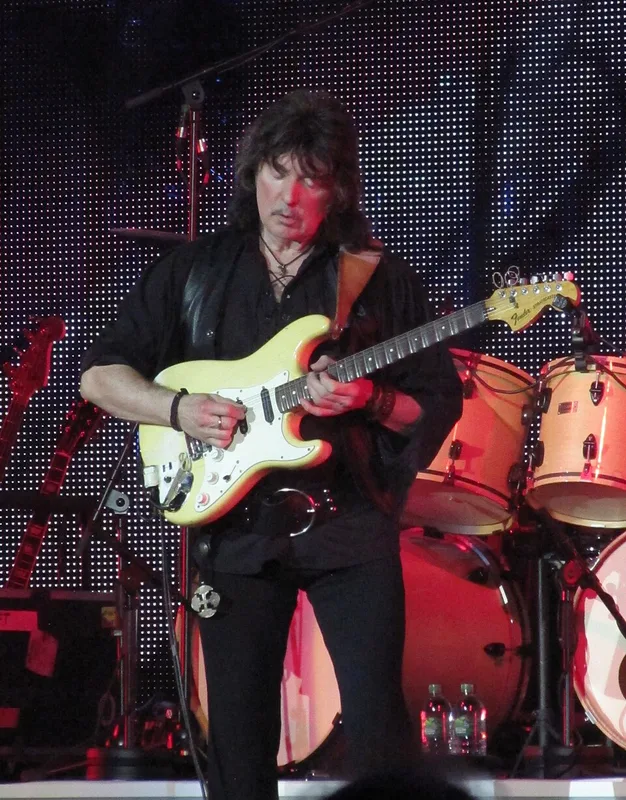 Ritchie Blackmore