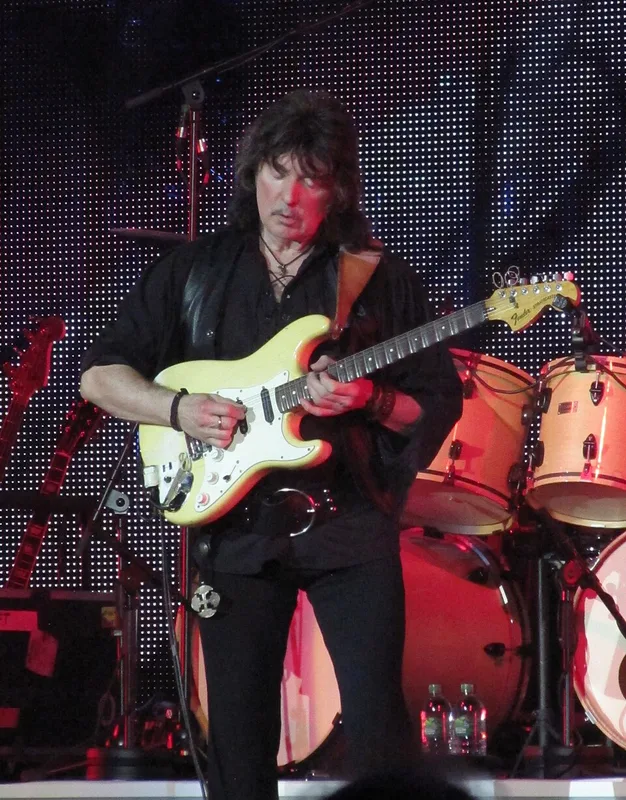
Ritchie Blackmore is Deep Purple's lead guitarist, and for most of his career his sound came from remarkably few boxes. Through the Deep Purple Mk2 years the core of the rig was a Hornby-Skewes treble booster driving a 200-watt Marshall Major1. In late 1973, right before the Burn tour, he changed his live setup: the treble boosters were retired and an Aiwa TP-1011 reel-to-reel tape recorder took over both the boost and the echo jobs23. Later, with Rainbow and Blackmore's Night, he moved through ENGL amps, Lace Sensor and OBL pickups, and a master tone circuit built into his Strat, but the Aiwa preamp stayed at the center of his drive tone42.
Treble booster into a Vox AC30
At the start of Deep Purple Mk1 in 1968, Blackmore's rig was a 1961 cherry red Gibson ES-335 TD into a Vox AC30 with a Hornby-Skewes germanium treble booster2. The booster was there to compensate for the lack of gain in the amps of the day and mainly to overdrive the preamp1. The Hornby-Skewes unit was made by John Hornby Skewes to complement and brighten up the company's Zonk Machine fuzzbox, and Blackmore used only the booster from that set, not the fuzz26.
The Dallas Rangemaster is often named alongside players of that era, but the treble booster Blackmore actually used was the John Hornby Skewes6. A 2007 Premier Guitar review of BSM's recreations put it plainly:
"it turns out Mr. Blackmore used a Hornby-Skewes treble booster which was responsible for his seemingly incongruous tone."
He used the germanium version of the Hornby-Skewes until spring 1971, alongside one of the silicon versions1. BSM, whose recreations of these circuits are built around Blackmore's history, describes the unit's character as "a powerful and biting sound" and credits it with helping create Deep Purple In Rock and Fireball8. Treble boosters of this kind are generally recommended with vintage amps such as the Fender Deluxe, Fender Bassman, Vox AC30, plexi Marshall 100w or Marshall Major9. For more on the category, see boost pedals.
Deep Purple: Hornby-Skewes and the Machine Head sessions
The Deep Purple Mk2 sound is dominated by the combination of a treble booster and a 200-watt Marshall Major1. Blackmore played only the Marshall Major 200 watt amps in that period1, and he had them modified early with a cascaded preamp design right from the factory10. His relationship with the builder went back a long way; to quote Jim Marshall: "Ritchie more or less lived in my shop"1.
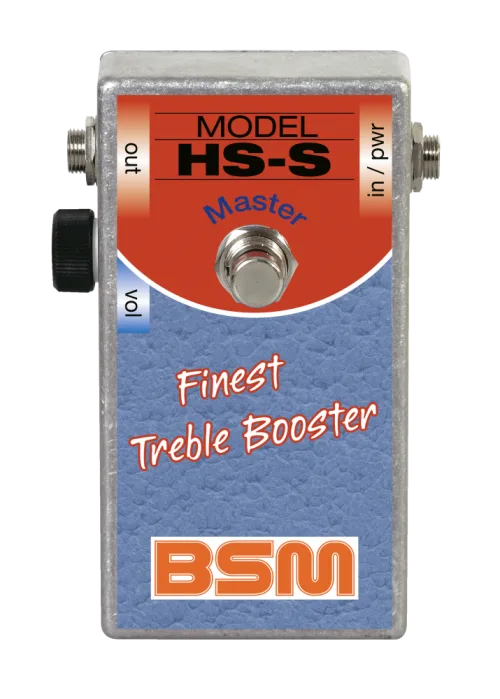
For the December 1971 Machine Head recordings he mainly used a Vox AC30, with the fuzz no longer employed and a treble booster used in front of the AC30 instead111. The Hornby-Skewes Treble Booster was his favorite box for live and studio recordings like the 1971 Machine Head and the later 1974 Burn sessions10, and the HS-S type unit was the one used on Machine Head12. Between recordings he also went back to his old germanium HS model, heard on the 1972 live album Made in Japan13.
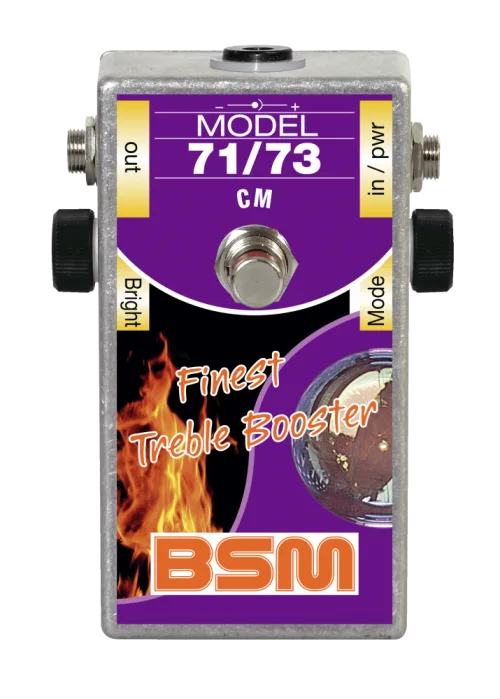
From 1971 forward he added a second box: the CM booster, a custom circuit built and designed by Bill Hough, which he used alongside the mid-rangy Hornby-Skewes trebleboosters until the end of 1973145.
His guitars in this period shifted from the ES-335, which stayed with him on stage until midway 1970 and in the studio at least until the December 1971 "TOTP" TV session2, to a stock 1968 black maple-neck Stratocaster bought in spring 1969, fitted with a custom-made 1/4" (6.3mm) heavy weighted steel tremolo arm and the stock 0.1uF tone cap2.
The Burn tour switch to the Aiwa TP-1011
In November 1973, right before the start of the Burn tour, Blackmore changed his live setup15. He wanted to play live with an echo effect and made the Aiwa TP-1011 reel-to-reel tape recorder his first choice3. From December 1973, at the beginning of the Burn tour in Northern Europe, the preamps of his Marshall Major amps were modified, the treble boosters were retired, and the Aiwa TP-1011, built in December 1970, served both as a booster and as a delay effect2. With its integrated microphone preamp doing the boosting, his beloved Hornby-Skewes treblebooster of many years was no longer needed and was sent into retirement16.
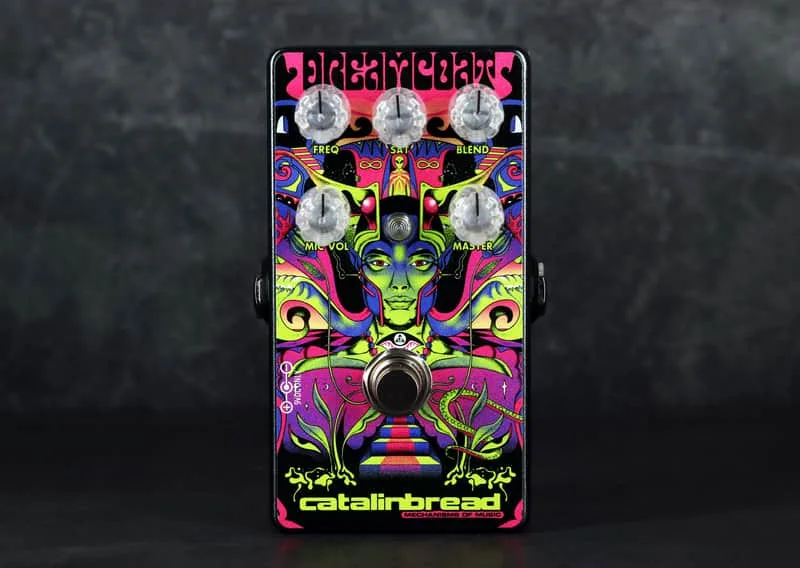
The Aiwa TP-1011 is a reel-to-reel deck found in '60s and '70s classic rock recordings, originally designed to accept a microphone input, and it ran at 18V17. Its echo repeats ran at the typical two to three seconds3. Catalinbread, whose Dreamcoat pedal is based on the same preamp, notes that Blackmore favored feeding his amp from the preamp of a modified reel-to-reel tape recorder18. BSM's recreations aim to rebuild the Aiwa preamp stage from the Burn tour while integrating the important high-pass function with the original cutoff frequency19.
From the late '70s on, his favorite studio setup included a modified Marshall Major amp and the old Aiwa reel-to-reel as a preamp2. He kept the Aiwa TP-1011 sound stage from late 1973 onward5, and at the July 17, 2016 Loreley Rainbow concert he used it again as his delay machine with the tape reels2. For the last Deep Purple studio recordings, The Battle Rages On... from early 1993, the live album Come Hell or High Water from late 1993, and all later recordings, he used a 19-inch rack-mounted Yamaha digital delay instead2. See delay pedals for the modern take on the effect.
Fuzz, wah and other effects
Blackmore had used effects units since the early 1960s11. In 1968 he acquired a Marshall Reverb Fuzz #2021 and used it live, for instance in Mandrake Root11. In 1969 he acquired several Arbiter boxes in one go, an Add-A-Sound and a Soundette, and the Soundette replaced the Marshall #2021 for Mandrake Root until about mid-197011. Around 1966-67, when he was still a session musician, he owned a Vox Wah-Wah11. With Rainbow he used a Schulte Compact Phaser "A", available in black, orange or yellow, heard on Catch the Rainbow2; see phaser pedals and wah pedals.
Later guitars, amps and the MTC
After retiring the Marshall Major 200, Blackmore used an ENGL Savage 120 on the Rainbow stage, with a 2x12" 50-watt ENGL Sovereign combo for smaller stages2. In mid 1978 he started using his first hum-canceling Stratocaster, a 1977 Olympic white model, serial number S778960, designed and built by his tech, with Velvet Hammer VHS-2 pickups and the first prototype of the MTC Master-Tone-Circuit2. He used the MTC filter box from around 1978 onward, and with the volume rolled back he often used its mid-filter function to sweeten up his tone when needed20.
His pickup choices moved from OBL 450XL double blade humbuckers in the 1980s and the beginning of the '90s21, to Lace Sensor "Gold" pickups, which BSM describes as very similar in sound and output to the old Fender standard singlecoil Strat pickups from the '50s2. His master Strat in 2010, for Blackmore's Night, was fitted with two Lace Gold Sensors2. During his time with Blackmore's Night he took the tremolo arm off his Strat because he became fed up using it, and he relies on finger vibrato2. For solos in Rainbow and Blackmore's Night studio work he often used a heavy weighted black Strat, supposedly with an ash body, a small headstock and noise-free pickups of unknown brand2.
In the studio he usually recorded his amps with three mics: a Shure SM57 about 10 cm in front of the cab, a Shure SM56 about 1.5 meters away, and a Neumann U87 about 50 cm in front2. A Beyerdynamic M-160 double ribbon microphone was used quite often in the Deep Purple Mk2/3 days and on earlier Rainbow recordings2.
Scalloped fretboards
Blackmore himself said that he played scalloped fretboards since about 19712. His first Strat with a scalloped rosewood fretboard was an Olympic white '74 Strat, serial number 578265, first used in autumn 1976 and fitted with Schaller tuners for the first time2. A 1974 sunburst Strat, serial number 576183, with a scalloped rosewood fretboard, an overwound lead pickup at 6.6 kOhms DC resistance, a treble bleed capacitor and a 300k Bourns volume pot replacing the stock 250k, was his master guitar during the Long Live Rock 'n' Roll period2.
Modern recreations
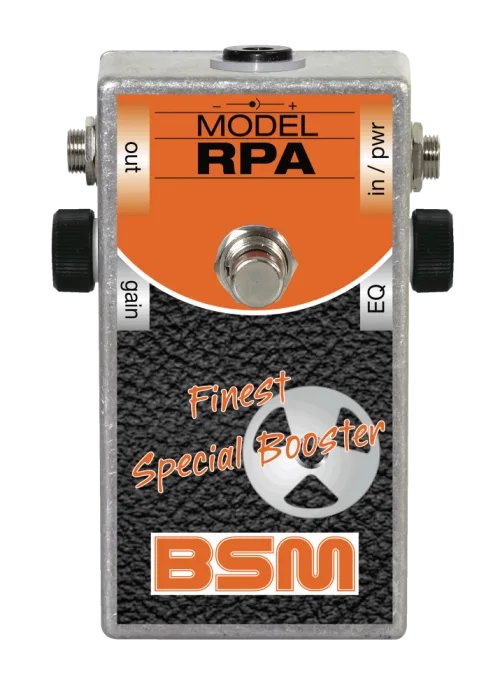
Several makers have built pedals around this rig. BSM's HS Treble Booster recreates the Hornby-Skewes circuit, and the BSM Galaxy 1011 recreates the Aiwa TP-1011 sound stage Blackmore used from late 197382. The BSM RPA Special Booster combines the Aiwa preamp stage with the high-pass treble booster function from his hot-rodded Marshall Major, to emulate his post-'74 sound with any standard amp22, and the BSM RPA California is described by BSM as covering the complete sound spectrum of his Deep Purple Mk3 time23. In 2021 Catalinbread released the Skewer, a three-knob replica of the Hornby-Skewes Treble Booster, and the Dreamcoat, an overdrive/fuzz based on the Aiwa TP-1011 microphone preamp with added controls for saturation and frequency boost24.
Questions
What treble booster did Ritchie Blackmore use?
A Hornby-Skewes Treble Booster, a germanium unit made to complement the company's Zonk Machine fuzzbox. He used the germanium version until spring 1971, then also a silicon version, running it in front of his amp to overdrive the preamp. From 1971 he also used a custom CM booster built by Bill Hough. The Hornby-Skewes was retired in late 1973 when the Aiwa TP-1011's preamp took over the boost job.
What amp did Ritchie Blackmore use on Machine Head?
For the December 1971 Machine Head recordings he mainly used a Vox AC30, with a treble booster in front of it and no fuzz. In Deep Purple Mk2 more broadly his sound was built on a treble booster driving a 200-watt Marshall Major, an amp he had modified with a cascaded preamp design right from the factory.
Did Ritchie Blackmore use a fuzz pedal?
Yes, early on. In 1968 he acquired a Marshall Reverb Fuzz #2021 and used it live, including in Mandrake Root. In 1969 he bought several Arbiter boxes, an Add-A-Sound and a Soundette, and the Soundette replaced the Marshall fuzz for Mandrake Root until about mid-1970. By Machine Head the fuzz was gone in favor of a treble booster.
How did Ritchie Blackmore get his echo sound live?
From an Aiwa TP-1011 reel-to-reel tape recorder. Adopted in late 1973 before the Burn tour, it gave him the typical two to three second echo repeat, and its built-in microphone preamp also served as his booster. He was still using the Aiwa as his delay machine with tape reels at the 2016 Loreley Rainbow concert.
Did Ritchie Blackmore play scalloped fretboards?
Yes. Blackmore himself said he had played scalloped fretboards since about 1971. His first Strat with a scalloped rosewood fretboard was an Olympic white 1974 Strat, serial number 578265, first used in autumn 1976. A 1974 sunburst Strat with a scalloped rosewood board was his master guitar during the Long Live Rock 'n' Roll period.
Sources (24)
- Mk2 Sound, treblebooster.net (BSM - Finest Treble Booster), 2025
- Ritchie Blackmore Zone, BSM - Finest Treble Booster (treblebooster.net), 2025
- RPA Special Booster, treblebooster.net (BSM), 1974
- New Ritchie Blackmore-inspired Catalinbread Dreamcoat and Skewer pedals, gearnews.com, 2021-06-23
- Custom made, BSM (treblebooster.net), 2025
- All About… Boosts, Guitar.com, 2016-03-23
- review8.pdf, Premier Guitar, 2007-09
- HS-C Treble Booster, treblebooster.net (BSM), 2025
- hs_hs-c.pdf, treblebooster.net, 2025
- HS-S Treble-Booster, treblebooster.net, 2025
- Effect Units, treblebooster.net (BSM - Finest Treble Booster), 1968
- bsm-treble-boosters-2019.pdf, treblebooster.net, 2019
- BSM, gitarre & bass, 2011-03
- 71/73 CM Treble Booster, BSM (treblebooster.net), 1971
- RPA California II Special Booster, treblebooster.net (BSM - Finest Treble Booster), 2025
- RPA California Special Booster, treblebooster.net, 1974
- Dreamcoat/Skewer Special Edition Box Set, Catalinbread Effects
- Aclam Guitars The Windmiller Preamp review, Guitar World, 2022-03-14
- BSM Treble Boosters RPA Major & J-Fuzz Demos, Premier Guitar, 2009-05-07
- Spice Box, treblebooster.net (BSM), 2026-03
- rpa_full_quarter.pdf, treblebooster.net, 2025
- neutral_rpa.pdf, treblebooster.net, 2025
- neutral_rpa-california.pdf, treblebooster.net (BSM), 2025
- Catalinbread Dreamcoat/Skewer Box Set, Delicious Audio, 2021-06-23