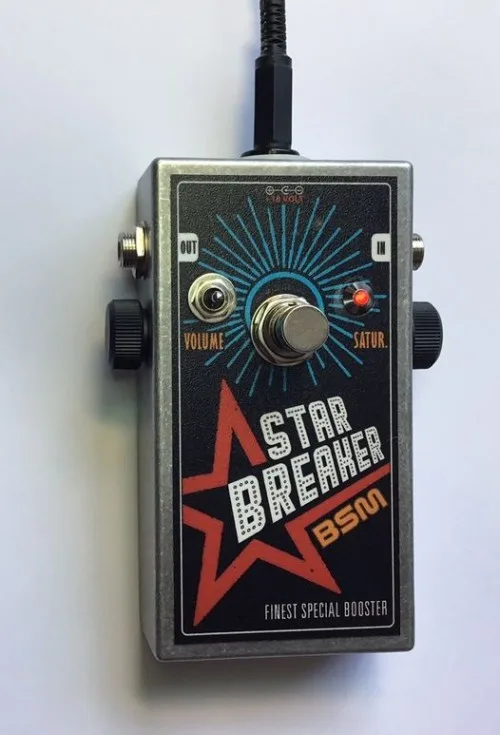

The BSM Starbreaker is an analog, semiconductor-based booster/overdrive pedal that simulates the sound of the overdriven 200-watt Marshall Major amplifiers Ritchie Blackmore used. BSM designed it for the scenario of emulating that amp's sound, modeling the electroacoustic properties of the Major's power amp with its so-called ultra-linear power tube arrangement, preceded by a modified AIWA circuit, the electronics from the reel-to-reel tape recorder Blackmore deployed to obtain boost and mild fuzz effects1. BSM announced it in October 2022 as its newest sound-enhancing tool, to be issued in autumn of 20222.
BSM describes the Starbreaker as an analog, semiconductor-based simulation of the overdriven Marshall Major, built to reproduce the equipment Ritchie used in the studio and live from the Deep Purple Mk. III phase onward1. Its transfer function is a somewhat asymmetrically shaped hyperbolic tangent tanh(x), which shapes the way the circuit clips the signal1.
A Marshall Major simulation for Ritchie Blackmore's sound
The Starbreaker exists to recreate a specific rig. Blackmore's Deep Purple Mk2 sound was dominated by the combination of a treble booster and a 200-watt Marshall Major amplifier, and modifications to those amps over the following years resulted in what BSM's history article calls "a VOX-style tone of his amps, giving him his signature Blackmore sound"3. The Starbreaker approaches that target from the power amp side: rather than boosting a front end, it is an analog simulation of the overdriven Major power amp itself, with the modified AIWA tape recorder circuit placed before it1.
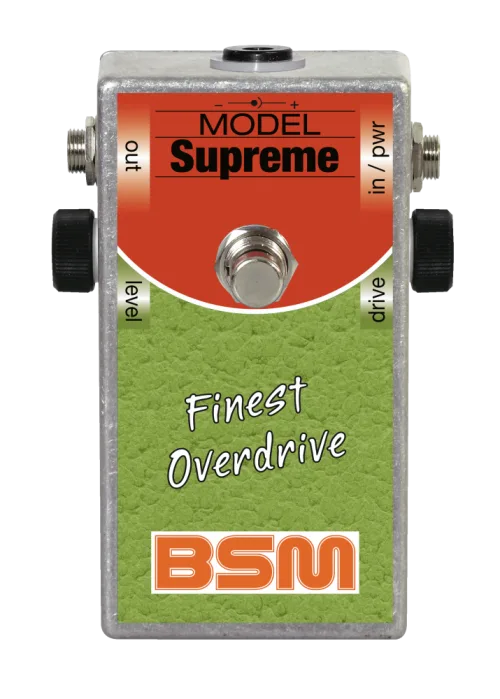
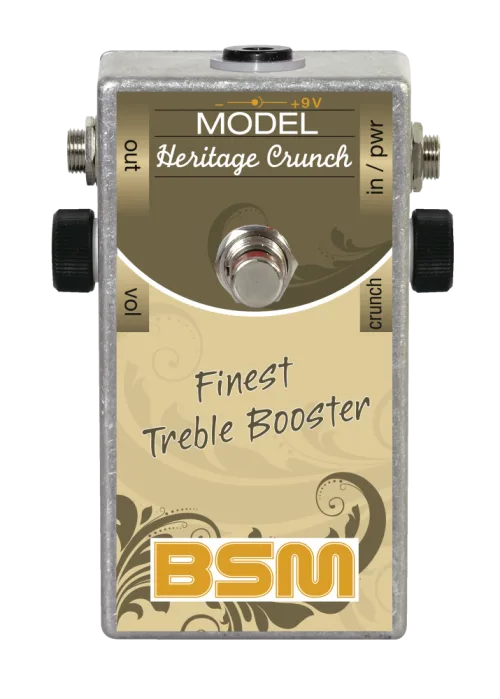
BSM describes the result as a perfect simulation of the equipment Blackmore used in the studio and live, from and including the Deep Purple Mk III phase1. The pedal sits in BSM's overdrive and booster line alongside models such as the BSM SUPREME special overdrive and the BSM Heritage Crunch.
How the circuit saturates without diode clipping
The Starbreaker's saturation comes from its transfer function, which BSM describes as a somewhat asymmetrically shaped hyperbolic tangent, tanh(x)1. BSM frames this against the usual approach in overdrive and distortion pedals:
"we achieved a much more desirable, smoother transition that is completely exceptional for a solid-state device."
In other words, instead of diode clipping, the circuit produces a smoother transition into signal saturation that BSM says is all but identical to a tube-powered output stage2. The pedal is, in BSM's words, "completely built with discrete silicon transistors and no OPs," meaning no operational amplifier ICs4.
Controls
| Control | What it does |
|---|---|
| Overdrive control | Precisely adjusts the degree of overdrive of the Marshall Major simulation, covering the full range of Blackmore's sounds from late '73 to mid '791 |
| Mini-switch | Manipulates the overtone range in two ways4 |
| Output level | Adjustable up to +10dBm1 |
BSM notes the unit works fine with all pickup types but that its design center is a Stratocaster with modern single-coil pickups4.
Power: +18V DC, 8mA
The Starbreaker works exclusively with +18V DC at 8 mA current consumption14. An 18V output on a power supply or a dedicated 18V adapter is therefore required. The higher rail supports the pedal's output headroom: the output level can be adjusted up to +10dBm1.
Videos
Haiko Heinz
Questions
Can the BSM Starbreaker run on 9 volts?
No. BSM states the Starbreaker works exclusively with +18V DC at 8 mA current consumption, so players need an 18V output on their power supply or a dedicated 18V adapter. The upside of the higher voltage is an output level that can be adjusted up to +10dBm.
Is the BSM Starbreaker still made?
No. BSM's owner Bernd C. Meiser passed away in 2024 and the company has since closed down, so the Starbreaker, released in autumn 2022, is no longer in production. Used units are the only way to find one.
Is the Starbreaker a treble booster or an overdrive?
BSM designates it a booster/overdrive, and also calls it a tube power amp simulator booster pedal. It is not a treble booster in the Hornby-Skewes or Range Master sense: it models the overdriven power amp of a Marshall Major, with the overdrive degree adjustable by a control and the overtone range shaped by a mini-switch.
Which Deep Purple era does the Starbreaker cover?
BSM describes the Starbreaker as a simulation of the equipment Ritchie Blackmore used in the studio and live from, and including, the Deep Purple Mk III phase. Its overdrive control covers the full range of Blackmore's sounds from late 1973 to mid 1979.
Sources (4)
- gerateblatt_starbreaker.pdf, treblebooster.net, 2025
- Special overdrive infos, BSM - Finest Treble Booster, 2025
- Mk2 Sound, treblebooster.net (BSM - Finest Treble Booster), 2025
- Starbreaker Booster, treblebooster.net (BSM), 2025