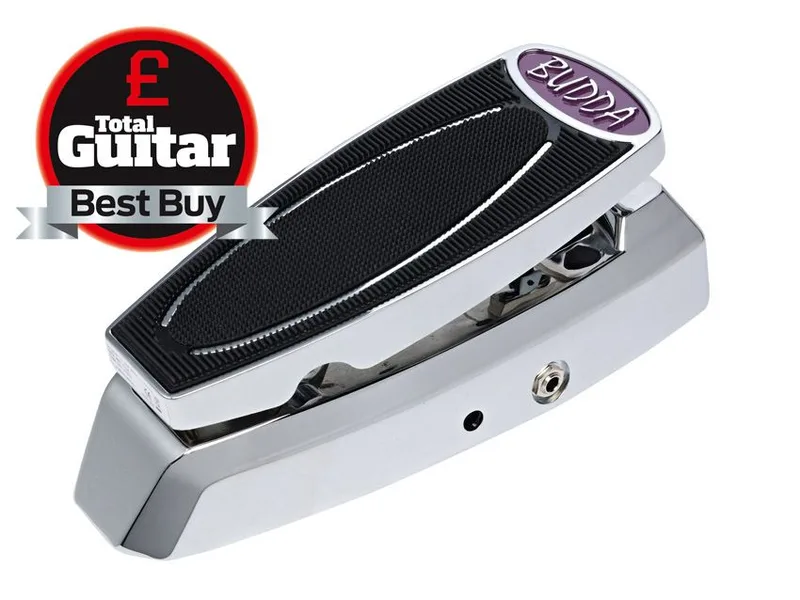


The Budda Budwah is a wah-wah stompbox made by Budda, a pedal in the wah-wah pedals family that sweeps a filter across your guitar's frequencies as you rock the treadle. Its defining feature is a custom coil inductor inspired by the vintage Fasel inductor, the component at the heart of the late 1960s and early 1970s Italian wahs. Budda's stated aim with that inductor voice is the midrange honk of vintage wahs without the top-end harshness1.
The Fasel connection
The inductor is, as the wah-modding community puts it, the heart of the wah circuit in the same way transistors are the heart of a Fuzz Face. aNaLoG.MaN notes that "The Fasel inductor was used on the late 60s/early 70s Italian wahs," and those Italian-made pedals, including the Jen wahs with their red Fasel inductors, are prized for a thicker, more vocal quality than later designs34. GuitarPCB's circuit analysis of classic wah pedals finds that usable replacement inductors fall anywhere between a DC resistance of 10 to 200 ohms and an inductance of 200mH to 1H (500mH typical), which is why different inductors give such different wah voices5.
Rather than hunting down an original Fasel, the Budwah ships with a custom coil inductor built to evoke that vintage character. Budda's announcement describes the result as "the midrange honk of vintage wahs without the top-end harshness"1.
The 2010 upgrade
In September 2010, Budda announced a set of hardware and design upgrades to the Budwah, described as taking the pedal's tried and true sound to a higher level of quality and durability2. The changes were:
- A military-grade sealed potentiometer2
- A heavier case for enhanced stability in live performance2
- A new battery compartment with door and battery cradle2
- Circuitry featuring a hard-wire bypass2
Budda stated that despite the improvements, the pedal's price remained unchanged after the upgrade2.
What reviewers said
MusicRadar's review praised the build as much as the sound: "The Budwah's chrome casing is tough and looks great too." The same review placed it against the competition on price, noting that "in the £150 to £200 mark, it more than holds its own," and concluded: "One of the pricier wahs on the market, but you certainly get what you pay for with this quality pedal."6
Ultimate Guitar's verdict, quoted in MusicRadar's news coverage, was blunter: "The Budwah is hands-down the one of the finest wah-wah pedals ever made."1
Guitar World also reviewed the pedal on video, presented by Paul Riario, the magazine's tech editor, as bonus content related to the October 2011 issue7.
The Budwah's design intent shows up in how it behaves at the extremes of the sweep. Budda states that at bass settings the tone is thick without losing note clarity, and that when accentuating the highs, a carefully selected roll-off frequency keeps the pedal from being piercing2.
The Budwah also lives on in software form: HeadRush's ReValver plug-in collection includes a stompbox model described as the "Official Budda® Budwah Model"8.
Videos
Guitar World
llmreviews
Music City CZ
Questions
Is the Budda Budwah true bypass?
Budda describes the Budwah's circuitry as featuring a hard-wire bypass, announced alongside the pedal's 2010 upgrades. Hard-wire bypass routes the input directly to the output when the pedal is off, which is the point of interest for players worried about tone loss in bypass. Budda's own announcement used the term hard-wire bypass rather than the marketing phrase true bypass.
Does the Budda Budwah use a Fasel inductor?
Not an original Fasel. According to Budda's 2010 announcements, the Budwah uses a custom coil inductor inspired by the vintage Fasel inductor, the component used in the late 1960s and early 1970s Italian wahs that gives those pedals their thicker, more vocal quality. The design intent is the midrange honk of vintage wahs without the top-end harshness.
Does the Budwah run on a battery?
Yes. The 2010 upgrade added a new battery compartment with a door and a battery cradle, so the pedal can run on an internal battery as well as external power. The upgrade was announced by Budda in September 2010, with the new pedals in stores at that time.
What changed in the Budda Budwah upgrade?
In September 2010 Budda announced a set of hardware upgrades: a military-grade sealed potentiometer, a heavier case for enhanced stability in live performance, a new battery compartment with door and battery cradle, and circuitry with a hard-wire bypass. Despite the improvements, Budda stated that the pedal's price remained unchanged.
Sources (8)
- Budda updates Budwah pedal, MusicRadar, 2010-09-10
- Budda Announces Upgrades to Budwah Pedal, Premier Guitar, 2010-09-13
- Analog Man Wah Wah pedal mods, aNaLoG.MaN (analogman.com), 2026
- All About… Wah, Guitar.com, 2015-11-30
- Dunlop CryBaby GCB-95 Cicuit Analysis, GuitarPCB
- Budda Budwah review, MusicRadar, 2010-09-20
- Review: Budda Budwah Wah Pedal, Guitar World, 2011-08-28
- Budwah 2 Stompbox Model, HeadRush FX (revalver.headrushfx.com), 2026