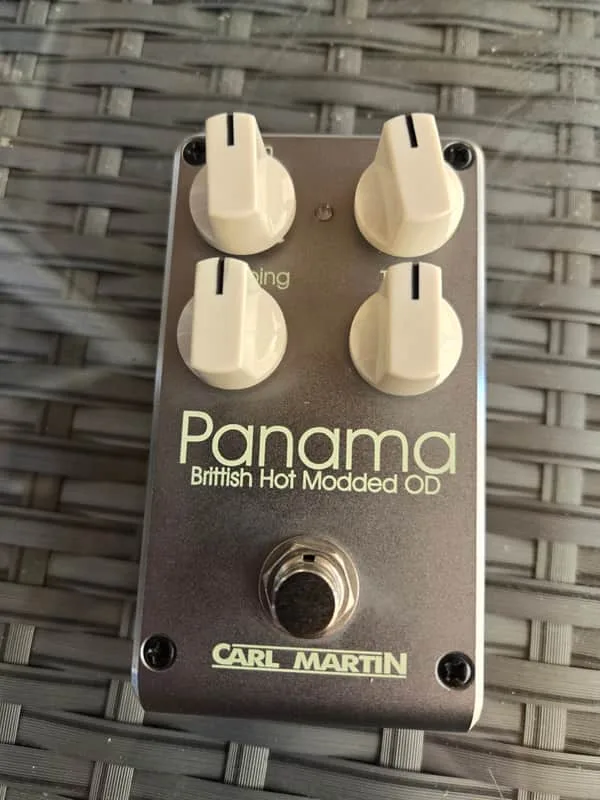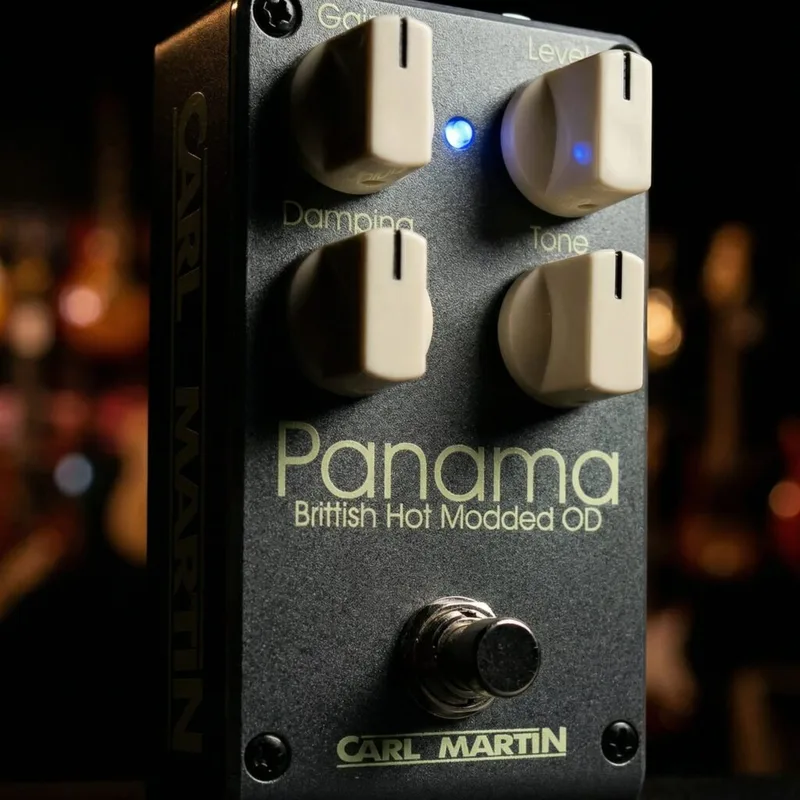


The Carl Martin Panama is an all-analog, high-gain overdrive pedal voiced after what Carl Martin calls the hot-rodded British "brown sound" amps of the 1980s1. Where the company's better-known PlexiTone covers classic Plexi and early Marshall territory, the Panama pushes into hotter, more compressed 1980s Marshall voicing, with a strong, articulate midrange and high gain potential1. It was introduced in April 2019 at a US price of $1992.
The pedal carries four controls: Gain, Level, Tone and a Damping knob that is unique to this model in the Carl Martin line13. Guitar World's reviewer, Trevor Curwen, found it delivers amp-like drive4, while MusicRadar's Michael Astley-Brown judged from the amount of gain on tap that it was "more of a distortion pedal than an overdrive"5.
A hot-rodded Marshall-style overdrive
Carl Martin has a solid reputation for Marshall-style overdrives, and the Panama extends that lineage into 1980s hot-rod territory3. The maker describes it as a hot-modded British overdrive with strong, articulate midrange and high gain potential1, and Guitar World's launch coverage framed it as a pedal offering classic Eighties-style distortion tones2.
Where it sits on the overdrive-to-distortion spectrum depends on who you ask. Carl Martin labels it a British hot modded overdrive, but Pete Thorn, demoing the pedal on his YouTube channel, said: "British hot modded overdrive is how they label this one I really think it's a distortion pedal but they say overdrive"6. MusicRadar reached a similar conclusion, writing that "Based on the sheer amount of gain available (as heard in Pete Thorn's demo below), we'd say this was more of a distortion pedal"5. For a player, that means the Panama is best thought of as a high-gain pedal: it can do pushed-amp overdrive at lower Gain settings, but its natural home is heavier crunch and saturated lead tones.
The circuit is analog throughout18, and it uses Carl Martin's DC/DC converter circuitry, which allows the pedal to run internally at plus and minus 12V from a 9V supply32. Delicious Audio noted this is the same converter design Carl Martin uses across its line, and it is part of why the pedal has the headroom it does3. The whole thing ships in Carl Martin's anodized enclosure58.
The controls: Gain, Level, Tone and Damping
Four knobs and a footswitch. The footswitch turns the effect on or off1.
| Control | What it does |
|---|---|
| Gain | Controls the amount of overdrive1 |
| Level | Sets the output volume2 |
| Tone | Shapes the overall brightness2 |
| Damping | Adjusts the tightness and response of the low end9 |
The Damping control is the Panama's distinguishing feature, and the reason it behaves differently from the rest of Carl Martin's Marshall-voiced pedals. Carl Martin's own support documentation explains: "The Damping knob is a unique feature on the Panama, it adjusts the tightness and response of the low end"9. The maker describes it as adjusting low-end response for either a tight, focused attack or an open, dynamic feel1.
Pete Thorn explained how it works in practice: "with this damping control as you turn it up it cuts base", letting you tighten the low end and raise the gain without the sound getting loose and flubby6. Premier Guitar's launch coverage described the same behavior from the other direction: turn the Damping up and the distortion becomes more aggressive, more cutting and clear; turn it down for a deeper, thicker sound with more bass dynamics8. Guitar World added that turning the control up produces more aggressive and cutting EVH-type sounds2.
Power: 9V DC, center-negative
The Panama runs on a 9V DC center-negative power input1. It draws about 65 mA according to Carl Martin's current product page1; earlier press coverage specified a regular 9V 100mA external power supply38, so any supply rated at 100 mA or more covers it.
The Panama does not accept a battery; there is no battery clip inside1. Plan on a 9V DC center-negative supply, and make sure your power brick's output can deliver at least the roughly 65 mA the pedal draws1.
How it differs from the PlexiTone and PlexiRanger
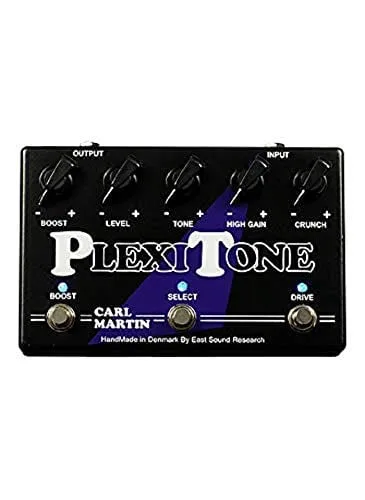
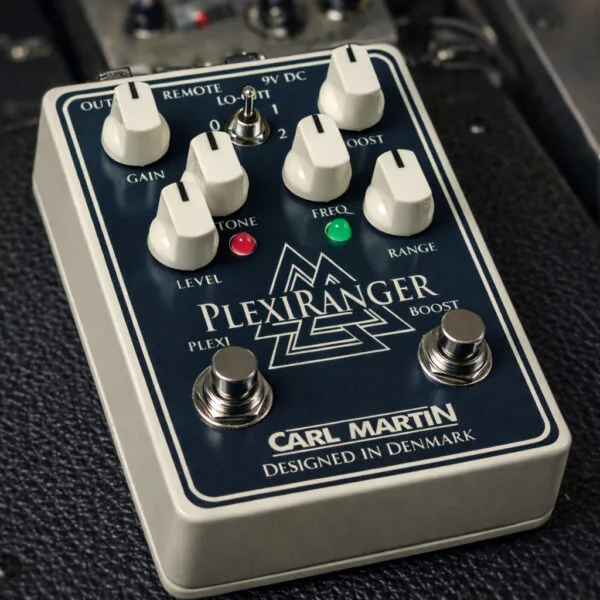
Carl Martin positions the Panama against its own Plexi-family pedals. In the company's words, the PlexiTone and PlexiRanger do the classic Plexi and early Marshall voicing, whereas the Panama is hot-rodded 1980s Marshall: more gain, more compression, and a Damping control the others lack1. Guitar World's reviewer also heard the family resemblance, writing that "The Panama's Brit tones probably owe a lot to that pedal, as well as to the classic amp that inspired it, of course"4.
Pete Thorn put it more simply in his demo: "it really reminds me of the plexitone in many ways but it's got this control on it called damping"6. So the choice between them comes down to era and gain: classic late-1960s Plexi crunch versus hotter 1980s saturation, with the Damping knob as the practical differentiator for tightening the low end at high gain.
Who uses it
Carl Martin lists two artists as Panama users on its artist page: Pelle Holmberg and Faruque Hossain10.
Pete Thorn's demo
Pete Thorn demoed the Panama on his YouTube channel in February 2019. He walked through the four controls, focused on how the Damping knob cuts bass as you turn it up so the low end stays tight at higher gain settings, and compared the pedal's character to the PlexiTone while noting he considers it a distortion pedal rather than an overdrive6.
Videos
Carl Martin
Brett Kingman
Questions
Does the Carl Martin Panama take a battery?
No. The pedal runs on a 9V DC center-negative power supply only, and there is no battery clip inside the enclosure. You will need a standard 9V pedal power supply or an isolated output on your pedalboard power brick to run it.
Is the Carl Martin Panama an overdrive or a distortion?
Carl Martin labels it a British hot-modded overdrive, but several reviewers disagree. MusicRadar called it more of a distortion pedal based on the sheer amount of gain available, and Pete Thorn said he really thinks of it as a distortion pedal even though the maker says overdrive. It sits in high-gain territory.
How is the Panama different from the Carl Martin PlexiTone?
The PlexiTone does the classic Plexi and early Marshall voicing, while the Panama is voiced after hot-rodded 1980s Marshall amps, with more gain and compression. The Panama also adds a Damping control that the PlexiTone lacks, which lets you tighten or loosen the low end.
Can the Panama get Eddie Van Halen tones?
That is the design brief. Carl Martin voices the Panama after hot-rodded British brown sound amps of the 1980s, and Guitar World noted that turning the Damping control up produces more aggressive and cutting EVH-type sounds, while turning it down gives deeper, thicker distortion.
How much current does the Carl Martin Panama draw?
Carl Martin's product page says the pedal draws about 65 mA. Earlier press coverage specified a regular 9V 100mA external power supply, so any 9V supply rated at 100 mA or more will cover it comfortably on a pedalboard.
Sources (10)
- Panama - Carl Martin, Carl Martin, 2026
- Carl Martin Introduces New Panama Overdrive, Guitar World, 2019-04-12
- Carl Martin Panama Plexi Drive, Delicious Audio, 2021-12-10
- Carl Martin Panama British Hot Modded OD review, Guitar World, 2022-04-20
- Carl Martin revs up Panama overdrive pedal, MusicRadar, 2019-04-15
- HOT MODDED PLEXI TONES! CARL MARTIN PANAMA OVERDRIVE, YouTube (Pete Thorn channel), 2019-02-02
- Unchained Overdrive, PedalPCB.com
- Carl Martin Unveils the Panama Overdrive, Premier Guitar, 2019-04-12
- Support - Carl Martin, Carl Martin (carlmartin.com), 2026
- Artists - Carl Martin, Carl Martin (carlmartin.com), 2026