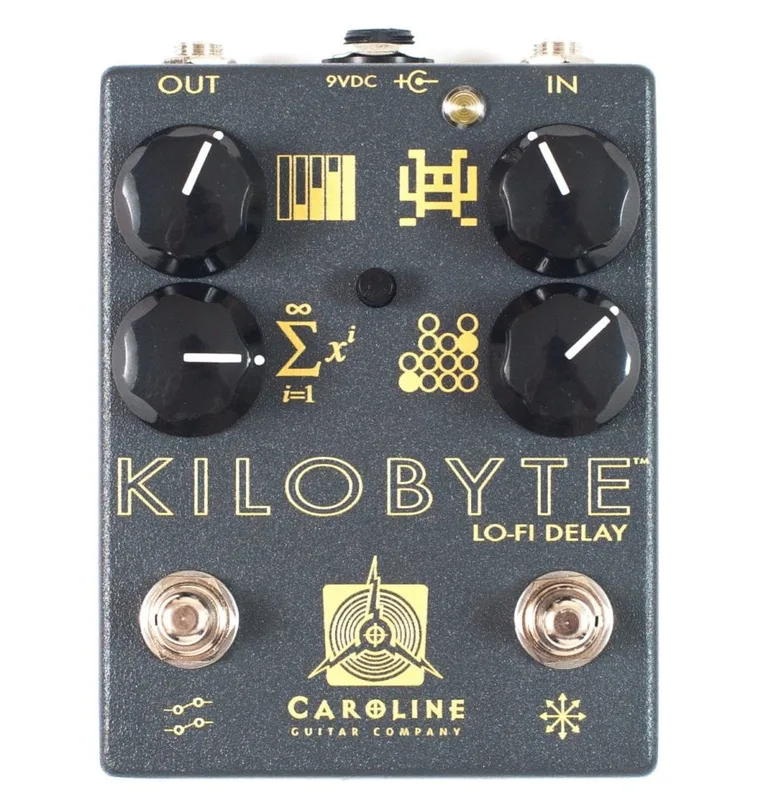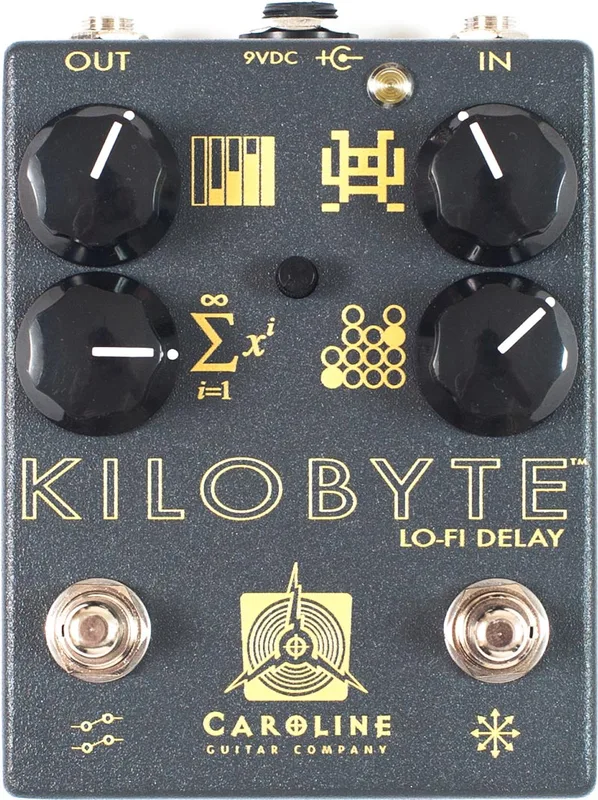


The Caroline Kilobyte is a lo-fi delay pedal from Caroline Guitar Company, first launched in 20131. Its design idea is unusual for a digital delay: your dry signal stays analog and untouched, while a +21dB boost/overdrive preamp drives a low fidelity digital delay chip, a part Caroline describes as one "designed for karaoke machines and kids' toys," into "smeared, repeated glory"2. The result is a delay whose repeats are deliberately degraded and dirty rather than clean and hi-fi.
The pedal carries a list price of $219.99 USD as of September 20262.
A lo-fi digital delay with an analog dry path
Caroline's own description of the circuit is the clearest explanation of what the pedal does: "We've kept your original, dry signal path analog and pure, then given you a +21db boost/overdrive preamp to smash a low fidelity digital delay chip designed for karaoke machines and kids' toys into smeared, repeated glory"2. The delay chip is the PT2399, a low fidelity, bandwidth reduced part that Pedal of the Day's reviewer called "a special unit indeed" for the way it creates the repeats5. Premier Guitar's reviewer found that the chip "had an alluring, analog-like character"7.
For a player, this means the Kilobyte does not aim for the clean, pristine repeats of a studio-style digital delay. Guitar.com's reviewer noted that with modulation at zero "there's just a touch of treble roll-off helping the repeats to blend in naturally," and summed up the concept as proof that "lo-fi doesn't have to mean analogue"1.
The controls, Tacos modulation and the Havoc switch
The pedal carries four main knobs plus a modulation control and a second footswitch. Guitar.com lists the control set as Level, attack (delay gain), summation (feedback), binary clock (delay time), and a trimpot for modulation depth1.
| Control | What it does |
|---|---|
| Level | Sets the output level1 |
| Attack (delay gain) | Sets the gain of the preamp feeding the delay chip1 |
| Summation (feedback) | Sets repeat count; turn it up for oscillation21 |
| Binary Clock | Sets overall delay time, usually maxing out between 500 and 600ms depending on the pedal5 |
| Tacos (modulation) | Gently tweaks the subtle amount of pitch shifting and detuning in the repeats6 |
| Havoc footswitch | Hold down to temporarily max out the feedback setting for runaway self-oscillation1 |
The Tacos modulation circuit was crafted by Jack DeVille after Caroline's Kickstarter campaign3. On the Kickstarter version it was an internal trimpot, "so that modulation is still available" as a fifth knob6; on the newer version it moved to the outside of the pedal3. Pedal of the Day's Sharrod J found the pitch shifting of the repeats "a nice touch"8.
The Havoc switch is the pedal's party trick. You can create self-oscillation with the feedback and delay controls alone, but Guitar.com's reviewer wrote that "it's a real bonus to have the havoc switch at your disposal here" for soaring and swooping self-oscillation patterns1. One practical note for anyone buying used: Pedal of the Day's reviewer found the knobs, identified only by odd shapes and designs rather than words, confusing at first3.
Original thru-hole and newer SMD versions
There are two distinct versions of the Kilobyte, and the differences matter if you are buying secondhand3.
- Original thru-hole version (2013): Full-size thru-hole parts, hand populated and either hand soldered or wave soldered, with a Jack DeVille board design and a 3PDT mechanical bypass switch, warranty serviced for the life of the product. Limited to roughly the first 470 handmade units3.
- Newer SMD version (from 2014): Surface mount components on a Jon Cusack SMD board design, with Cusack's silent relay-based switching system, which Caroline describes as still true bypass. Identified by four knobs plus a small trimpot in the center, with Tacos moved to the outside3.
Guitar.com's review of the current-at-the-time version noted that "unlike the handwired 2013 version, this pedal is built around a printed circuit board"1. The original Kickstarter run also had finish variations: a black and gold sparkle finish for Kickstarter supporters and advance customers who paid a premium, while the standard color was Kingsport Gray, a gun-metal color6. A Vintage King Special Edition also existed5.
The Kilobyte line continued after this pedal. The original thru-hole version used full size parts, hand populated and either hand soldered or wave soldered, with a modulation circuit designed by Jack DeVille3. The newer SMD version moved to surface mount components on a Jon Cusack SMD board design with Cusack's switching, and unlike the handwired 2013 original, it is built around a printed circuit board31.
What reviewers said
Reviewers were broadly enthusiastic. Pete Thorn demoed it and called it "a lo-fi vibey delay," adding "I love the kilobyte as well"9.
"Overall, this is one incredible delay pedal, and the fact that it uses a low fidelity, bandwidth reduced PT2399 digital delay chip for creating the repeats makes it a special unit indeed."
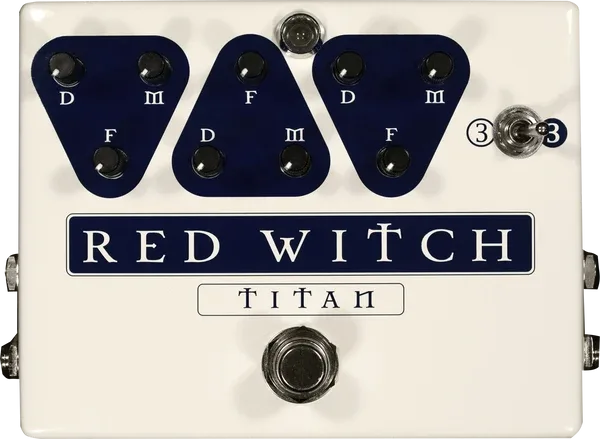
Guitar.com's Richard Purvis found it "a warm, soothing delay" with a smidgeon of modulation1, and in Guitar.com's 2016 Gear of the Year awards Gary Walker's verdict was that riding the Havoc switch "is as much fun as I've had with a pedal this year," taking the prize over the Red Witch Titan, which had been his favorite delay of recent times10.
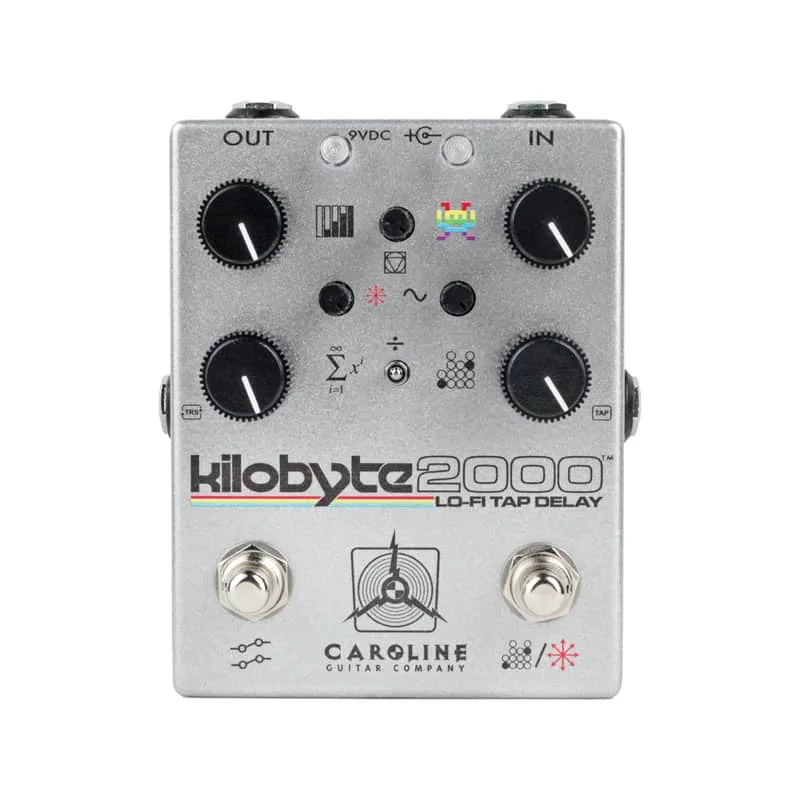
On That Pedal Show, demoing the Kilobyte 2000 successor, Dan and Mick found that with input gain low and modulation dialed in, it was "a digital delay pedal doing a very nice impression of an analog delay"11.
Videos
Pete Thorn
CarolineGuitarCo
The Pedal Zone
Questions
Is the Caroline Kilobyte true bypass?
Yes. Caroline states that all of its pedals are true bypass with a high quality, rugged 3PDT mechanical switch, and the original Kilobyte used that switch. The newer SMD version moved to a silent relay-based switching system designed by Jon Cusack, which Caroline describes as still true bypass, just without the mechanical click.
Does the Caroline Kilobyte take a battery?
No battery option is stated for it. Guitar.com's review lists it as powered by a 9V DC adaptor, which is not supplied with the pedal, so you will need a power supply on your board rather than an internal battery.
What chip does the Caroline Kilobyte use?
It uses the PT2399, a low fidelity, bandwidth reduced digital delay chip that Pedal of the Day's reviewer described as originally designed for karaoke machines and kids' toys. Caroline drives it with a +21dB boost/overdrive preamp, which is what gives the repeats their smeared, degraded character.
How long is the delay time on the Kilobyte?
The Clock knob sets overall delay time, which usually maxes out between 500 and 600ms depending on the individual pedal. Pedal of the Day listed over 500ms, and Guitar.com's reviewer found the maximum delay time not far short of a full second.
What is the difference between the Kilobyte and the Megabyte?
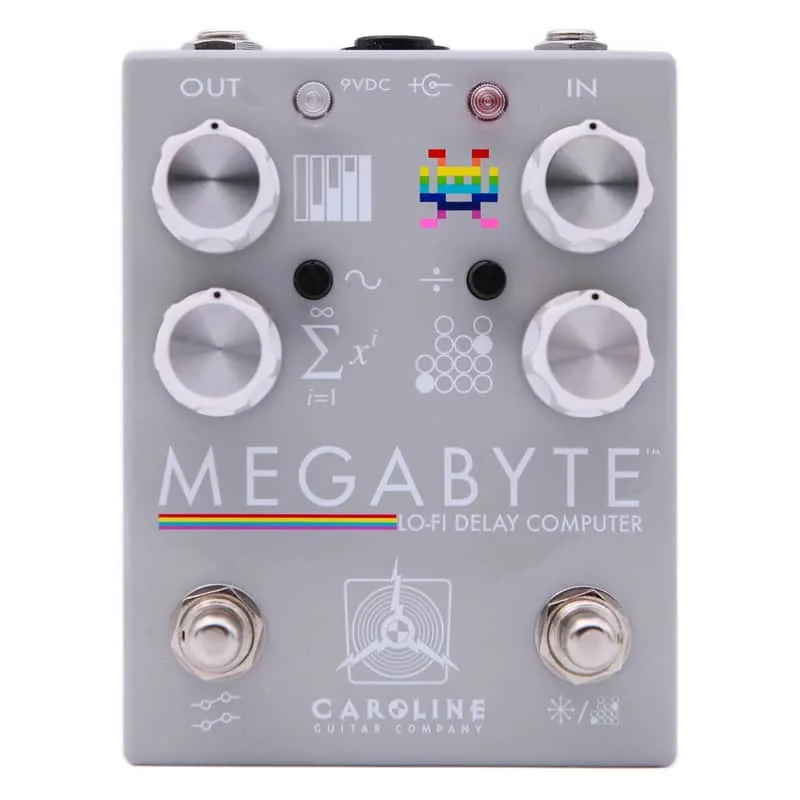
The Megabyte is Caroline's follow-up to the Kilobyte, with double the delay time, tap tempo, a choice of trails or true bypass, and a nastier Havoc self-oscillation circuit. The Kilobyte itself is the simpler original: no tap tempo, a shorter delay, and the same lo-fi PT2399 repeat character.
Sources (11)
- Caroline Kilobyte & Haymaker Reviews, Guitar.com, 2016-12-01
- Kilobyte, Caroline Guitar Company, 2026-09-07
- What we're changing about Kilobyte, and why., Caroline Guitar Company, 2014-04-19
- Kilobyte Lo-Fi Delay by Caroline Guitar Company, RockBoard PedalPedia, 2026
- Caroline Guitar Company Kilobyte™ Lo-Fi Delay, Pedal of the Day (www.pedal-of-the-day.com), 2017-01-27
- FAQ: KILOBYTE™ Lo-Fi Delay Pedal, Caroline Guitar Company, 2013-07-09
- Alien Seeks Digital Love: Echo Romance Unveiled, Premier Guitar, 2020-09-24
- Caroline Guitar Company Kilobyte Lo-Fi Delay, Pedal of the Day (www.pedal-of-the-day.com), 2015-06-11
- Caroline Guitar Co. Météore Reverb, demo by Pete Thorn/Vintage King, Pete Thorn (YouTube), 2015-12-10
- Gear Of The Year 2016, Guitar.com, 2016-12-16
- New Pedals! Keeley Nocturne, Jam Retrovibe 4, Caroline Kilo 2K, DevTech Soft Drive, Hagerman EF86, That Pedal Show (YouTube), 2026-01-30