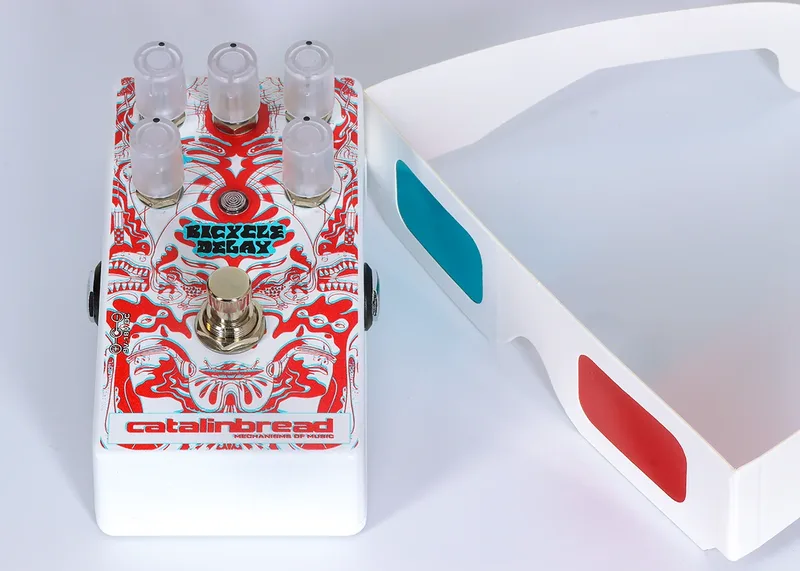


The Catalinbread Bicycle Delay 3D is a delay pedal whose repeats can be pitch shifted as they fade, with the direction and speed of that shift set from the front panel. It is part of Catalinbread's delay line, alongside pedals like the Belle Epoch Deluxe and the Adineko, and it is currently sold by the maker as a B-Stock unit, meaning a pedal with minor cosmetic imperfections that has been tested and is guaranteed to work perfectly1. For more on the wider category, see Delay Pedals.
The controls
The front panel carries four knobs, each with a distinct job:
| Control | What it does |
|---|---|
| EXPANSE | Sets the time delay between the original sound and its echoed repeats1 |
| REFLECT | Sets the number of repeats, from a single repeat up to self-oscillation at maximum1 |
| MOOD | Determines the direction and velocity of the pitch shift of the repeats1 |
| LUCIDITY | Wet/dry mix, balancing the effected and original signals1 |
REFLECT is the feedback control in everything but name. Catalinbread describes it as determining "the number of steps in this staircase, representing the number of repeats of your signal," and at its maximum "it can lead to self-oscillation, where the repeats build infinitely until interrupted"1. Players who like runaway echoes can dial it to the top and let the pedal generate its own tail.
MOOD is the knob that sets this pedal apart from a straightforward delay: it moves the pitch of each successive repeat, up or down, faster or slower, depending on where it is set1.
Inside the pedal
Two things live under the hood rather than on the top panel:
- SL/SB mode switch: an internal slider switch that selects between the two voicings, "Super Lead" and "Super Bass"1
- PRESENCE trimpot: accessible by removing the bottom plate, it fine-tunes the amount of presence, meaning the high treble frequencies, and comes factory set1
Both the voicing switch and the presence trimpot require taking the bottom plate off. Set them with the pedal on a bench, not on a live board mid-set.
Power
The Bicycle Delay 3D takes a negative tip DC supply rated from 9 to 18 volts1. It does not run on batteries, so a power supply is required, full stop1.
The voltage you feed it changes how it responds. Catalinbread's Nicholas Harris puts it this way1:
"If you desire increased volume, headroom, and a sharper percussive attack, consider using an 18-volt power supply."
At 9 volts the pedal gives a slightly softer sound that saturates more readily, according to the same page1. Since the pedal accepts the full 9 to 18 volt range, both options are within spec, and the choice comes down to how much headroom and attack you want.
Videos
ProGuitarShopDemos
Catalinbread Effects
Catalinbread Effects
Questions
Does the Catalinbread Bicycle Delay 3D run on a battery?
No. Catalinbread states plainly that the Bicycle Delay does not operate on batteries. It needs a DC power supply with a negative tip, rated anywhere from 9 to 18 volts. Plan for a dedicated supply output or a daisy chain that can feed it, and keep a battery clip out of the equation entirely.
What is the difference between Super Lead and Super Bass on the Bicycle Delay 3D?
The pedal offers two distinct voicings, named Super Lead and Super Bass, and you switch between them with an internal slider switch rather than an external toggle. Catalinbread does not publish a detailed frequency description of each voicing on the product page, so the practical difference is one you set with a screwdriver before playing rather than a knob you stomp mid-song.
Can the Bicycle Delay 3D self-oscillate?
Yes. With the REFLECT control at its maximum, the pedal can self-oscillate, and Catalinbread describes the repeats as building infinitely until interrupted. In practice that means turning REFLECT all the way up starts a runaway echo that keeps going until you change the setting or cut the signal.
What does the Presence trimpot do on the Bicycle Delay 3D?
Inside the pedal, accessible by removing the bottom plate, there is a trimpot that lets you fine-tune the amount of presence, meaning the high treble frequencies. It comes factory set, so most players can leave it alone, but it is there if you want to tailor the top end to your rig.
Does 18 volts sound different from 9 volts on the Bicycle Delay 3D?
According to Catalinbread, yes. Running the pedal at 18 volts gives increased volume, headroom and a sharper percussive attack, while 9 volts gives a slightly softer sound that saturates more readily. The pedal accepts a negative tip DC supply from 9 to 18 volts, so both options are within its rated range.
What does B-Stock mean for a Catalinbread pedal?
B-Stock items are effect pedals with minor cosmetic imperfections. Catalinbread states that they have been tested and are guaranteed to work perfectly, so the difference is appearance rather than function. The Bicycle Delay 3D is sold in B-Stock form on the maker's own product page.
Sources (1)
- Bicycle Delay 3D (B-Stock), Catalinbread Effects