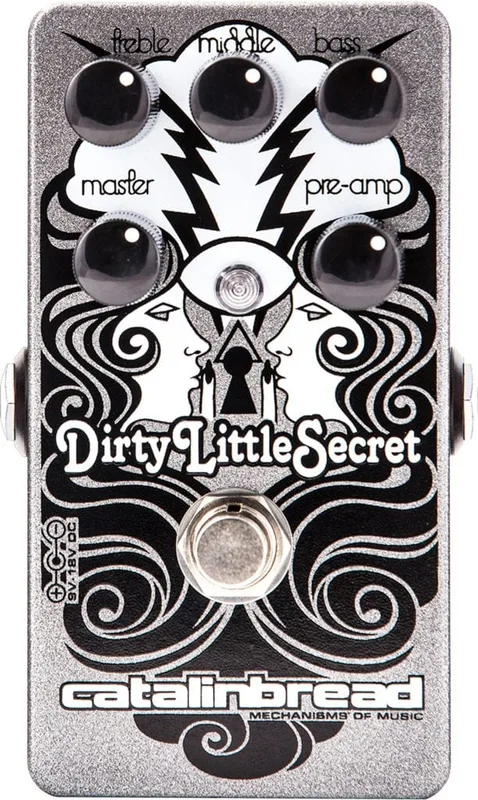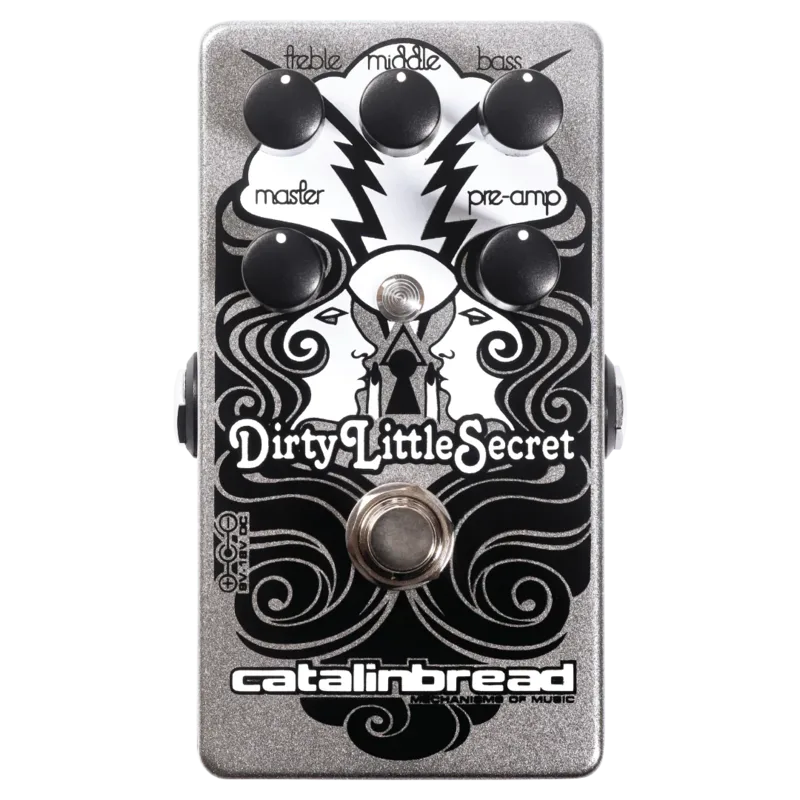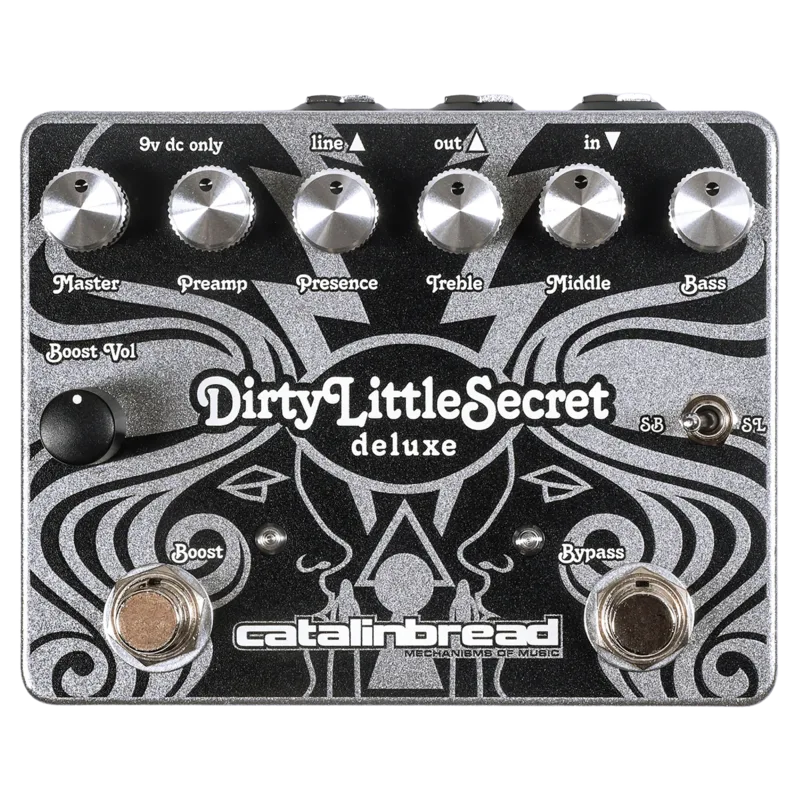


The Catalinbread Dirty Little Secret Deluxe is a Marshall Plexi emulation pedal, an amp-in-a-box built by Catalinbread that models a full Plexi signal path: an all-discrete analog circuit with a preamp, phase inverter, power amp sim and output transformer1. What started internally as a fourth version of the flagship Dirty Little Secret grew into the Deluxe, adding an external Super Lead/Super Bass toggle, a rebuilt tone section, a built-in boost, and a +10dB line out for direct recording1.
The boost side is a single preamp tube simulator taken from the Dirty Little Secret circuit, and it works on its own or with the main overdrive2. Catalinbread describes the result as a six-amp experience: boost alone gives chime-y Marshall cleans, the DLS side alone gives a cranked Plexi, and both together give the sound of a roaring JCM, in both Super Lead and Super Bass voicings1.
A Plexi preamp in a pedal, with a boost
The Deluxe goes further than earlier Dirty Little Secret pedals by modeling more of the amp than the preamp alone. Inside there is a MOSFET-driven phase inverter and power amp sim, along with an output transformer that Catalinbread says injects "a little iron" into the signal1. The Master control sits before the phase inverter and output transformer rather than at the end of the circuit, just as on a real amp, so cranking it does not noticeably change the tone; at full volume it adds subtle sag and gentle compression, which Catalinbread suggests suits always-on use1.
The boost is a piece of the Dirty Little Secret itself, a single preamp tube simulator that can run independently of the main circuit2. The two sides can be ordered either way: boost before the DLS for a high-powered saturated tone, or boost after it to pummel the front end of your amp2. Catalinbread ships the pedal with the boost first, and an internal switch reverses the order1.
The controls
The Deluxe carries two footswitches, Boost and Bypass, and its controls sit in a horizontal 1590-BB enclosure5.
| Control | What it does |
|---|---|
| Preamp | Gain, tweaked for a wider range: more cleans at the low end, more cranked Marshall tones at the top1 |
| Treble / Middle / Bass | Classic Marshall amp tone stack values taken from the amps themselves; fully passive and interactive, so noon is not flat1 |
| Presence | A low-pass filter: 3dB attenuation above 1.59kHz fully down, climbing out of audible range at the top of the turn1 |
| Tightness | A high-pass filter: cuts nothing audible fully down, up to about 230Hz at maximum, trimming bass into the low mids1 |
| Master | Volume, placed before the phase inverter and output transformer like a real amp1 |
| SL/SB toggle | Switches between Super Lead and Super Bass modes1 |
Because the tone stack is passive, the Bass control in particular is not flat at noon, and the knobs interact the way a Marshall front panel does1.
Super Lead and Super Bass modes
The external toggle selects between the two voicings: Super Lead mode is a cutting, upper-midrange-heavy tone, and Super Bass mode is smoother and smokier with a lower midrange emphasis1. On earlier Dirty Little Secret pedals this choice was an internal slider switch678, so moving it to the outside of the enclosure is one of the Deluxe's practical changes. The Super Bass voicing follows the tone and gain structure of a Marshall Super Bass, which is very similar to a JTM45 or JTM50/1009.
Power, outputs and direct recording
The pedal runs on a 9-volt center-negative DC supply delivering at least 7mA1.
Catalinbread warns that plugging in anything other than 9V center-negative DC (center-positive, AC, or higher voltage) will damage the pedal, possibly beyond repair, and void the warranty1.
The rear panel adds a Line Out, a dedicated +10dB output for direct recording or mixing into a DAW1. The dry signal is boosted to +10dB on that jack, and the standard output and Line Out can be plugged in at the same time, so you can feed an amp and a mixer at once1. Because of this output split, the pedal uses a buffered bypass with an output buffer to preserve signal integrity1.
History and versions
The Dirty Little Secret line goes back over a decade. The Mk. II arrived in 2011 and was replaced in 2013 by the Mk. III, a full redesign that Catalinbread has kept in production10. The Mk. III launched on February 12, 2013 with a redesigned three-knob treble-middle-bass tone control that reconfigures for each mode setting11. Its gain range runs from classic plexi to modified JCM800 levels in Super Lead mode9.
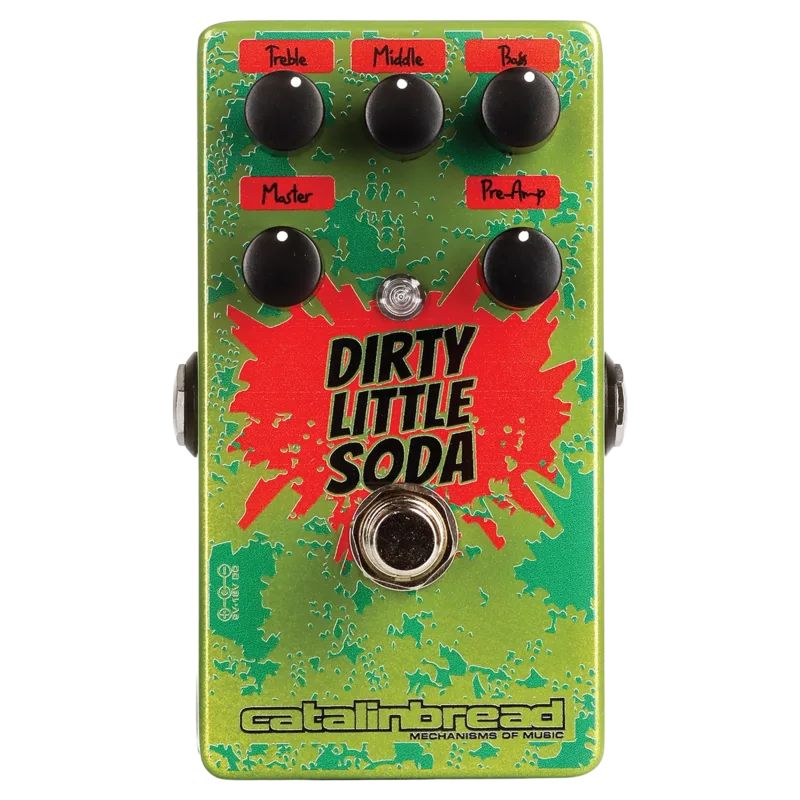
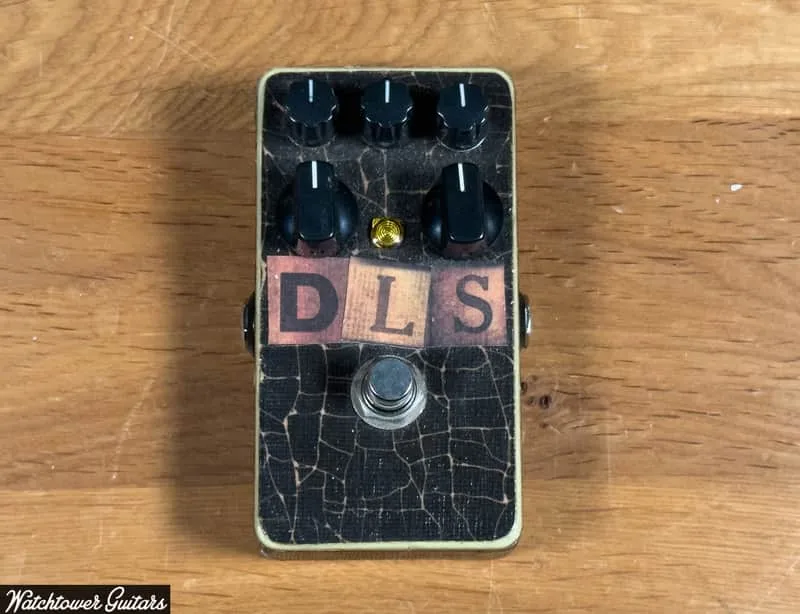
The Deluxe began as a fourth version of the circuit and ended up as its own pedal, released in September 202314. It followed a run of limited editions, including the DLS Red Mod, a hot-rodded version of the Mk. III in a red enclosure with more gain and a more hi-fi EQ section1213. Compared with the standard Mk. III, the Deluxe externalizes the Super Lead/Super Bass switch and adds Presence and Boost controls5.
What reviewers said
Guitar Pedal X's reviewer could not fault the control topology or feature set, and considered the $299 price about right5. The same writer noted that Andy Martin has long cited the Dirty Little Secret as his favorite Marshall-in-a-box pedal5.
MusicRadar's Trevor Curwen reviewed the standard Dirty Little Secret as "a versatile tone-building dirt box with two distinct M-style flavours"14, and on That Pedal Show the hosts called it "very vibby" with a real classic character1415. Dave Depper, in a Strymon pedalboard feature, called it "the best Marshall-in-a-box pedal I've come across"7.
"this is the best Marshall-in-a-box pedal I've come across"
Videos
AndyDemos
R.J. Ronquillo
Brett Kingman
News
Questions
Can you change the boost order on the Dirty Little Secret Deluxe?
Yes. It ships with the boost placed before the Dirty Little Secret side, but an internal switch flips the order. Boost into the DLS gives a saturated, high-powered tone; boost after the DLS pushes the front end of your amp harder. The boost can also be used on its own, independent of the main circuit.
Is the Dirty Little Secret Deluxe true bypass?
No. Catalinbread equips the Deluxe with buffered bypass. Because the pedal splits its signal between the standard output and the Line Out, it uses an output buffer to preserve signal integrity when both jacks are in use.
What is the difference between Super Lead and Super Bass mode?
Super Lead mode is a cutting, upper-midrange-heavy tone, while Super Bass mode is smoother and smokier with a lower midrange emphasis. On the Deluxe the choice is made with an external toggle switch, rather than the internal slider used on earlier versions.
Can you record direct with the Dirty Little Secret Deluxe?
Yes. The rear panel has a dedicated Line Out with a +10dB output intended for direct recording or mixing into a DAW. The standard output and Line Out can be plugged in at the same time, so you can run to an amp and a mixer simultaneously.
Where is the Catalinbread Dirty Little Secret made?
Catalinbread's Dirty Little Secret pedals are hand-made in Portland, Oregon. The company has also hand-built limited editions such as the DLS Red there.
Sources (15)
- Dirty Little Secret Deluxe, Catalinbread Effects
- Catalinbread Dirty Little Secret Deluxe, Delicious Audio, 2023-09-22
- Dirty Little Secret (B-Stock), Catalinbread Effects
- “A fully customizable amp-in-a-box experience”: Has Catalinbread's Dirty Little Secret Deluxe just redefined amp-like overdrive pedals?, Guitar World, 2023-09-07
- Guitar Pedal X, Guitar Pedal X, 2023-09-14
- Triton Preamp Drive Mk. III / Catalinbread DLS V3, Aion FX, 2020-11-27
- Pedalboard Feature: Dave Depper, Strymon, 2015-10-05
- Dirty Little Soda (DLS Red), Catalinbread Effects
- Guitar FX Layouts: Catalinbread DLS MKIII, tagboardeffects.blogspot.com (Guitar FX Layouts), 2013-04-27
- Triton Preamp Drive Mk. II / Catalinbread DLS V2, Aion FX, 2020-11-23
- Catalinbread Launches Updated Dirty Little Secret, Premier Guitar, 2013-02-06
- Catalinbread gives the Dirty Little Secret an upgrade, Guitar.com, 2019-11-26
- Catalinbread Unveils New Dirty Little Secret Red Pedal, Premier Guitar, 2019-11-28
- Catalinbread Dirty Little Secret review, MusicRadar, 2016-01-15
- TPS AB Comparisons, That Pedal Show, 2017-01-03