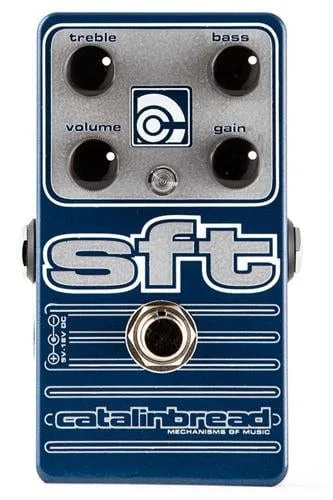


The Catalinbread SFT is an analog overdrive and preamp pedal that emulates the response of a big Ampeg tube amp, the family of bass heads that includes the SVT12. Catalinbread, a maker known for "amp-in-a-box"-style drive pedals that capture classic vintage amplifiers32, built the SFT so a player can get that amp's clean, edge-of-breakup and saturated sounds at board level, into any rig.
The pedal is straightforward to operate: four knobs (Treble, Bass, Gain, Volume) and a Stones/Stoner toggle that re-voices the whole circuit14. It is aimed squarely at low-end duties, with a Bass control that can deliver a huge low-frequency boost, but it works for guitar too, covering everything from clean tones to fuzz5.
What the SFT does: a big Ampeg tube amp in a pedal
Catalinbread describes Stones Mode as emulating "the authentic response of a big Ampeg tube amp," delivering "classic, refined tones with a slight emphasis on lower mids, akin to the iconic Ampeg sound," and suited to clean and slightly overdriven tones1. The circuit is built on gain stages that avoid standard guitar-pedal cathode capacitors, drawing instead from high-fidelity audio design, and it uses a two-band Baxandall EQ for its Bass and Treble controls2.
Because it is a preamp-style circuit rather than a simple clipping overdrive, it is not strictly a dirt box. Gearnews noted it "can do clean tones as well" as fuzz5. Aion FX's documentation of the circuit confirms the lineage: the SFT is "based on the legendary Ampeg SVT bass amplifiers"6.
Controls
| Control | What it does |
|---|---|
| Gain | Sets the amount of overdrive or distortion. Low settings are clean and bright; 10:00 to noon gives edge-of-breakup that responds to pick attack; noon to 2:00 is the overdrive sweet spot; beyond 2:00 adds crunch and saturation1 |
| Volume | Overall output. Plenty of boost for clean sounds even at low Gain; needs less adjustment at higher gain, especially in Stoner mode1 |
| Bass | Low-frequency amount. Below noon is tighter, above noon is bass-heavy, and at maximum it gives a huge low-end boost suited to fuzz settings in Stoner mode1 |
| Treble | High-frequency amount. Below noon is darker, above noon brighter, and higher settings boost upper mids too1 |
| Stones/Stoner toggle | Selects the two voicings described below4 |
Gearnews called this "a nice, simple layout"4.
Stones and Stoner modes
The toggle switches between two personalities4:
- Stones: Catalinbread says it emulates the authentic response of a big Ampeg tube amp, with refined tones and a slight emphasis on lower mids, ideal for clean to slightly overdriven sounds1. Gearnews characterized it as "a classic 'second generation white boy blues' tone"4.
- Stoner: Catalinbread describes it as transforming the pedal into "a high-gain distortion powerhouse," aimed at "ripping distortion tones and the ability to produce huge fuzz sounds"1. Gearnews called it "sludgy and downright dirty"4.
On the V2 circuit, the switch re-voices the tone, and RockBoard describes Stoner mode as transforming the pedal into a high-gain distortion powerhouse, designed for players seeking ripping distortion tones and the ability to produce huge fuzz sounds17. Gearnews' reviewer was enthusiastic about the dirty side: "I love the tones you can coax from it when it goes really dirty in Stoner mode!"5
Power: 9 to 18 volts
The SFT runs on a negative tip DC supply from 9 to 18 volts1, and it can also run off a 9-volt battery4. The voltage choice changes the character, according to Catalinbread: an 18-volt supply gives more volume, headroom and percussive attack, while 9 volts has a slightly softer sound that saturates more easily1. Gearnews relayed the same trade-off, with the 9V option giving a "softer feel" and 18V allowing more headroom4.
Current draw is listed at 4mA2, so the pedal is easy on a power supply budget.
Higher voltage means more headroom, not more gain. If you want the softer, easier-saturating character Catalinbread describes, run it at 9 volts; for a tighter, louder, more percussive feel, use 181.
History and versions
The SFT has two main versions6:
| Version | Year | Circuit |
|---|---|---|
| SFT (V1) | 2009 | Original version6 |
| SFT V2 / SFT II | 2016 | Revised version with the external Stones/Stoner switch62 |
The revised pedal with the Stones/Stoner switch was released on 29 February 2016 at an RRP of $179.994. Gearnews describes it as a revised version of the pedal rather than a straight reissue, noting that it is not strictly speaking just a dirt box, as it can do clean tones as well5.
The pedal has appeared in several of Catalinbread's finish collections, including the Traditional Ink Collection2 and a '70s Collection version with the same controls and behavior7.
DIY builders have documented the V2 circuit closely on tagboardeffects, where one builder reported that the original SFT V2 uses a 470uF filter capacitor that turned out to be critical for avoiding bass oscillation in clones8. Another builder's verdict on a completed clone: "It's a really good sounding pedal with a lot of sounds available"8.
Where it sits among dirt pedals
As an amp-in-a-box preamp rather than a pure overdrive, distortion or fuzz pedal, the SFT covers ground that would otherwise take several boxes: clean boost, edge-of-breakup, crunch and fuzz, all voiced like an Ampeg bass head15. For bass players building a bass pedals board, its SVT lineage and low-end-focused Bass control are the draw16; for guitarists, it doubles as a touch-sensitive overdrive with a sludgy side4.
Videos
ProGuitarShopDemos
Catalinbread Effects
Catalinbread Effects
Questions
Does the Catalinbread SFT run on a battery?
Yes. Gearnews reported that the SFT can run off a 9-volt battery or a 9V to 18V power supply. Catalinbread's own product pages specify a negative tip DC supply from 9 to 18 volts, so a standard center-negative pedal power supply works, and higher voltage brings more headroom.
Is the Catalinbread SFT good for bass?
Yes. The circuit is based on the Ampeg SVT bass amplifier, and the pedal is built around bass frequencies. The Bass control offers a huge low-end boost at maximum, which Catalinbread describes as suitable for fuzz settings in Stoner mode, and the maker positions the pedal as a big Ampeg tube amp in a box.
How much current does the Catalinbread SFT draw?
RockBoard's PedalPedia lists the SFT's current draw as 4mA. That is low enough that the pedal can share a daisy chain or a modest isolated supply with several other pedals without straining the power budget.
What is the difference between the Catalinbread SFT and SFT II?
The SFT II is the 2016 redesign. The original 2009 SFT used 2N5457 JFETs, which were discontinued in through-hole format, so the V2 was rebuilt around MPF4393 JFETs and adds the external Stones/Stoner switch. Aion FX notes that although both are voiced against the same Ampeg SVT reference, the two circuits are very different.
Can you use the Catalinbread SFT on bass?
Yes. The pedal emulates the response of a big Ampeg tube amp, the amp family the SVT bass heads belong to, and its Bass knob is designed for shaping low frequencies, from a tightened response below noon to a bass-heavy sound above it. Gearnews described it as based on an Ampeg bass head circuit.
Sources (8)
- SFT (Blackout Series), Catalinbread Effects
- SFT (Traditional Ink Collection) by Catalinbread, RockBoard PedalPedia, 2026
- NAMM 2017: Catalinbread Formula No. 55 Overdrive pedal offers some heavy tweed, gearnews.com, 2017-01-18
- Catalinbread's revised SFT pedal: From Stones to Stoner at the flick of a switch, gearnews.com, 2016-02-29
- Top 5 Fuzz Pedals: The best dirt boxes of 2016, gearnews.com, 2016-05-18
- Artemis Preamp Drive Mk. I, Aion FX, 2020-11-25
- SFT ('70s Collection) B-Stock, Catalinbread Effects
- Guitar FX Layouts: Catalinbread SFT II, tagboardeffects.blogspot.com, 2017-10-16