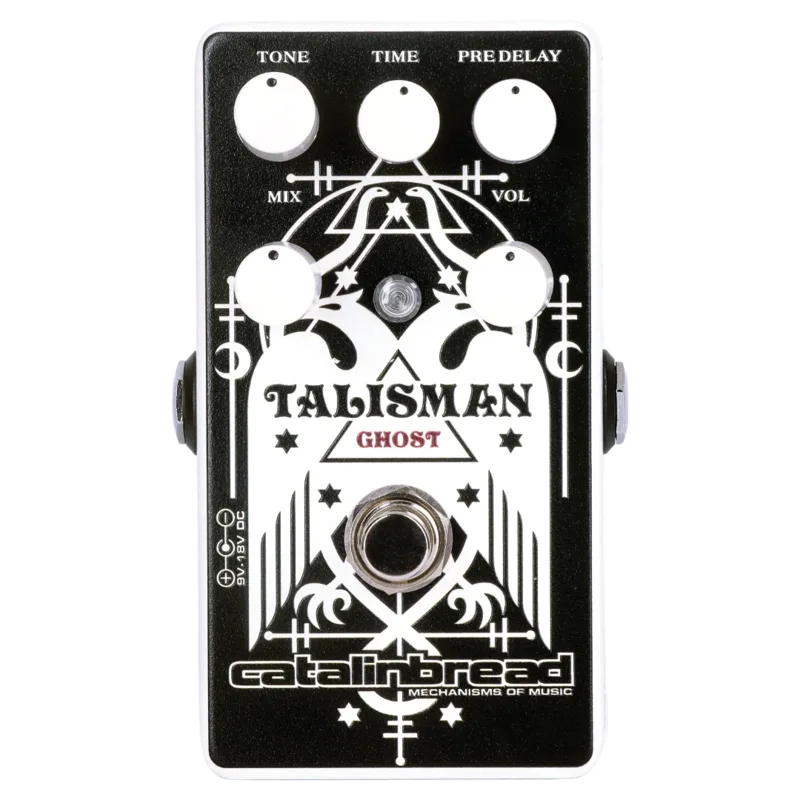


The Catalinbread Talisman is a compact reverb pedal that recreates the EMT 140 plate reverb, the studio unit that German company EMT introduced in 195712. Guitar.com describes it as "a compact recreation of an EMT 140 plate reverb," first released in 20151. Where the original hardware was a massive steel plate suspended by springs that created a splashy, metallic sound when hit with a signal3, the Talisman puts that plate character on a pedalboard in a box roughly the footprint of a standard stompbox.
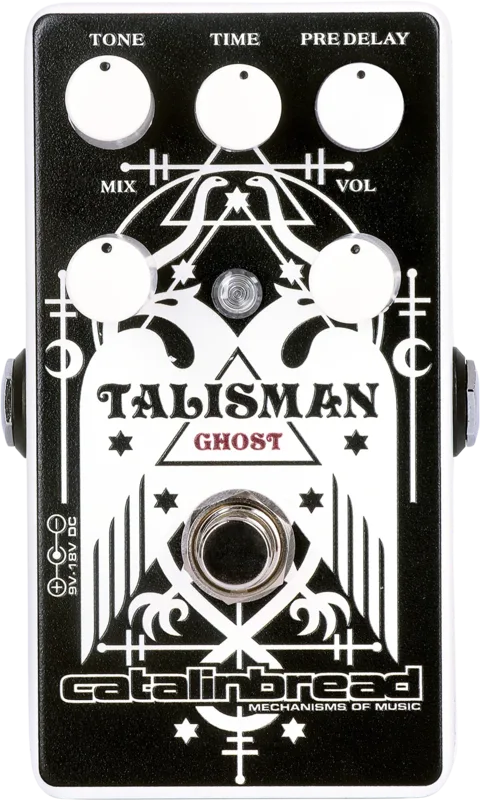
The Talisman sits among Catalinbread's reverb line alongside the Talisman Ghost, a 2025 revision that simulates two EMT 140 plates in parallel with added pitch modulation1. Delicious Audio has called the original "the popular Catalinbread Talisman reverb pedal"4.
What a plate reverb is, and what the Talisman does with it
The EMT 140 was groundbreaking in its day: a thin steel plate where higher frequencies travel faster than low frequencies, giving plate reverb its distinctive smooth but metallic decay2. EarthQuaker Devices' history of the format describes the hardware as "a massive steel plate suspended by springs that created a splashy, metallic sound"3. The Talisman emulates that behavior digitally in a compact enclosure, so a player gets studio plate ambience without the eight-foot plate the original required.
The low-cut control, preamp and internal switch
The Talisman's HIGH PASS control gradually filters out lower frequencies as it is increased, letting a player keep the reverb out of the bass range so it does not muddy the low end of the guitar6. This is the control a plate emulation most needs, since the original hardware's low-frequency behavior was part of what made real plates tricky to place in a mix.
The pedal also carries a discrete preamp that Catalinbread says "is also capable of a healthy amount of boost"6. That means the Talisman can push an amp harder while adding reverb, rather than acting only as an effect at the end of the chain.
Inside the pedal is a slider switch with two modes, BUFF and TB, and the Talisman ships from the factory in BUFF mode6. The choice matters in two ways:
- BUFF mode: the output stays buffered when the pedal is bypassed, so the reverb tail keeps sounding. Catalinbread notes that in this mode "it's possible to bypass the pedal and play over that 'infinite pad' with an unaffected signal"6.
- TB mode: the pedal goes true bypass. Unity volume against the bypassed signal occurs at different knob settings depending on whether the pedal is powered at 9V or 18V6.
The internal slider is set to BUFF when the pedal leaves the factory. If you switch it to TB, expect the volume relationship between engaged and bypassed signal to change, and to differ between 9V and 18V power6.
Power
The Talisman can be powered by any center-negative 9 to 18V DC supply designed for use with effect pedals, and the supply must provide at least 100mA of current6. There is no battery option in Catalinbread's power specification, so the pedal needs a spot on a power supply. The same power requirement applies to the Talisman Ghost7.
At 100mA minimum, the Talisman draws more than a typical analog drive pedal, so check your power supply's per-output rating before daisy-chaining it with other pedals6.
Talisman versus Talisman Ghost
Catalinbread revised the Talisman in 2025 as the Talisman Ghost. The Ghost retains the same core functionality but simulates two EMT 140 plates in parallel and adds pitch modulation that Guitar.com's reviewer said applies "a thick chorus to the reverb trails"14. Where the original Talisman aims at a straight plate sound, the Ghost, in the same reviewer's words, "focuses on making the sound darker and weirder"1.
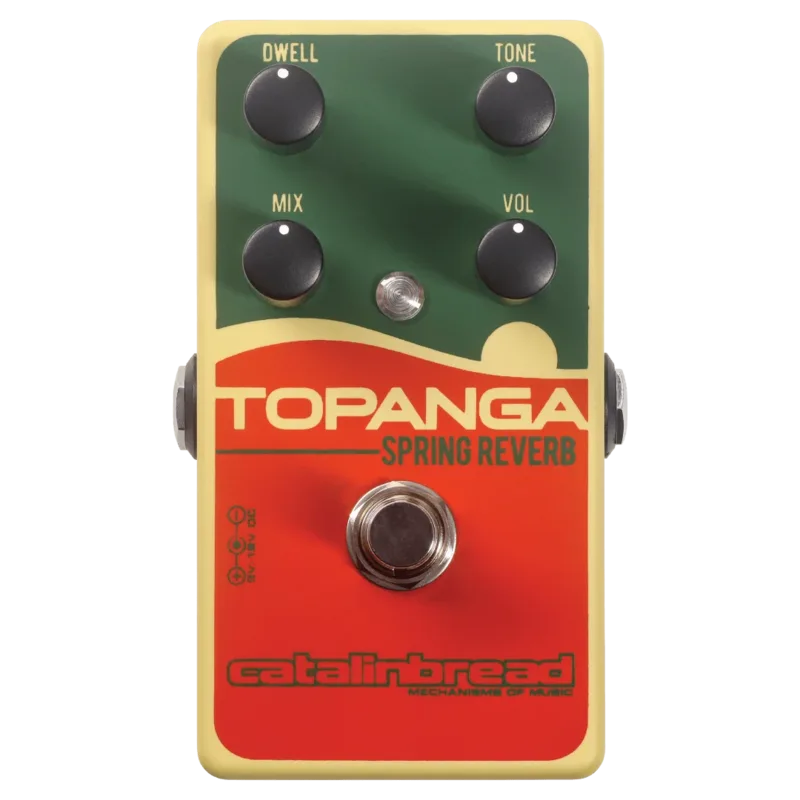
The Ghost is a mono, single-stomp pedal with five knobs (predelay, time, mix, volume and tone), one footswitch, no presets and no expression pedal support18. Guitar.com scored it 9/10, calling it "relatively expensive for a single-stomp reverb, however it is also markedly high fidelity when compared to some" options16. MusicRadar's Jonathan Horsley wrote of the Ghost: "It can do subtle. It can do dreamy. And quite possibly it might do for plate reverb what Catalinbread's superlative Topanga did for spring reverb"8.
Where it is made
Catalinbread is a Portland, Oregon company that hand-builds its pedals there5. The claim goes back a long way in press coverage: Vintage Guitar reported in 2011 that "All Catalinbread pedals are hand built in the U.S.," and Premier Guitar has described the Portland-based company's handbuilt stompboxes910.
Videos
ProGuitarShopDemos
Catalinbread Effects
Catalinbread Effects
Questions
What does the internal BUFF/TB slider switch do on the Talisman?
It selects whether the pedal's output stays buffered or goes true bypass when you disengage it. In BUFF mode you can bypass the pedal and keep playing over the reverb tail, which Catalinbread calls the infinite pad. In TB mode the signal path is fully bypassed, and where you find unity volume against your bypassed signal depends on whether you power the pedal at 9V or 18V.
What is the difference between the Talisman and the Talisman Ghost?
The Talisman Ghost, released in 2025, keeps the Talisman's core plate reverb function but simulates two EMT 140 plates in parallel and adds pitch modulation that thickens the reverb trails like a chorus. Guitar.com's reviewer described it as darker and weirder than the original. The original Talisman dates back to 2015 and has no modulation.
Does the Talisman need a power supply or can it run on a battery?
It needs a power supply. Catalinbread specifies any center-negative 9 to 18V DC supply designed for effect pedals, providing at least 100mA of current. There is no battery option in the maker's power specification.
Where is the Catalinbread Talisman made?
Catalinbread builds its pedals by hand in Portland, Oregon. The company's product pages state the Talisman is hand-made there, and press coverage back to 2011 has described all Catalinbread pedals as hand built in the US.
Sources (10)
- Catalinbread Talisman Ghost review: a killer reverb unit, Guitar.com, 2025-05-27
- ''Creating dreamy sounds that were once only possible in world-class recording studios…'' The new award-winning range of stompboxes from Universal Audio will blow your mind, GuitarPlayer (www.guitarplayer.com), 2023-11-17
- Six Songs You Can Use Ledges to Emulate, EarthQuaker Devices, 2023-09-05
- New Pedal: Catalinbread Talisman Ghost Plate Reverb, Delicious Audio, 2025-03-19
- Talisman, Catalinbread Effects
- Talisman (Blackout Series), Catalinbread Effects
- Talisman Ghost, Catalinbread Effects
- “Part of reimagining old technology is stepping outside the boundaries of possibility”: Catalinbread's new stompbox tribute to the EMT 140 runs two emulations of the classic plate reverb and runs them in “modulated tandem”, MusicRadar, 2025-03-20
- Catalinbread Revamps Drive Line, Vintage Guitar magazine, 2011-06-28
- Catalinbread CB30 Pedal Review, Premier Guitar, 2011-10-20