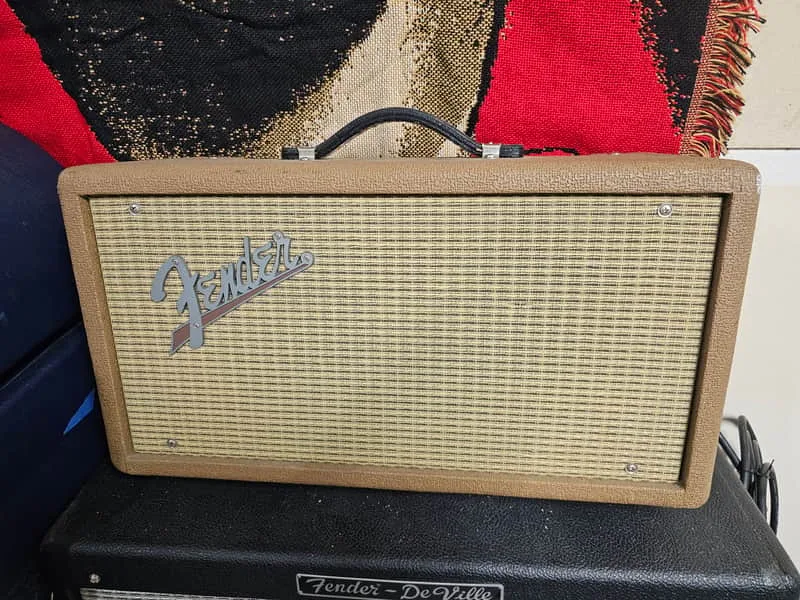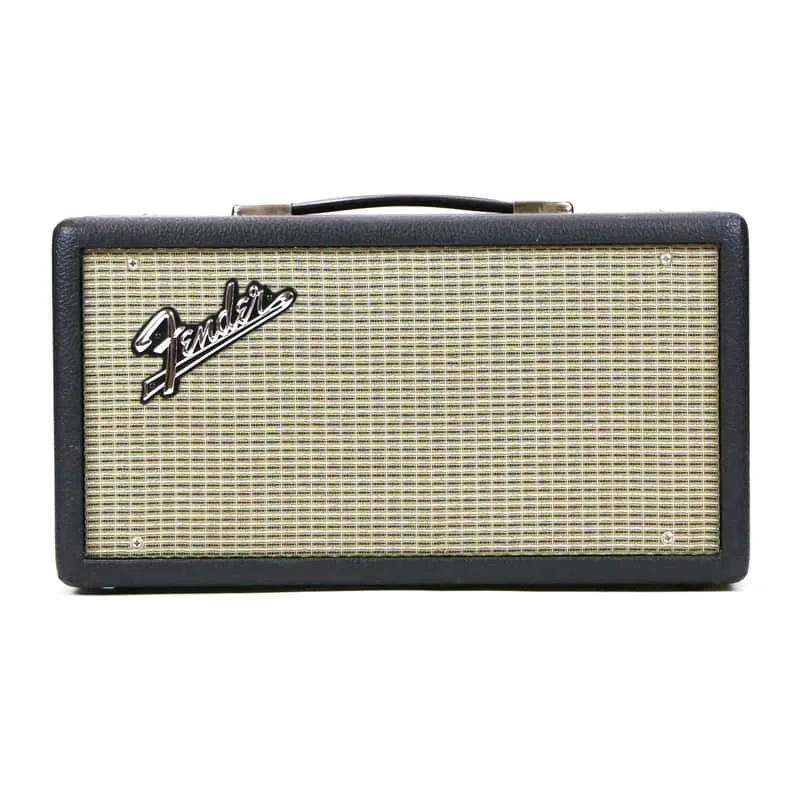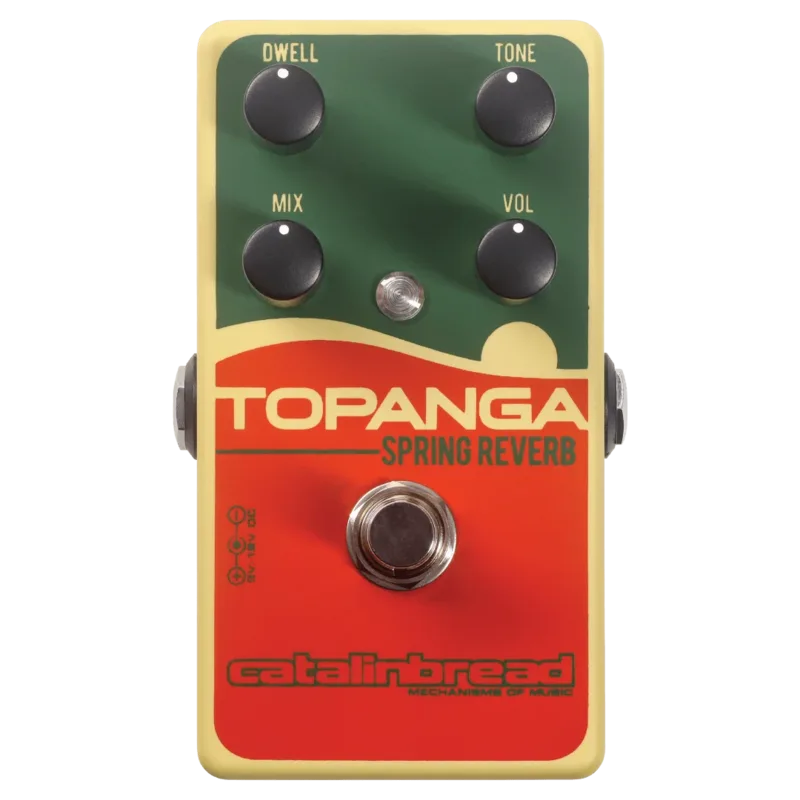


The Catalinbread Topanga is a spring reverb pedal from the American pedal maker Catalinbread, built as a digital emulation of the outboard Fender 6G15 tube reverb unit. Where most reverb pedals offer a generic spring setting, the Topanga copies the whole experience of the standalone box: the tube preamp, the way the springs are driven, and the controls that made the original famous on recordings from the early '60s onward12. Delicious Audio calls it "an accurate, digital emulation of the legendary outboard Fender 6G15 spring reverb" and considers it, in the view of many guitarists, one of the most authentic-sounding digital recreations of the vintage Fender spring reverb found in vintage Fender amps13.
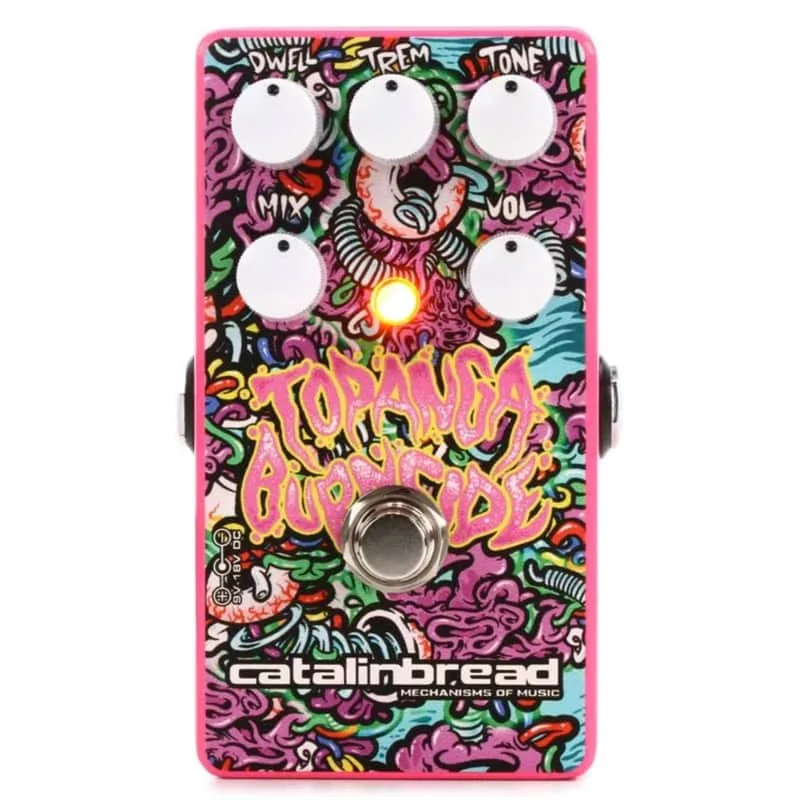
The pedal was announced in March 2014 alongside the Karma Suture, priced at $195 and available immediately24. It has since been reissued as the limited edition Topanga II and joined by the Topanga Burnside, a variant that adds tremolo to the circuit43.
A digital take on the Fender spring reverb unit
The Topanga exists because the Fender 6G15 was not an amp effect but a separate tube-driven unit sitting between guitar and amplifier, with its own controls and its own gain staging. Catalinbread modeled that whole signal path. The maker explains that the original Fender unit's Dwell control was basically the volume control for its tube preamp, and the Topanga's Dwell knob works the same way, controlling how hard the virtual spring circuit is driven1.
Delicious Audio's write-up describes the result as "a very distinctive reverb sound with a lot of attitude and complex non-linearities" that are hard to emulate, which is the argument for modeling the original circuit rather than approximating a spring sound1. gearnews's buying guide notes the pedal "responds naturally to your playing dynamics and integrates seamlessly into any setup"10.
The controls: Dwell, Mix, Tone and Volume
The four knobs map directly to the front panel of the Fender unit. Here is what each one does, per the maker's own descriptions9:
| Control | What it does |
|---|---|
| Dwell | Sets how hard the transformer and springs are driven, from a very mellow reverb to the over-the-top reverb that made the original famous |
| Tone | A low-pass filter for the reverb signal coming out of the spring tank; back it off for mellower background reverb |
| Mix | Full counter-clockwise is dry signal only, full clockwise is reverb signal only |
| Volume | Controls both the dry signal's volume and the reverb, and affects the output gain of the discrete preamp |
Two of these deserve a closer look from a player's point of view. Guitar.com's reviewer, Huw Price, noted that the mix control range is altered compared with the original unit to allow 100 per cent wet signal to pass, so the pedal can be used as a full wet effect rather than just a blend11. And because Volume governs a discrete preamp, cranking it produces a clean boost to drive your amp harder11. On the Topanga II, gearnews reports the Volume control has enough output to drive the amp into saturation7.
The hidden modulation mode
The Topanga also has an undocumented extra. Premier Guitar's reviewer Brook Hoover, writing in a 2026 spring reverb roundup, eventually found mentions of a hidden mod mode, which is activated by applying power with the Tone knob at minimum8. It is not in the control list and easy to miss if nobody tells you about it.
Power: 9 to 18V DC
The Topanga runs from 9 to 18 volts using a standard DC center-negative power supply for pedals, sold separately97. Running it at the higher end is a headroom choice: gearnews notes of the Topanga II that if you prefer more headroom, you are welcome to operate the pedal between 9 and 18 volts7.
The Topanga does not run on batteries9. It also draws more current than a small drive pedal: the spec sheet lists 64mA, while the maker's own page recommends a supply providing at least 100mA59. Plan your power supply accordingly, and be careful daisy-chaining it with pedals that share the same supply.
Bypass: true or buffered, your choice
An internal switch lets you select true bypass or a buffered mode that keeps the onboard preamp and volume control active even when the Topanga is switched off512. That buffered option matters if you use the Volume knob as a boost: in buffered mode the preamp stays in the path with the effect off. The original 2014 release was described in the launch press as true bypass137, and the Topanga II carries the same choice between true and buffered bypass forward7.
Versions: the Limited Edition Surf, the Topanga II and the Burnside
The Topanga line has grown into several distinct pedals:
- Topanga (original, 2014): the digital 6G15 emulation with Dwell, Tone, Mix and Volume, launched at $1951811.
- Topanga II (2019, limited edition): a reissue that retains the basic sound of the first version and the same knob layout, but adds a "+" toggle switch that changes the reverb core to one drawing from the deepest, gnarliest spring tank, extending the decay and reverb intensity47. In "+" mode gearnews found the decaying reverberation significantly denser and richer, with more interactive controls7. MusicRadar describes it as covering classic surf rock tones with a more extreme psych-surf reverb wipeout available via the switch4. Hand-built in Portland, Oregon, with a four-year warranty, it retailed for $219.994.
- Topanga Burnside: adds a Trem knob controlling the rate of a lush tremolo effect to the original Topanga circuit, aimed at surf rock and skate punk sounds where reverb and tremolo are used together39. It shipped in an all-metal chassis with a true-bypass footswitch, made in the USA3.
- Topanga Limited Edition Surf: a current maker listing of the pedal with the same control set and power requirements9.
The Burnside was a Sweetwater exclusive with a custom finish, shipping in a matching box along with a skateboard soft deck with turning wheels, as demonstrated in Sweetwater's video by Mitch Gallagher14.
"the tapanga burnside features a custom finish it's only available at sweetwater comes in a very cool matching box and it"
What reviewers said
Published coverage of the Topanga has been consistent about what it is and who it is for. Premier Guitar's 2026 spring reverb roundup lists it at a $195 street price and treats its hidden mod mode as a known secret among owners8. MusicRadar's reviewer Alex Lynham lists it at $209 in a 2026 comparison15. gearnews's 2025 best spring reverb pedals guide includes it, noting it is made in the USA and priced at 233 euros from Thomann10. Delicious Audio added the Burnside to its article about the best spring reverb pedals with tremolo3.
Videos
Catalinbread Effects
Catalinbread Effects
Catalinbread Effects
Questions
Is the Catalinbread Topanga true bypass?
It can be. An internal switch lets you choose true bypass or a buffered mode that keeps the onboard preamp and volume control active even when the pedal is switched off. The original 2014 release was described as true bypass, and the Topanga II offers the same choice between true and buffered bypass.
Does the Topanga run on batteries?
No. Catalinbread states plainly that Topanga does not run on batteries. It needs a 9 to 18V DC center-negative power supply, sold separately, and the maker recommends a supply providing at least 100mA.
How do you turn on the Topanga's hidden modulation mode?
Apply power with the Tone knob turned all the way down, to its minimum position. Premier Guitar's reviewer noted the mode is undocumented enough that he only found mentions of it after digging, so it is easy to miss if you do not know the trick.
Is the Catalinbread Topanga analog or digital?
The Topanga is a digital emulation of the outboard Fender 6G15 spring reverb unit. Delicious Audio describes it as an accurate digital recreation, and it is considered by many guitarists as one of the most authentic-sounding digital takes on the vintage Fender spring reverb.
Is the Topanga discontinued?
The original Topanga was superseded when Catalinbread reissued the pedal as the Topanga II in 2019, a limited edition that retains the basic sound of the first version. Related versions followed, including the Burnside, which adds tremolo to the circuit.
What is the difference between the Topanga and the Topanga II?
The Topanga II keeps the same Dwell, Tone, Mix and Volume layout and the basic sound of the original, but adds a toggle switch marked + that swaps the reverb core for one drawing from a deeper, gnarlier spring tank, extending the decay and modulating the reverb. It also lets you choose true or buffered bypass.
Sources (15)
- Catalinbread Topanga Spring Reverb, Delicious Audio, 2018-03-04
- Catalinbread announces two new pedals, MusicRadar, 2014-03-20
- Catalinbread Topanga Burnside Spring Reverb + Tremolo, Delicious Audio, 2021-11-02
- Catalinbread makes a splash with limited edition Topanga II spring reverb, MusicRadar, 2019-08-20
- Topanga - Catalinbread Effects, Catalinbread Effects
- Topanga Burnside by Catalinbread, RockBoard PedalPedia, 2026
- Catalinbread Topanga II: More verb, more surf, more spaghetti, gearnews.com, 2019-08-22
- “Spring-Reverb” Pedal Review Roundup, Premier Guitar, 2015-02-13
- Topanga (Limited Edition Surf), Catalinbread Effects
- Best Spring Reverb Pedals 2025: Sunny Sounds for Surf Rock and Skate Punk, gearnews.com, 2025-07-07
- Catalinbread Topanga & Belle Epoch review, Guitar.com, 2015-06-29
- Catalinbread debuts limited-edition version of Topanga Spring Reverb, Guitar.com, 2019-08-20
- Catalinbread Launches Karma Suture & Topanga Reverb, Premier Guitar, 2014-03-19
- Catalinbread Topanga Burnside Spring Reverb Pedal Demo, Sweetwater, 2021-09-09
- Crazy Tube Circuits White Whale Junior review, MusicRadar, 2026-08-21