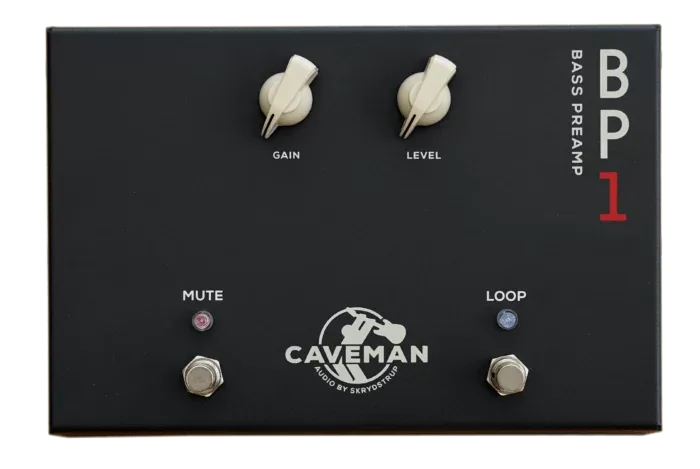



The Caveman Audio BP1 is a bass preamp with a switchable effects loop, built into a compact stompbox format. Caveman Audio describes it as a scaled-down version of the company's BAS1 Bass Channel, integrating the preamp and output stage of that rack system into a pedal you can put on a board1. The maker says it is designed to enhance the low mid-range frequencies of a bass, providing clarity and definition that helps the sound stand out in a mix1.
The switchable loop is the feature that sets it apart from a plain preamp pedal. Your overdrive, fuzz or filter pedals connect in the loop, which sits after the input buffer but before the preamp. When the loop is switched off, those pedals are taken out of the signal chain entirely, and Caveman Audio says the switching is instant and silent1.
What it does, and where it came from
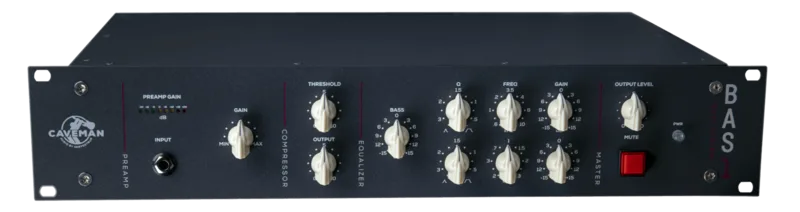
The BP1 grew out of the BAS1 Bass Channel, which Caveman Audio calls its flagship bass preamp channel21. The BP1 carries the preamp and output stage of that system into pedal form, with the addition of the switchable loop for isolating extra stompboxes1. Bass Musician Magazine has referred to the BP1 as an acclaimed bass preamp pedal with a high-quality, transformer-balanced DI output3.
The DI output is a central part of the design. It is a gold-plated Neutrik XLR output, transformer balanced to avoid hum and noise issues, and it eliminates the need for an external DI box or line driver. Caveman Audio notes it is line level, not mic level, and designed for loads of 2kΩ or more1. The amp output is a 1/4-inch TRS jack, also transformer balanced for the same reason when connecting an external amplifier1.
Ida Nielsen is named by the maker as playing live with the BP11.
The controls and jacks
The front panel is deliberately simple: a GAIN control, a LEVEL control, a ground lift, and the switchable loop1.
| Control or jack | What it does |
|---|---|
| GAIN | Controls how hard you drive the preamp. Higher gain pushes the preamp more and adds a touch of natural analog compression1 |
| LEVEL | Controls the overall output of the preamp1 |
| GROUND LIFT (GL) | Set for minimum noise1 |
| INPUT | 1/4-inch TS mono jack, the instrument input1 |
| LOOP SEND / RETURN | 1/4-inch TS mono jacks; the loop sits after the input buffer but before the preamp, and switching it off removes the pedals from the chain1 |
| TUNER OUT | 1/4-inch TS mono jack, always active, placed right after the input buffer for accurate tuning1 |
| AMP OUT | 1/4-inch TRS jack, transformer balanced1 |
| D.I. | Gold-plated Neutrik XLR, transformer balanced, line level1 |
The BP1W version adds a gold-plated Neutrik XLR input that is transformer balanced and designed to handle the output of a wireless system, so a wireless receiver can feed the preamp directly1.
Power and connections
The BP1 runs on mains power, not a pedalboard supply. It connects through an IEC inlet and operates on 100-240VAC 50/60Hz, which means the same unit works on both US and European mains without a step-down transformer1. That is worth knowing before you plan a board around it: there is no 9VDC input.
For a tuner, the BP1 offers two things. The TUNER OUT jack is always active and sits right after the input buffer, so the tuner sees a clean, buffered signal regardless of the loop state. The unit also provides a 9VDC output for powering a tuner only, accepting both 2.1mm and 2.5mm / 5.5mm plugs, with short-circuit protection and an LED indication1.
Impedance figures from the maker: 5MΩ input impedance, 50kΩ return impedance for the loop, 1kΩ or more output load on the send, and 2kΩ or more on the DI1.
The BP1 Compact
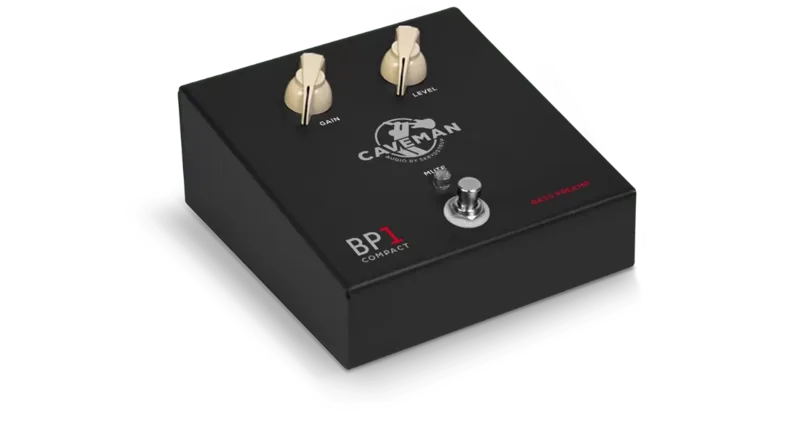
Caveman Audio also makes the BP1 Compact, described by the maker as a compact, low-voltage version of the BP14. It shares the same core design: a Hi-Z cable input, a loop send and return placed after the input buffer but before the preamp, a transformer-balanced amp output, and a gold-plated Neutrik XLR DI output that is transformer balanced, line level, and designed for loads of 2kΩ or higher. The tuner out is likewise always active and placed right after the input buffer4.
The big difference is power. The Compact runs on 12VDC, center negative, requiring a minimum of 400mA, and the maker is emphatic that it will not run on 9VDC or 18VDC. A 12VDC 1000mA supply is fine, since only 400mA is the minimum4. Caveman Audio says the Compact adds definition in the low-mid part of the sound, making a bass sit in the mix with definition and dynamics4. It carries the same 10-year warranty as the BP14.
The BP1 and the BP1 Compact have different power requirements. The BP1 needs mains power through an IEC inlet. The Compact needs 12VDC center negative at 400mA minimum, and will not work on the 9VDC or 18VDC supplies common on pedalboards14.
Related Caveman Audio gear
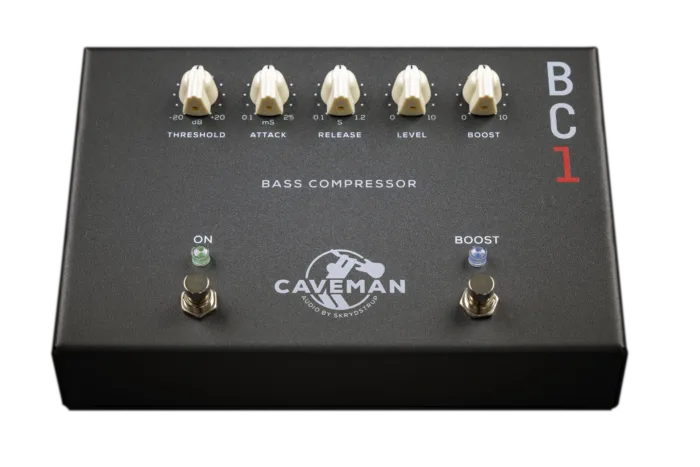
Caveman Audio's range also includes the BAS1 Bass System, the rack unit whose preamp and output stage the BP1 integrates in a compact stompbox format21, and the BC1 Bass Compressor1.
Videos
Caveman Audio
Caveman Audio
BassTheWorld.com
Sources (4)
- BP1 Bass Preamp, Caveman Audio, 2025-06-02
- BAS1 Bass Channel, Caveman Audio, 2026-04-13
- Gear News: Caveman Audio to Announce BC1 Bass ‘Master’ Compressor, Bass Musician Magazine, 2023-07-12
- BP1 Compact, Caveman Audio, 2025-06-05