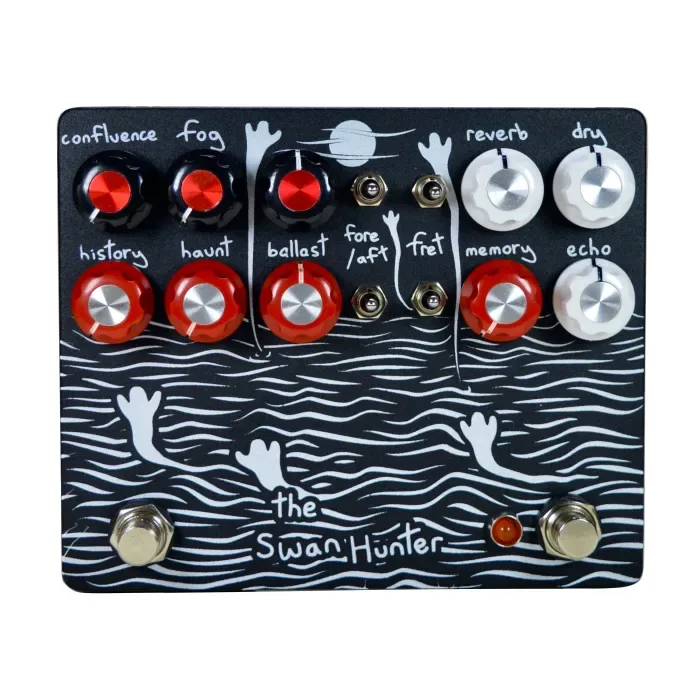


The Swan Hunter is a lo-fi echo and reverb pedal from Champion Leccy, the one-person operation of Woolly (Wool Robson), who designs and assembles every pedal by hand in a South Philadelphia rowhome1. It runs two wet signal paths at once: a tape-style echo built on a PT2399 delay chip, the same chip as the Woozy, and a reverb built on a Belton brick, the same as The Skitter2.
The maker describes its range as running from "warm analogue style slapback like repeats and clean belton brick reverb, to wibbly tape echo and oscillating reverb, through to super lofi fuzzy noise chaos"3. Delicious Audio's lo-fi pedals buying guide groups it with pedals built around analog tape artifacts4.
What it does to your sound
The pedal is laid out in two rows. The top row of knobs and switches controls the reverb, and the bottom row controls the echo1. Dry, reverb and echo each have their own volume controls, so you can set the balance of the two wet paths against your clean signal independently3.
Both the echo and the reverb have a ducking and expansion control that reacts to playing dynamics, which the maker says creates unique gating effects: play harder and the effect opens up, stop playing and it closes down3. The reverb side also has a feedback control, called fog, that lengthens the reverb tails, and around 3 o'clock on that knob the maker says it enters oscillation territory3.
On the echo side, the memory knob sets delay time with what the maker calls wibbly, tape-like repeats, and it can be combined with the history control to add character to otherwise steady repeats3.
Parallel or series, and the fx loop
The confluence control in the reverb row blends between putting the reverb in parallel with the echo or in series with it, and when in series the reverb sits after the echo3. In practice that is the difference between hearing two distinct wet sounds side by side and hearing your repeats washed in reverb.
The pedal also has an fx loop send and return wired into the feedback path. With nothing plugged in, the feedback loop is connected internally. The send is a shunt jack, so plugging something into it breaks the feedback loop, which means the haunt control stops working and only a single echo is heard. Plugging the pedal's own output into the fx loop return completes the feedback loop again, now controlled by the haunt knob3. That jack arrangement lets you put another pedal inside the feedback path.
The second footswitch
There are two footswitches. The left one is labeled brake/break and serves two functions2. RockBoard's PedalPedia describes it as providing "silent oscillation breaking and lofi noisy performance traits"5, so it can be used to stop a runaway oscillation quietly, or to bring in lo-fi noise as a performance effect.
Not a modulation pedal
Woolly is direct about what the pedal is not: "It isn't a modulation pedal, there's no LFO"2. Any wobble in the repeats comes from the PT2399 chip's tape-style behavior and the feedback controls rather than from a modulation source. In Champion Leccy's own function comparison table across its range, the Swan Hunter's listed functions include the Belton brick reverb, echo, reverb tremolo, tape sounds, oscillation, resonant echo, resonant reverb and tap tempo, with two wet signal paths2.
Designer, launch, and limited finish
The Swan Hunter was designed by Woolly, and all Champion Leccy pedals are designed and assembled by hand in a South Philly rowhome12. He introduced it on the Champion Leccy site on July 31, 2021, writing that it "does have some gritty tape echo sounds, haunting reverbs, gated echo and lofi noise to mess around with"2. The launch was set for Friday the 13th of August at noon EST, with the regular screen printed version at $275 retail2. A special finish was available for the launch, costing a little bit more2. The current listed price is $295.00 USD as of October 20261.
The finishes listed on the current product page are black, evening blue, purple dusk and purple dusk (blem)1.
"There may well be a special finish available for the launch. It will cost a little bit more, if it exists, which it does"
Power and build
The Swan Hunter takes a standard BOSS style +9V DC center negative power supply, which is not supplied with the pedal, and draws an average of 125mA1. RockBoard's PedalPedia lists the circuit as analog and notes it is housed in a durable stompbox enclosure5.
The 125mA average draw is higher than many analog pedals, and the pedal uses a center negative supply. Plan a dedicated or well-isolated 9V output rather than assuming it will share a supply with low-current pedals.
Videos
collector//emitter
Emily Hopkins
ambienttrash
Questions
Is the Champion Leccy Swan Hunter a modulation pedal?
No. Woolly of Champion Leccy states plainly that it is not a modulation pedal and has no LFO. Its wobble and character come from the tape-style behavior of the PT2399 delay chip, the feedback controls and the ducking circuits, not from a modulation source. It is a lo-fi echo and reverb pedal.
What delay chip does the Swan Hunter use?
It uses the PT2399, the same delay chip as Champion Leccy's Woozy. The repeats are described by the maker as wibbly, tape-like repeats, and the memory knob sets delay time while the history control adds character to otherwise steady repeats. The reverb side uses a Belton brick, the same as the Skitter.
Who designed the Swan Hunter?
The Swan Hunter was designed by Woolly, also named as Wool Robson, who designs and hand-assembles every Champion Leccy pedal in a South Philadelphia rowhome. He introduced the pedal on the Champion Leccy site in July 2021 ahead of its launch that August.
What does the second footswitch on the Swan Hunter do?
The left footswitch is labeled brake/break and has two functions. RockBoard's PedalPedia describes it as providing silent oscillation breaking and lo-fi noisy performance traits, so it can be used to stop the reverb or echo from self-oscillating, or to inject noise as an effect while playing.
How does the Swan Hunter blend reverb and echo in parallel or series?
The confluence control in the reverb row blends between putting the reverb in parallel with the echo or in series after it. Dry, reverb and echo each have their own volume controls, so the two wet paths can be balanced independently, and both sides have a ducking control that reacts to playing dynamics.
What finishes did the Swan Hunter come in?
The current product page lists black, evening blue, purple dusk and purple dusk (blem) finishes. At the 2021 launch a special finish was offered at a slightly higher price than the regular screen printed version, which sold for $275 retail.
Sources (5)
- The Swan Hunter, Champion Leccy, 2021-08-08
- The Swan Hunter, Champion Leccy, 2021-08-01
- The Swan Hunter, Champion Leccy, 2021-09-14
- The Best LoFi Guitar Pedals In 2024: Analog & Digital Artifact Simulators, Delicious Audio, 2024-07-22
- The Swan Hunter by Champion Leccy, RockBoard PedalPedia, 2026