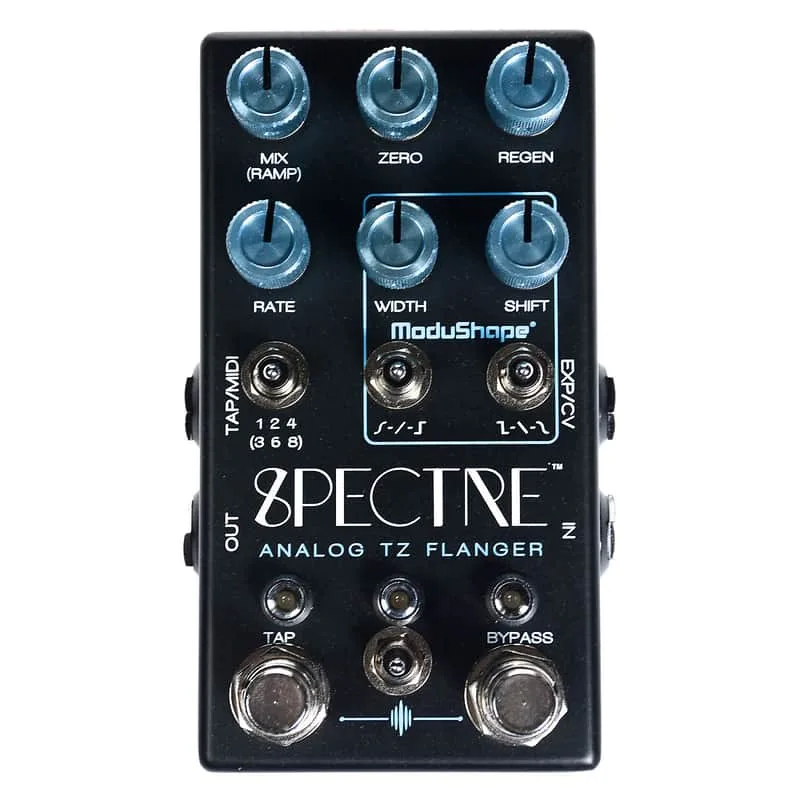


The Chase Bliss Audio Spectre Analog TZ Flanger is an analog through-zero flanger in a compact, standard-sized stompbox, built hand-wired with old-school through-hole components and new-production analog BBD chips, each with its own calibration trimpot1. Through-zero flanging is the effect you get when a delayed copy of your signal catches up with and passes the dry signal, then crosses back again, which produces the dramatic "jet" sweep that tape and rack flangers were built around. It carries a $349 street price1.
Inside, the Spectre follows Chase Bliss Audio's signature approach of digitally controlling analog circuits1. It is a true through-zero analog flanger built on two analog delay lines running in parallel, using new-production analog BBD chips with calibration trimpots, hand-wired with through-hole components1.
What through-zero flanging does
A conventional flanger mixes a short, modulated delay with the dry signal, but the delay never reaches zero, so the two signals never actually meet. The Spectre's two delay lines let the wet copy pass through the zero point, which is what gives through-zero flanging its distinctive character. Premier Guitar's reviewer described the effect quality as "thick, immersive, and three-dimensional"1.
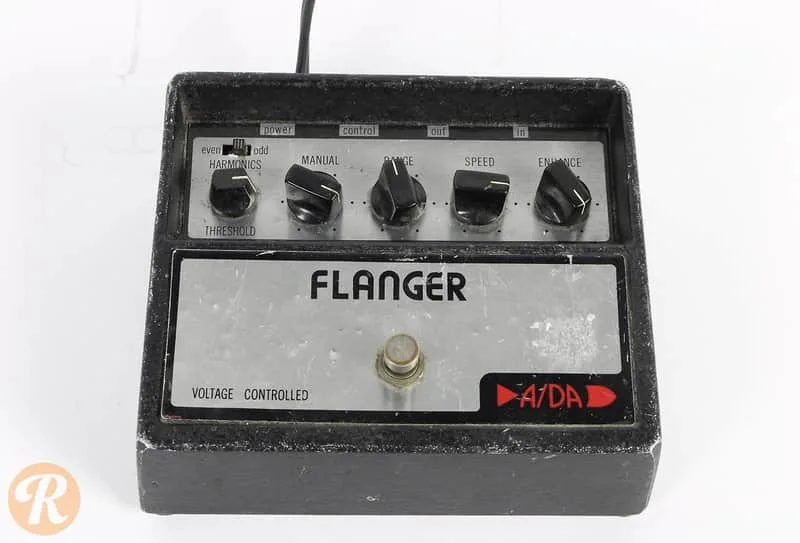
The zero control is central to this. It works like the manual knob on the classic A/DA Flanger: it sets the delay time, generating flange tones at low settings and more chorus-like colors at higher settings1.
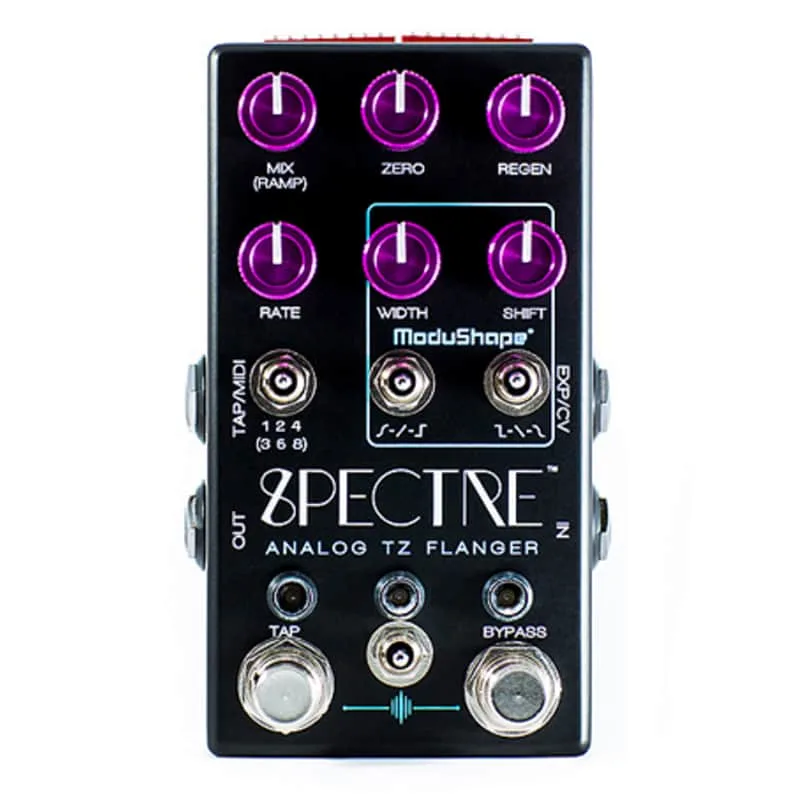
The controls: six knobs, four toggles and 16 DIP switches
The top panel carries six knobs, four toggles, four jacks, and 16 tiny DIP switches1. The DIP switches are the heart of how the pedal is configured: they determine what each control knob does, whether that is rate, width, feedback, or manual settings, or all of the above, plus sweep range, sweep polarity, and more1. Pedal of the Day noted that the DIP switches also work with the Exp/CV jack and can switch the tap division to 3-6-8 for rate or ramping parameters2.
| Control | What it does |
|---|---|
| Zero | Sets the delay time; flange tones at low settings, chorus-like colors at higher settings1 |
| Shift | Determines whether sweeps are symmetrical, or whether positive sweeps are longer and negative sweeps shorter (or vice versa)1 |
| Mix | Doubles as a multipurpose control pot1 |
| Two waveform toggles | Select sine, triangle, or square wave for each half of the modulation; mix and match between them2 |
| Preset toggle | Between the footswitches; left and right recall two presets, middle shows current control settings in real time2 |
You can independently select sine wave, triangle wave, or square wave modulation for each delay line1, and Pedal of the Day found that mixing and matching waveforms between the two halves of the modulation "can create some really unique sounds"2.
Tap tempo, MIDI and expression
The Spectre has two footswitches: bypass, and a second footswitch for tap tempo at the bottom of the pedal2. There is tap tempo with selectable rhythmic subdivisions, plus a jack for an external tap-tempo footswitch, which is not included1.
The tap tempo jack also serves as a MIDI control port, though you need a MIDI-to-1/4" adapter, such as the $49 Empress Midibox1. An expression pedal (also not included) can be connected to sweep settings with your foot1.
Presets
You can save three presets, though you must bend over and flick a small toggle to recall them1. Pedal of the Day describes the same toggle in more detail: the switch between the two footswitches gives access to two presets, left or right, with the middle position showing all the current controls manipulated in real time2.
What reviewers said
Premier Guitar's 2021 review was blunt about one thing: the noise. The reviewer wrote1:
"This pedal is really, really noisy."
Premier Guitar1
The analog hiss was measured against other pedals in the reviewer's experience as at least double the noise of most analog delays, and a wetter mix means more noise1. That said, the same review found the effect quality itself "thick, immersive, and three-dimensional"1, so the trade-off is between the character of true analog through-zero flanging and the hiss that comes with it.
The Spectre's analog design sets it apart from most modern flangers: it uses new-production analog BBD chips, each calibrated with its own trimpot, in a hand-wired through-hole build1.
Videos
Premier Guitar
chase bliss
chase bliss
Questions
Does the Chase Bliss Spectre take a battery?
No. The Spectre has no battery compartment and runs on a standard 9V power supply, so you need a mains-powered pedal supply on your board. That is normal for a pedal of this type, given how much circuitry is packed inside the enclosure.
Is the Chase Bliss Spectre stereo?
No. The Spectre is monophonic, with just one input and one output jack. If you need a stereo flanger, you have to look elsewhere in the flanger category, since this pedal is built around two internal analog delay lines rather than a stereo output path.
Where is the zero point on the Spectre's Zero knob?
The zero control works like the manual knob on the classic A/DA Flanger: it sets the delay time. At low settings it generates flange tones, and at higher settings it moves toward more chorus-like colors as the two delay lines sit farther from the through-zero crossing point.
Is the Chase Bliss Spectre noisy?
Yes. Premier Guitar's reviewer found it very noisy, at least double the noise of most analog delays, because the analog hiss scales with the wet mix. Whether that matters depends on how wet you run it and how much gain follows it in your signal chain.
How do presets work on the Spectre?
You can save three presets, recalled by a small toggle switch between the two footswitches. The left and right positions recall the two saved presets, and the middle position shows all the current control settings in real time, so you can compare a stored sound against what the knobs say now.
Sources (2)
- Chase Bliss Audio Spectre Analog TZ Flanger Review, Premier Guitar, 2016-07-11
- Chase Bliss Audio Spectre Analog TZ Flanger, Pedal of the Day, 2016-01-30