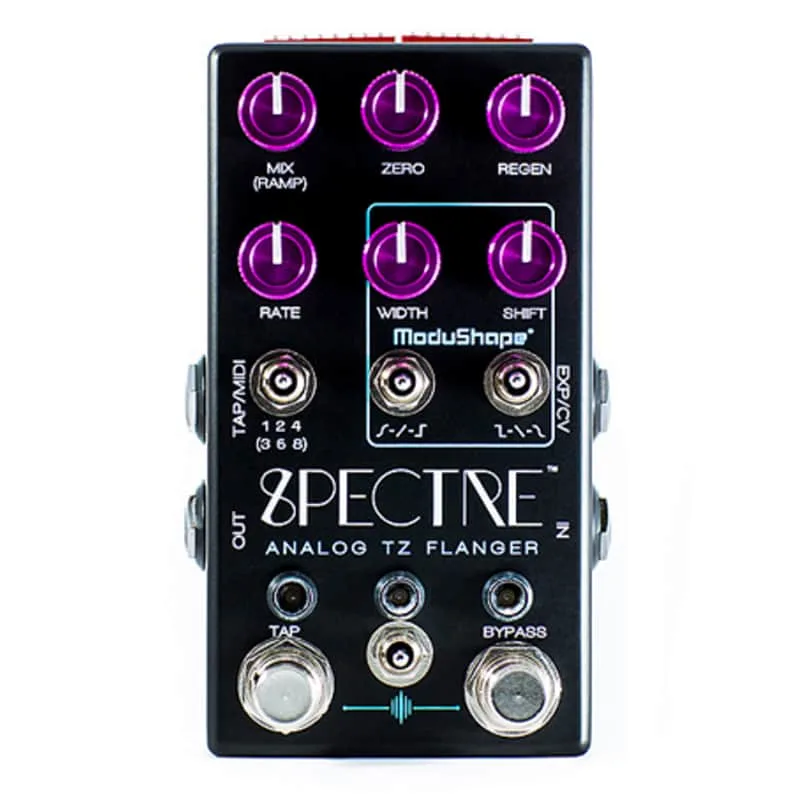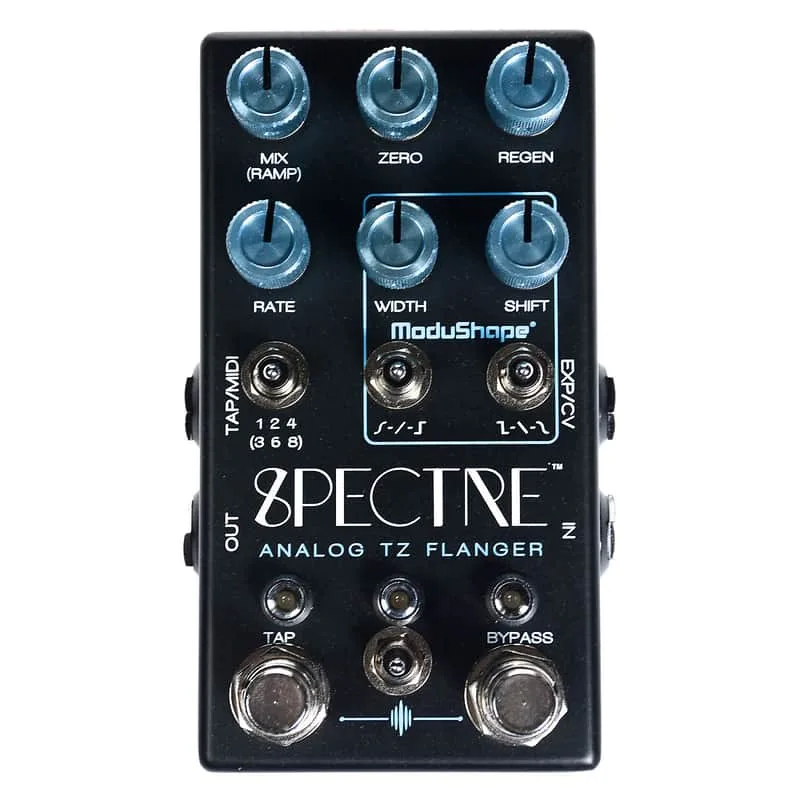


The Chase Bliss Spectre is an analog through-zero flanger pedal from Chase Bliss Audio, announced in November 2015 with a suggested retail price of $3491. It carries a $349 suggested retail price and was first available exclusively at Chicago Music Exchange on Black Friday, with a worldwide release at the 2016 Winter NAMM show in Anaheim1. What sets it apart from most flangers is its through-zero design: by using two delay lines instead of just one, the Spectre can cross over the elusive "zero point"2.
The other half of the story is how it is controlled. Every knob and switch is connected to what RockBoard's PedalPedia calls a little digital brain, while the guitar signal stays 100% analog the entire time2. That combination, analog circuitry with digital control, is Chase Bliss Audio's signature approach3.
What through-zero flanging means
A conventional flanger mixes the dry signal with a single, modulated delay line. The Spectre instead uses two delay lines, which allows the effect to cross the zero point, the moment where the modulated delay passes through the dry signal's timing2. The pedal also offers positive or negative polarity flanging1. For players, that means the sweep can pass through the point where the two signals align rather than just approaching it, which is what gives through-zero flanging its distinctive character. RockBoard's PedalPedia says the Spectre can be dialed in to create any amount of subtle and wacky flange tones, plus an impressive array of chorus and vibrato tones2.
Controls and the DIP switch system
The face of the pedal holds six knobs, four toggles, four jacks, and 16 tiny DIP switches on the top panel3. The six knobs control Mix, Zero (manual flange), Regen, Rate, Width and Shift1.
| Control | What it does |
|---|---|
| Mix | Blends dry and effected signal1 |
| Zero | Manual flange position1 |
| Regen | Feedback, up to self-oscillation1 |
| Rate | Speed of the modulation1 |
| Width | Depth of the sweep1 |
| Shift | Shifts the modulation1 |
The 16 DIP switches determine each control knob's role. You can choose whether a knob controls the rate, width, feedback, or manual settings, or all of the above, and you can also specify sweep range, sweep polarity, and more3. Two of the toggles select from two sets of waveforms, one for the first half of the wave modulation and one for the second; you can choose Sine, Triangle or Square waveforms and mix and match them for unusual sounds5. Another toggle, labeled 1-2-4 (3-6-8), controls the tap division for the tap tempo feature, with the 3-6-8 configuration available via a DIP switch, for either the Rate or Ramping parameters depending on where that switch is set5.
Presets, MIDI, tap tempo and ramping
Because the control side is digital, the Spectre offers features RockBoard's PedalPedia says have never been heard or offered in analog stompboxes2:
- Analog presets that can be recalled on the fly via toggle switch or with a MIDI controller1
- MIDI capability, with a wide range of MIDI control through the use of a Chase Bliss Audio Modified Empress Midibox5
- Ramping or expression control on any parameter1
- Tap tempo with selectable rhythmic subdivisions, plus a jack for an external tap-tempo footswitch, which is not included3
The Tap/MIDI jack handles both input and output tap tempo capabilities as well as MIDI control5. Ramping means a parameter can sweep automatically between two settings over time, or follow an expression pedal, on any parameter you choose1.
Self-oscillation and whale tones
Push the Regen control far enough and the Spectre will feed back on itself. Chase Bliss Audio says the pedal has the ability to self-oscillate and make "whale tones"1. Between that, the waveform mixing and the through-zero sweep, the pedal covers ground from conventional flange and chorus through to sounds no single-knob flanger will reach.
Power
The Spectre runs on 9V DC, center negative, drawing 50mA2. It uses a standard 9V power supply and standard DC input13.
The 50mA draw and center-negative 9V DC requirement mean the Spectre should be run from a suitable isolated or pedalboard power supply rather than a battery.
Videos
chase bliss
chase bliss
chase bliss
Questions
What does through-zero flanging mean on the Chase Bliss Spectre?
A normal flanger uses one delay line, so the modulated signal only approaches the dry signal's timing. The Spectre uses two delay lines, which lets the modulated signal cross the zero point and pass through the dry signal's timing, producing the jet-like sweep that gives through-zero flanging its name. The pedal also offers positive or negative polarity flanging.
Is the Chase Bliss Spectre analog or digital?
Both, in a way. The guitar signal stays in an all-analog signal path the entire time, while every knob and switch is connected to a digital control system. That digital brain is what makes presets, MIDI, tap tempo and ramping possible on an analog flanger.
Does the Chase Bliss Spectre have MIDI?
Yes. The Spectre has MIDI capability through its Tap/MIDI jack, with a wide range of MIDI control available through the use of a Chase Bliss Audio Modified Empress Midibox. Analog presets can also be recalled on the fly via a toggle switch or with a MIDI controller.
Can the Chase Bliss Spectre self-oscillate?
Yes. Chase Bliss Audio says the Spectre has the ability to self-oscillate and make what the company calls whale tones. Pushing the Regen control up feeds the effect back on itself until it takes off on its own.
Is the Chase Bliss Spectre true bypass?
Yes. The Spectre uses true bypass via quiet relay switching, so when the pedal is off the guitar signal passes through without going through the effect circuitry.
Does the Chase Bliss Spectre have tap tempo?
Yes. There is a Tap Tempo stomp switch with selectable rhythmic subdivisions, plus a jack to connect an external tap-tempo footswitch, which is not included. A toggle labeled 1-2-4 (3-6-8) controls the tap division.
Sources (5)
- Chase Bliss Launches Spectre Analog Flanger Pedal, Premier Guitar, 2015-11-30
- Spectre by Chase Bliss, RockBoard (PedalPedia), 2026
- Chase Bliss Audio Spectre Analog TZ Flanger Review, Premier Guitar, 2016-07-11
- Chase Bliss Audio Spectre Analog Through-Zero Flanger, Pedal of the Day, 2016-01-23
- Chase Bliss Audio Spectre Analog TZ Flanger, Pedal of the Day, 2016-01-30