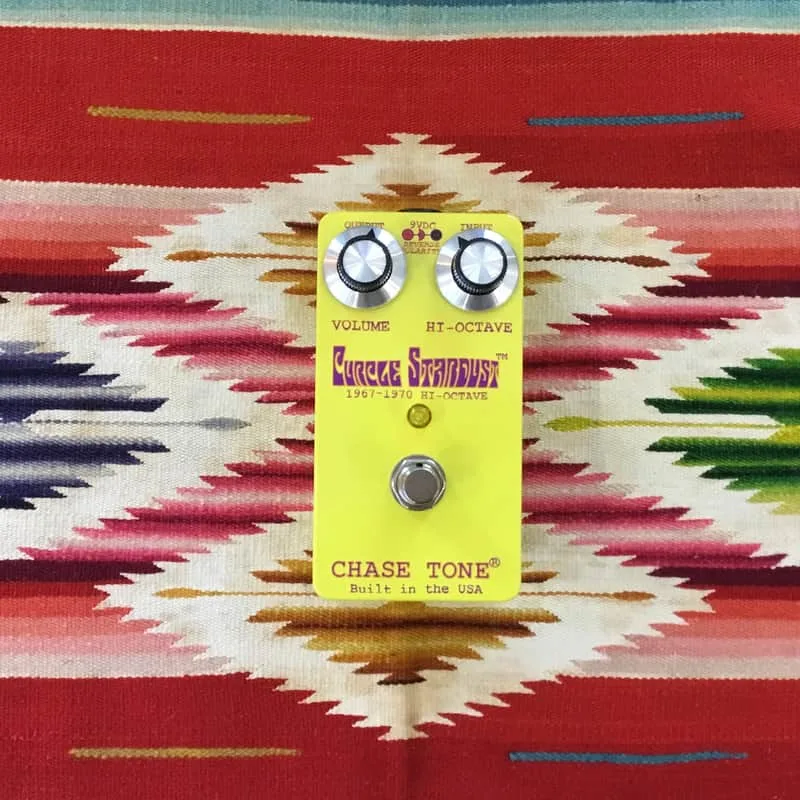


The Chase Tone Purple Stardust Hi-Octave-Fuzz is a pedal that produces a late 1960s style hi-octave fuzz, the octave-up fuzz effect associated with a particular run of Hendrix recordings. Chase Tone describes it as "a fluid & harmonically complex late 1960's style Hi-Octave Fuzz Effect... with increased note tracking, warmth and sustain that cuts through a band mix with authority, while remaining smooth and articulate with touch sensitivity and dynamics responding to the player's unique touch."1 It belongs to the broader family of octave and pitch pedals and fuzz pedals.
Both versions are now out of production. The original Flying Wedge enclosure version was a Limited Production Item in the 2010s and is listed as Sold Out, and the newer Purple Stardust Hi-Octave Reissue is listed as Sold Out and No Longer Made.12
Where it came from
Chase Tone positions the Purple Stardust as reminiscent of the iconic 1960s hi-octave fuzz heard on the studio recordings "Purple Haze (guitar solo)," "Fire," "One Rainy Wish," and "Little Miss Lover," and on the live Band of Gypsies era "Who Knows."1 The circuit uses what the maker calls harmonic doubling mirror circuitry, and because of it, Chase Tone notes that a player's dynamic touch and note choice play a crucial role in the sound.1
The original was built with Beta Matched new BC549B transistors alongside NOS 1970s Motorola 2N3906 transistors.1 The Reissue's 1967/1968 style hi-octave side instead uses NPN/PNP silicon transistors with matched germanium diodes.2
The controls: Output and Intensity
The original Flying Wedge version keeps things simple with two controls:
| Control | What it does |
|---|---|
| Intensity | Special circuit tuning allows a full range of fluid, over-driven hi-octave fuzz tones. Lower counter-clockwise settings allow cleaner, warmer octave sounds; higher clockwise settings gradually increase saturation and treble EQ.1 |
| Output | Maximizing this control increases output, sustain, punch, clarity and treble EQ. Chase Tone says the sweet spot is set in comparison to the Intensity control, and that an optimal Output setting is usually between 3/4 and maximum.1 |
The Reissue replaces this pair with a single Hi-Octave knob that, in Chase Tone's words, "fluidly and seamlessly blends from 1967/1968's thinner sharper cleaner yet warmer germanium Fire and Purple Haze like Hi-Octave to 1969/1970's increased overdrive, even-order harmonic saturation and more authoritative EQ punch of the Band of Gypsies era."2 Chase Tone calls the 11 o'clock position "the Goldilocks setting hybrid capturing 1967 to 1970."2
Power and connections
The power arrangement is the thing a buyer most needs to know before plugging in. The original uses a positive ground, non-standard DC jack, with rear facing American made input and output jacks.1 The Reissue carries the same convention: Chase Tone's power note reads "9VDC Reverse polarity positive center or battery."2
Positive ground (positive tip) pedals will not run from a standard center-negative daisy chain supply shared with most modern pedals. Use an isolated positive-tip output or, on the Reissue, a battery.12
The Reissue is described by Chase Tone as an extremely low noise design that never oscillates or sounds overly constricted, gain-y or harsh, and always maintains an open, fluid, singing hi-octave tone. Its circuit tuning is said to allow improved hi-octave note tracking across the fretboard via the neck pickup, with a pronounced hi-octave effect that cuts in a band mix.2
Build
Chase Tone describes the original's construction in some detail: an enclosure-mounted (with stop-lock-tab), PCB-mount potentiometer design, with the pots soldered onto a thick fiberglass circuit board with plated-through-holes. The finish is a high quality purple translucent Star Dust powder coat. The trapezoidal enclosure is described as pedalboard and gig bag friendly.1
Availability
The original Purple Stardust Hi-Octave-Fuzz listed at $189.99 USD and shipped free to United States customers via USPS Priority Mail with insurance and delivery confirmation; international shipping was USPS First Class Mail with tracking, at roughly 1 to 3 weeks from shipment.1 The Reissue page offered a 5% purchase price discount for United States Veterans with free USA shipping, and a 30 Day Satisfaction Guarantee for USA buyers.2 Both pages now show the pedals as sold out, so the practical route to one is the secondhand market.
Videos
Kevin Bryant
John Price
Tone Wise Productions
Questions
Is the Chase Tone Purple Stardust still made?
No. Chase Tone describes the original Flying Wedge enclosure Purple Stardust Hi-Octave as a Limited Production Item from the 2010s, and its product page lists it as Sold Out. The newer Purple Stardust Hi-Octave Reissue is likewise listed as Sold Out and No Longer Made on the Chase Tone site. Both versions are therefore discontinued, and any units that turn up would be secondhand.
Does the Chase Tone Purple Stardust use a positive ground power supply?
Yes. The original Purple Stardust Hi-Octave-Fuzz uses a positive ground, non-standard DC jack, so it will not share a standard center-negative daisy chain with most modern pedals. The Reissue follows the same convention: Chase Tone specifies 9VDC reverse polarity, positive center, or battery. Players need an isolated positive-tip supply or a battery.
Can the Purple Stardust run on a battery?
The Reissue can. Chase Tone's power note for the Purple Stardust Hi-Octave Reissue reads 9VDC reverse polarity positive center or battery, so a battery is an option alongside a positive-tip adapter. The original Flying Wedge version's page specifies the positive ground non-standard DC jack but does not list battery operation.
What transistors are inside the Purple Stardust?
The original Purple Stardust Hi-Octave-Fuzz uses Beta Matched new BC549B transistors together with NOS 1970s Motorola 2N3906 transistors, according to Chase Tone. The Reissue's 1967/1968 style hi-octave side uses NPN/PNP silicon transistors with matched germanium diodes.
Which classic hi-octave fuzz sounds is it modeled on?
Chase Tone describes the Purple Stardust as reminiscent of the iconic 1960s hi-octave fuzz heard on the studio recordings Purple Haze (guitar solo), Fire, One Rainy Wish and Little Miss Lover, and on the live Band of Gypsies era track Who Knows. The Reissue's Hi-Octave knob blends between the 1967/1968 germanium character and the 1969/1970 Band of Gypsies era sound.
What does the Hi-Octave knob do on the reissue?
On the Reissue, the Hi-Octave knob fluidly and seamlessly blends from the thinner, sharper, cleaner yet warmer germanium character Chase Tone associates with 1967/1968, toward the increased overdrive, even-order harmonic saturation and more authoritative EQ punch of the 1969/1970 Band of Gypsies era. Chase Tone calls the 11 o'clock position the Goldilocks setting, a hybrid capturing 1967 to 1970.
Sources (2)
- Chase Tone™ Purple Stardust™ Hi-Octave-Fuzz, Chase Tone
- CHASE TONE® PURPLE STARDUST™ HI-OCTAVE REISSUE, Chase Tone