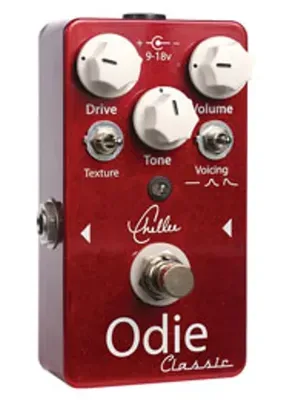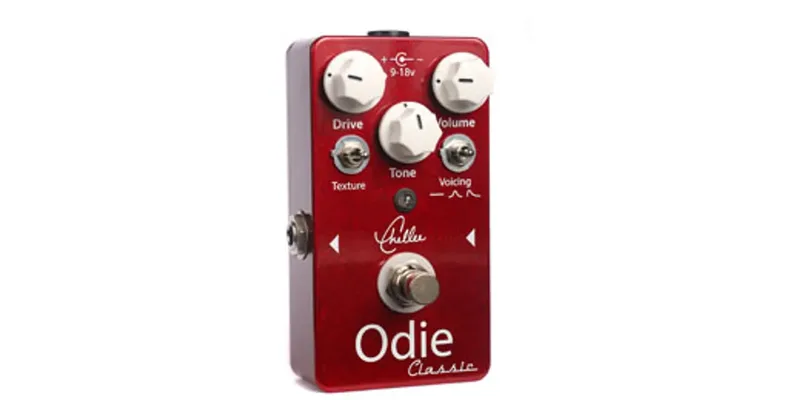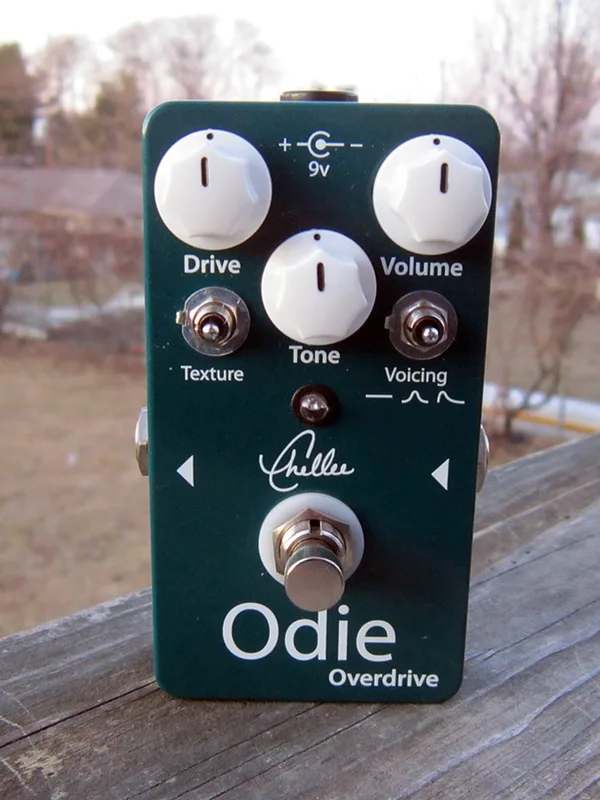


The Chellee Guitars Odie is an overdrive pedal that began as a Tube Screamer-style circuit but, as Guitar World's reviewer Billy Voight put it, "widened the scope on each end to give you more options"1. Where a stock Tube Screamer gives you three knobs and one fixed mid-forward voice, the Odie adds two three-way switches, Texture and Voicing, that change the clipping character and the EQ shape. Each pedal is handbuilt in the U.S.1, and the original Odie carried a street price of $100 as of March 20151.
The Odie line later grew a sibling, the Odie Classic, a modified version of the original announced in 2015. Both are covered below23.
A Tube Screamer with more range
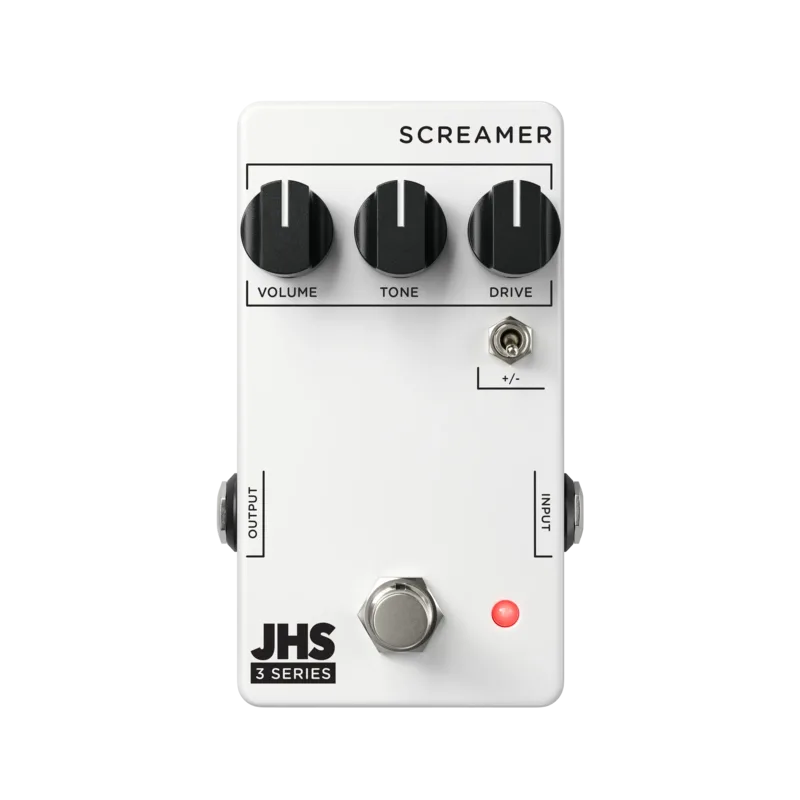
The Tube Screamer family is one of the most copied overdrive circuits in existence. JHS Pedals, which builds its own Tube Screamer variant, traces the lineage through models including the OD-1 (1977), TS-808 (1979), TS-9 (1982), TS-10 (1986) and TS-7 (1999), plus later modified versions like the Keeley Mod Plus (2002) and JHS Strong Mod (2008)5. The Odie sits in that tradition: Premier Guitar's reviewer of the Odie Classic wrote that its sound "suggests that the Odie leaps from the same launch pad as the TS family"4.
What separates the Odie from a stock Tube Screamer is range. Guitar World's review walked through four sound clips showing how far the two switches stretch the pedal1:
- Clip 1 (Strat): Texture on diode clipping, Voicing on mid bump, Drive low, Tone around 12 o'clock, Volume boosted to about 3 o'clock, for "that classic Tube Screamer tone"1.
- Clip 2 (Les Paul): Texture on Mosfet clipping, Voicing on low end boost, for what the reviewer called "a pretty mean modern rhythm tone"1.
- Clip 3 (Strat): Texture on Clean Boost, Voicing on Flat. "While it's not 100 percent clean, it really fattens up single-coil pickups"1.
- Clip 4 (Strat with a bridge humbucker): Texture on diode clipping, Voicing on mid bump, Tone and Drive at about 2 o'clock, for "a more classic Marshall-type overdrive with plenty of finger noise"1.
That spread, from a mid-bumped boost to a low-end-boosted modern rhythm tone, is the "widened scope" the reviewer described relative to a Tube Screamer1.
The controls
The Odie keeps the familiar three knobs and adds two switches on top of them1:
| Control | What it does |
|---|---|
| Drive | Sets the amount of overdrive1 |
| Level | Sets the output volume1 |
| Tone | Sets the treble balance1 |
| Texture (3-way) | Selects asymmetrical diode clipping, clean boost, or Mosfet clipping1 |
| Voicing (3-way) | Selects the EQ voicing, including mid bump, low end boost, and flat settings1 |
Guitar World's reviewer noted that "Drive, Level and Tone are all knobs I'm sure you're familiar with," so the learning curve is really in the two switches1. Texture is the clipping selector: diode clipping for the traditional compressed overdrive feel, Mosfet clipping for a harder modern edge, and clean boost for pushing the amp itself. Voicing reshapes the EQ, which is where the pedal moves away from the Tube Screamer's fixed mid hump.
The Odie Overdrive and the Odie Classic
In 2015 Chellee announced the Odie Classic, described in the announcement as "a modified version of the well received Odie Overdrive"2. The Classic keeps the standard three-knob drive, tone and level controls and adds two toggles of its own3:
- Three drive texture settings: silicon diode clipping, LED clipping, and clean boost2
- A voicing switch to shift between clipping diodes3
- An EQ voicing switch that lets you select the bottom end shelf3
- An EQ voicing shift switch including a fat mode that, per the announcement, "doesn't get muddy"2
- True bypass switching2
The Classic is built by hand in Orange City, Florida, and individually tested2. Premier Guitar's reviewer found its controls "versatile and effective," and singled out the EQ switch as "a bonanza of bonus tones, combining bass settings with heavy drive settings makes almost an entirely different pedal"4. The Classic can also be run at 18V, which the reviewer noted maximizes its headroom4.
Delicious Audio described the Classic as offering "the articulation and compression of the great vintage overdrives with more options to shape the drive than in any boutique pedal in its price point"3. The announcement for the Classic claimed "the feel and compression of a good vintage overdrive with modern clarity and more tone shaping than any handmade overdrive in its price range"2.
The original Odie Overdrive found its way onto pro boards: it is used by Dave LaRue, bassist of Flying Colors2, which also makes it an option for bass players browsing bass pedals.
Where it came from and what it costs
Chellee positioned the Odie Overdrive line as using "high quality, tight tolerance components" with "a rugged construction designed for the end user experience rather than ease of manufacture"2. The original Odie's street price was $100 in March 20151; the Classic was announced as offering "classic TS tones and handmade quality at a mass-produced price point"2.
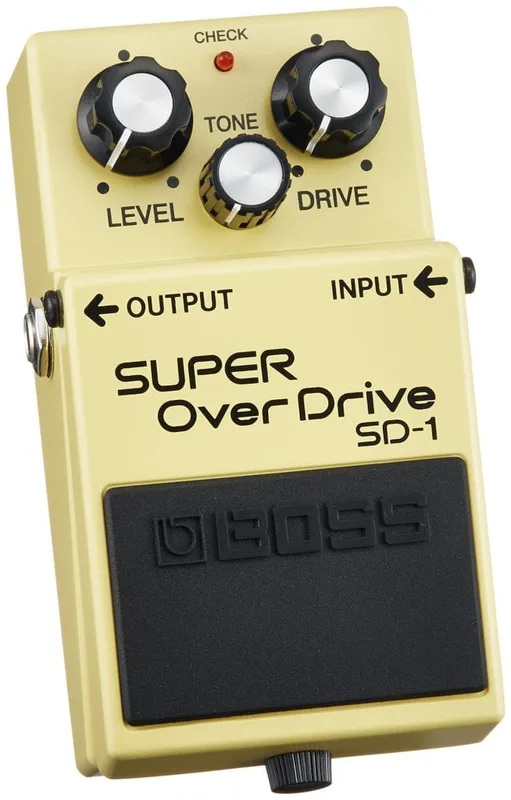
For players comparing Tube Screamer-family circuits, the Odie's appeal is the extra switching: with the Voicing set to mid bump and the Texture on diode clipping it delivers a classic Tube Screamer tone, with the Texture on Clean Boost and Voicing on Flat it fattens up single-coil pickups, and with the Texture on Mosfet clipping and Voicing on low end boost it gets a modern rhythm tone, where a Tube Screamer-style overdrive covers a narrower scope. The comparison between the Boss SD-1 and Ibanez TS9 covers how two classic circuits in this family differ link1.
Videos
Pete Thorn
ChelleeGuitars
Mike Hermans
Questions
Is the Chellee Odie true bypass?
Yes. The original Odie Overdrive features true-bypass switching, and the Odie Classic also lists true bypass switching among its features, so the pedal is out of the signal path when disengaged.
Can the Odie run on a battery?
Yes. The original Odie can be powered by a supplied 9-volt battery or by a 9- or 18-volt power supply. The Odie Classic can also be run at 18 volts, which Premier Guitar's reviewer noted maximizes its headroom.
What does the Texture switch do on the Odie?
Texture is a three-way switch that selects the clipping character: asymmetrical diode clipping, clean boost, or Mosfet clipping on the original Odie. The Odie Classic offers silicon diode clipping, LED clipping, and clean boost as its three drive texture settings.
How is the Odie different from a Tube Screamer?
Guitar World's reviewer described the Odie as a pedal that began as a Tube Screamer-style overdrive but widened the scope on each end to give you more options. The extra Texture and Voicing switches add clipping and EQ choices a stock Tube Screamer does not have.
Where is the Chellee Odie made?
Each Odie is handbuilt in the U.S., according to Guitar World's review. The Odie Classic is built by hand in Orange City, Florida, and individually tested before it ships.
Sources (5)
- Gear Review: Chellee Guitars Odie Overdrive Pedal, Guitar World, 2015-03-27
- Chellee Guitars Unveils the Odie Classic Overdrive, Premier Guitar, 2015-05-22
- New Pedals: Chellee's Odie Classic Overdrive, Delicious Audio, 2015-06-03
- Quick Hit: Chellee Odie Classic Overdrive, Premier Guitar, 2016-03-27
- BONSAI - JHS Pedals, JHS Pedals