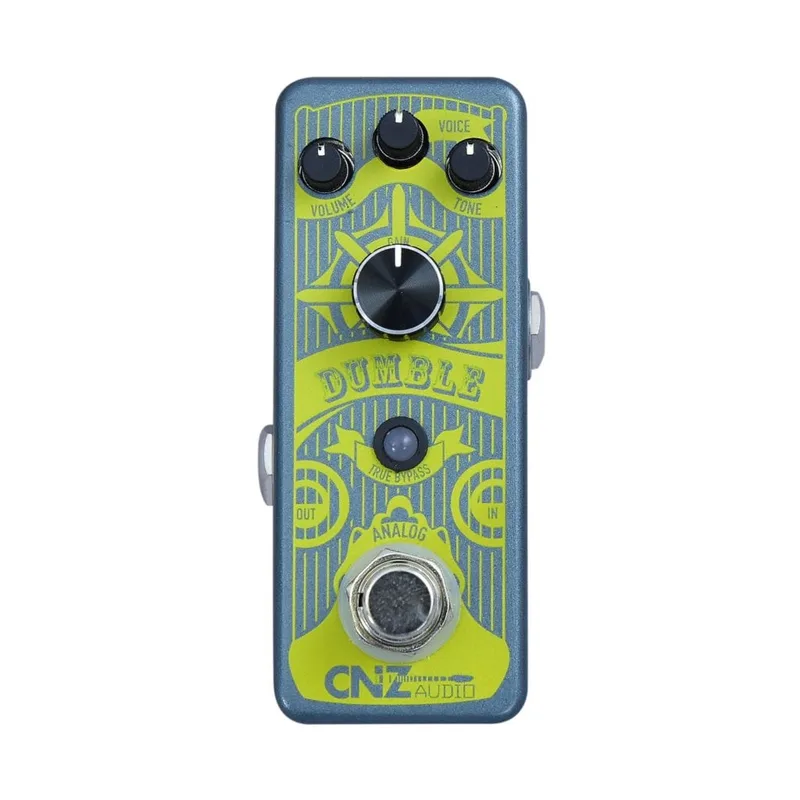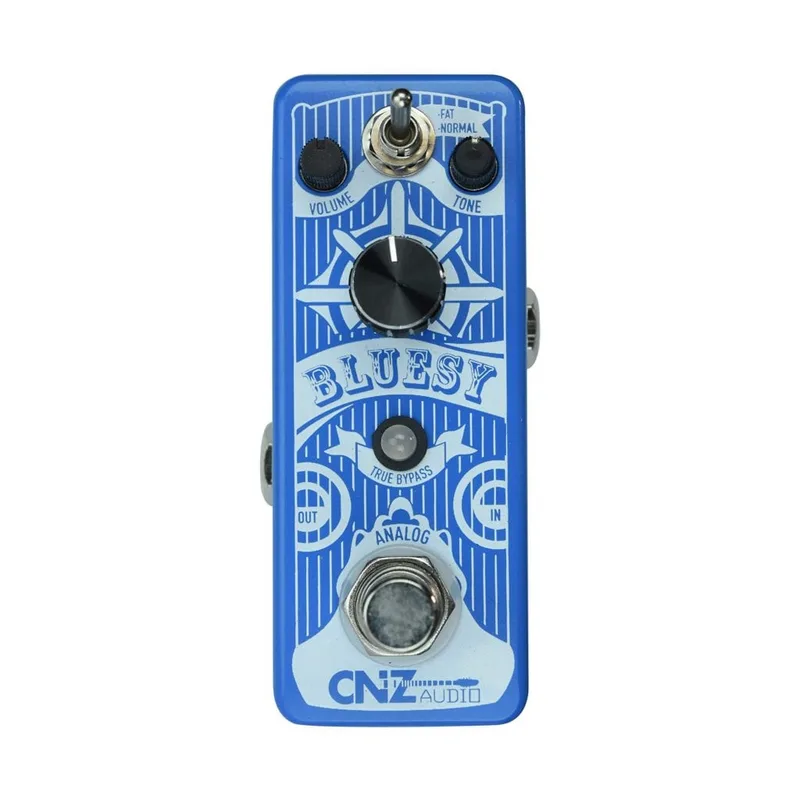


The CNZ Audio Bluesy is a compact overdrive pedal from CNZ Audio that the maker says "gives your music a vintage blues sound with a solid, mild overdrive effect"1. It is an analog circuit in a mini enclosure, with three knobs and a two-way mode switch, aimed at players who want a mild, amp-like push rather than heavy distortion1. Pedal of the Day reviewed it in December 2018 and described it as a pedal that "seeks to emulate the amplified sounds of the earliest electric blues players, whose amps had a special kind of mojo that can sometimes be difficult to recreate"2.
What it does to your sound
CNZ Audio positions the Bluesy as a mild overdrive rather than a high-gain box: the Gain knob "adjusts the amount of distortion in your mix," and the two modes range from mild to thick overdriven sounds12. The Normal mode "will mimic a classic tube overdrive," which is the setting for a pushed-amp feel at lower gain settings1. Fat mode is the other half of the pedal's character, covered in detail below.
Pedal of the Day's reviewer found the pedal delivers on that promise for its price bracket:
"While nothing too crazy or outside of the box here, the Bluesy Overdrive does just what you'd think it would, and well, especially when compared with other pedals in its extremely affordable price range."
The same review called it "another gem from our friends at CNZ Audio, and, while tiny, packs a huge sound and excellent amp-enhancing tone"2, and noted it belongs to a broader lineup of mini pedals from the maker2.
The controls
The control set is the familiar three-knob overdrive layout plus a mode toggle. Here is what each control does according to CNZ Audio's product page1:
| Control | What it does |
|---|---|
| Volume | Adjusts the overall output level of the pedal |
| Tone | Controls the highs and the lows of the effect |
| Gain | Adjusts the amount of distortion in your signal |
| Toggle switch | Selects between Normal and Fat modes |
Pedal of the Day found the knobs behave conventionally, "adding differing levels of tone and dirt into your signal, depending on your settings"2. The toggle is moved up and down to change modes1, and the maker describes the foot switch as firm, set in a solid aluminum housing on all sides1.
Normal and Fat modes
The mode switch is what separates the Bluesy from a basic three-knob overdrive. CNZ Audio describes the two voicings this way:
"The normal mode will mimic a classic tube overdrive while the Fat mode will add more bottom to your tone by filling out the lower EQ spectrum."
In practice, Normal is the leaner, more classic setting, while Fat is the one to use when the overdrive sounds thin, for example through a bright amp or a small speaker. Pedal of the Day characterized the two modes as "ranging in tonal structure from mild to thick overdriven sounds"2. The Amuzik version of the pedal lists the same two modes, Fat and Normal3.
Versions and related pedals
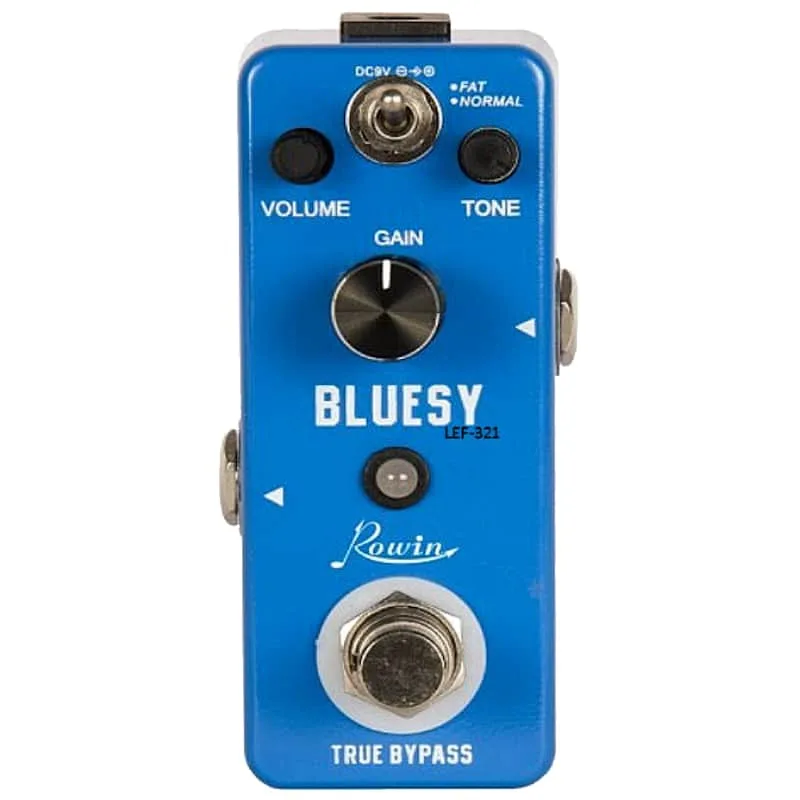
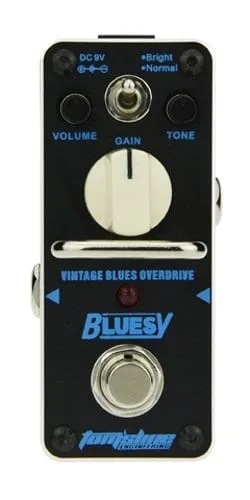
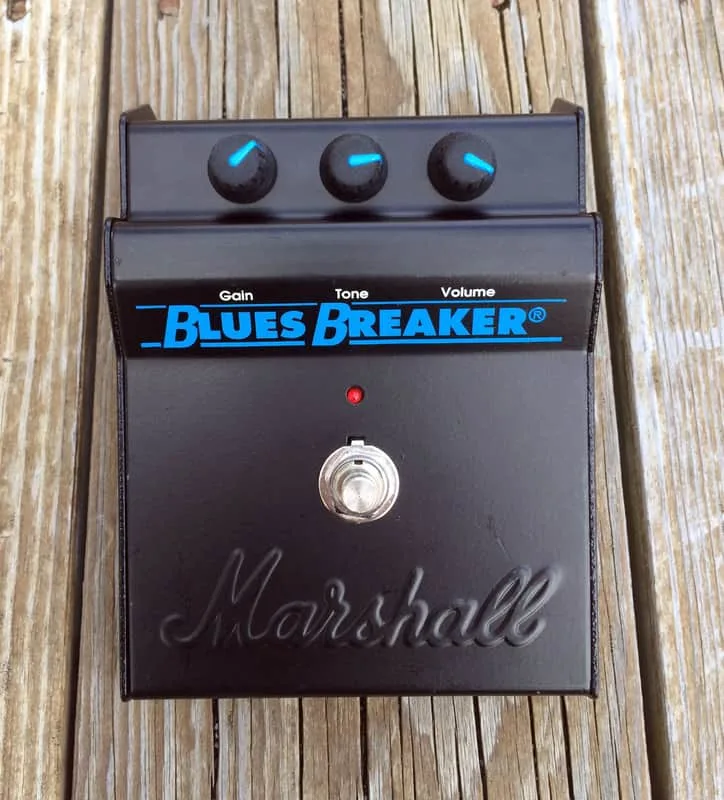
The Bluesy design appears under more than one brand name. CNZ Audio sells it as the CNZ Audio VBL-20 Bluesy, and the same pedal is listed by Rowin as the Rowin Bluesy, also with true bypass4. RockBoard's PedalPedia lists an Amuzik Bluesy described as an "Analog Vintage Bluesy Distortion Effect pedal" with the same Volume, Tone and Gain knobs, Fat and Normal modes, and true bypass3. A Tom's Line Mini "Bluesy" Pedal listing describes it as a "Classic blues style overdrive" with two mode options, volume, tone and gain control, and true bypass, "Based on 70's Marshall Blues Breaker"5.
The listings differ slightly on current draw: CNZ Audio specifies 10 mA1, while the Rowin page lists 14 mA at DC 9V, negative center4. Both agree on the 9V DC center negative power requirement14, and the Amuzik listing matches it at 9V DC, center negative3.
The Bluesy runs on 9V DC with a center negative plug1. The maker's specifications do not mention a battery option, so plan on a pedalboard power supply or a separate 9V adapter.
Power and connections
Power comes from a 9V DC input with a negative center and positive outside, drawing 10 mA1. That draw is low by pedal standards, so it places little demand on a pedalboard supply. Signal connections are standard 1/4 inch jacks, with an input impedance of 470K Ohms and an output impedance of 470 Ohms1. The enclosure measures 3.75 inches long by 1.77 wide by 1.9 high and weighs .53 lbs including the box, with solid aluminum housing on all sides1.
For players comparing mild overdrives, the Bluesy's Normal/Fat toggle and mini footprint are its distinguishing features against larger three-knob overdrives, and its shared design with the Rowin and Amuzik versions means the same circuit is available under several brand names43.
Videos
CNZ Audio
CNZ Audio
CNZ Audio
Questions
What does the Fat mode do on the CNZ Audio Bluesy?
Fat mode adds more bottom end to your tone by filling out the lower EQ spectrum, while Normal mode mimics a classic tube overdrive. You switch between the two with a two-way toggle on the pedal, so Fat is the setting to reach for when the overdrive sounds thin through a bright amp or a small speaker.
Is the CNZ Audio Bluesy the same pedal as the VBL-20?
The Bluesy carries the model number VBL-20 in CNZ Audio's own specifications, and the same pedal also appears under other brand names, including Rowin and Amuzik versions of the Bluesy with matching controls and true bypass. The core design is shared across these brands, with the CNZ Audio version sold under CNZ's own product page.
Is the CNZ Audio VBL-20 Bluesy true bypass?
Yes. CNZ Audio lists the Bluesy as true bypass, which the maker says provides transparent tone when the pedal is switched off. The Rowin and Amuzik versions of the Bluesy are also listed as true bypass, so your dry signal passes through uncolored in the off setting.
Is the VBL-20 Bluesy analog?
Yes. CNZ Audio describes the Bluesy as an analog overdrive effect, and the Amuzik version of the same pedal is likewise listed as an analog circuit. There is no digital processing in the signal path according to the maker's product description.
What power supply does the CNZ VBL-20 need?
It runs on 9V DC with a center negative plug, drawing 10 mA according to CNZ Audio. That is low enough to share an isolated output or a standard pedalboard supply with other mini pedals. The Rowin version lists a 14 mA draw at the same 9V DC center negative requirement.
Sources (5)
- VBL-20 | Bluesy Overdrive Pedal | CNZ Audio, CNZ Audio
- CNZ Audio Bluesy Overdrive Effects Pedal, Pedal of the Day, 2018-12-22
- Bluesy by Amuzik, RockBoard PedalPedia, 2026
- Bluesy - Rowin Pedal, Rowin
- Tom's Line, The Music Warehouse