

The Cornerstone Aquarium is a Uni-Vibe style pedal from Italian builder Cornerstone, the company's first modulation pedal after its lauded Gladio overdrive1. It is all analog and uses the same rotating bulb technology as the original Shin-ei Uni-Vibe, producing the three-dimensional chorus and vibrato tones players associate with that circuit1. What sets it apart from a straight vintage reissue is a set of additions aimed at the classic circuit's known problems: volume loss, tonal change and muddiness, plus dual speed controls you can morph between12.
Guitar.com's reviewer scored it 9 out of 10, calling it "A smart update that's up there with the very best Uni-Vibe types we've ever played"3.
The controls
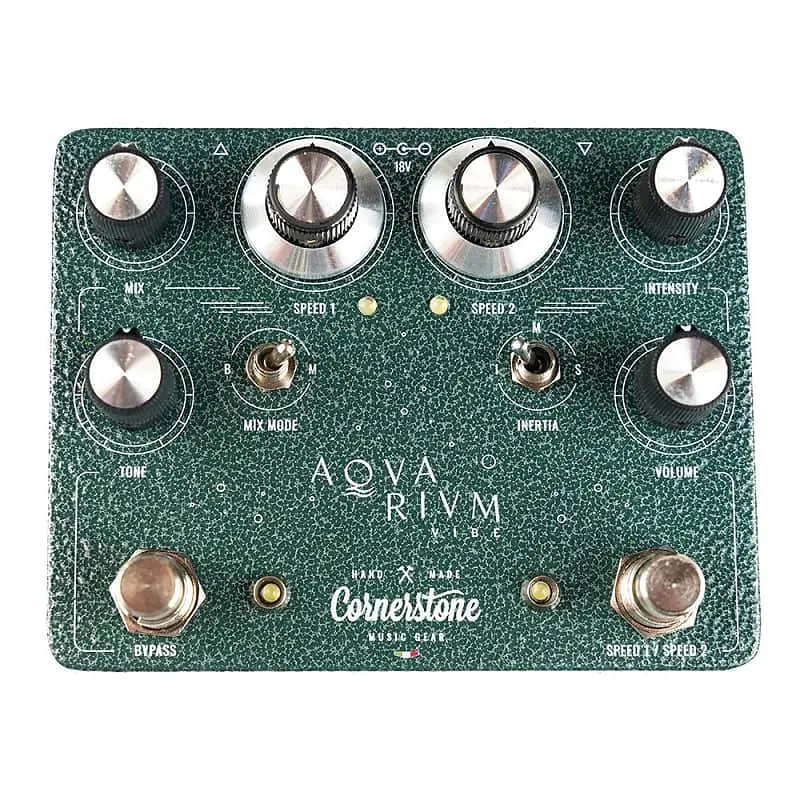
The Aquarium's control panel covers Speed 1, Speed 2, Volume, Mix, Intensity (Depth), Tone, a two-way Mix mode switch, a three-way Inertia switch, and bypass and speed footswitches3. Here is what each part does:
| Control | What it does |
|---|---|
| SPEED 1 / SPEED 2 | Two independent speed controls, chosen with the dedicated footswitch1 |
| DEPTH (Intensity) | Amplitude of the LFO modulation, the classic control on a Vibe1 |
| MIX | Balances dry and wet signal; behavior depends on the Mix mode toggle1 |
| TONE | Balances overall bass/treble to resolve the tone change and muddiness of classic circuits1 |
| VOLUME | Master output volume to cut or boost the level; unity volume is around 55% rotation1 |
| Inertia switch | Sets how fast the pedal morphs between the two speeds: I (Instant), M (Medium) or S (Slow)1 |
| Mix mode toggle | Chooses Blend ("B") or Mix ("M") mode1 |
| Bypass footswitch | True bypass on/off3 |
| Speed1/Speed2 footswitch | Selects the active speed; press and hold to momentarily swap between the two1 |
The Momentary Speed Change function is the performance feature at the center of the design: press and hold the Speed1/Speed2 footswitch and the pedal momentarily swaps to the other speed with a Medium inertia, then returns when you release1. Guitar.com's reviewer described the inertia control as allowing "various rates of Leslie-style morphing between speeds"3.
One omission worth knowing: the pedal has no expression input for rate control, something Guitar.com's reviewer wished it had3.
Blend and Mix mode
The Mix knob works differently depending on the toggle position1:
- Blend mode ("B"): the knob sweeps from 100% dry fully down to 100% wet all the way up, crossfading between the two13.
- Mix mode ("M"): the dry signal always stays at 100%, and the Mix knob sets the level of the wet vibe sound added on top of it13.
Mix mode is the closer cousin to how a Leslie-style effect sits in a mix, since your dry tone never thins out as you add modulation. Blend mode gives you the full-strength vibrato sound of the original circuit when the knob is wide open1.
Power: 18V and true bypass
The Aquarium runs on 18V DC, center negative, drawing 60mA2. Guitar.com notes it is powered by an 18-volt supply only3. Cornerstone says the 18V rail is key to obtaining the classic rich, deep Vibe tones from the analog bulb circuitry, matching the original Uni-Vibe's own 18V operation14.
The Aquarium requires an 18V DC center-negative supply, drawing 60mA32. Plan for a dedicated 18V output on your pedalboard power supply.
Bypass is true bypass, so the pedal is out of the signal path entirely when switched off13.
Design and the original Uni-Vibe
The Uni-Vibe was created in the 1960s by engineer Fumio Mieda for the Japanese company Shin-ei, designed to mimic the sound of a Leslie rotary cabinet567. Its modulation is generated by photo-resistors: in authentic lightbulb Uni-Vibes, a lamp and light-sensitive components (Vactrols/LDRs containing trace cadmium sulphide) sweep against each other to create the wobble89. MusicRadar notes the original Shin-ei units "distinguished themselves by using a lightbulb"10.
The Aquarium keeps that rotating bulb technology rather than substituting a modern LED-and-LDR scheme1. The Volume, Tone and Mix controls are there to fix the classic circuit's shortcomings, while keeping what Cornerstone describes as simplicity of operation and tonal flexibility1.
Guitar.com's reviewer found the result more versatile across a range of musical genres than a standard Uni-Vibe type, "from gentle vibrato wobbles to thick chorusing and rotary sounds," and called the pedal "a vast sonic playground for the creative player," with speed ramping between contrasting settings that sit in any mix from clean to high-gain3. On the design itself:
"Huge praise should go to Cornerstone for combining these sophisticated features into an intuitive and simple design."3
For more on the effect family the Aquarium belongs to, see chorus pedals.
Videos
Pete Thorn
R.J. Ronquillo
Sasha Ivantic
Questions
Is the Cornerstone Aquarium true bypass?
Yes. The Aquarium uses true bypass switching, so with the pedal off your dry signal passes through without the circuit coloring it. It is also 100% analog throughout, with no digital conversion of the effect signal.
What is the difference between Blend and Mix mode?
In Blend mode (toggle B) the Mix knob sweeps from 100% dry with the knob fully down to 100% wet with the knob all the way up, crossfading the two signals. In Mix mode (toggle M) the dry signal stays at 100% and the Mix knob sets the level of the wet vibe sound added on top of it.
Does the Aquarium use real light bulbs like the original Uni-Vibe?
Yes. The Aquarium uses the same rotating bulb technology as the original Shin-ei Uni-Vibe, with an analog bulb circuit generating the classic rich, deep Vibe tones. Cornerstone says running the pedal on 18V is key to obtaining those tones.
How much does the Cornerstone Aquarium cost?
The Aquarium retailed for $520 when Cornerstone released it in August 2022. Guitar.com's review, published in July 2022, listed the price as €520 in Europe.
Can I switch between two speeds on the Aquarium?
Yes. There are two independent speed controls, Speed 1 and Speed 2, chosen with a dedicated footswitch. Pressing and holding the same footswitch momentarily swaps between the two speeds, and the Inertia switch sets how fast the pedal morphs between them: Instant, Medium or Slow.
Sources (10)
- Cornerstone Aquarium Uni-Vibe, Delicious Audio, 2022-08-18
- Aquarium by Cornerstone Music Gear, RockBoard PedalPedia, 2026
- Cornerstone Aquarium Vibe review: Is this the ultimate luxury Uni-Vibe pedal?, Guitar.com, 2022-07-15
- The 9 Best Uni-Vibe Pedals In 2024: A Guide To UniVibe Clones, Delicious Audio (delicious-audio.com), 2024-02-16
- What was the original univibe effect?, Strymon, 2015-06-30
- The FX files: Uni-Vibe, MusicRadar, 2019-04-10
- That Pedal Show, That Pedal Show, 1960
- Korg Nuvibe Review, Premier Guitar, 2015-04-02
- Guitar Pedal X, Guitar Pedal X, 2024-11-15
- Strymon UltraViolet Vintage Vibe Pedal review, MusicRadar, 2023-12-12