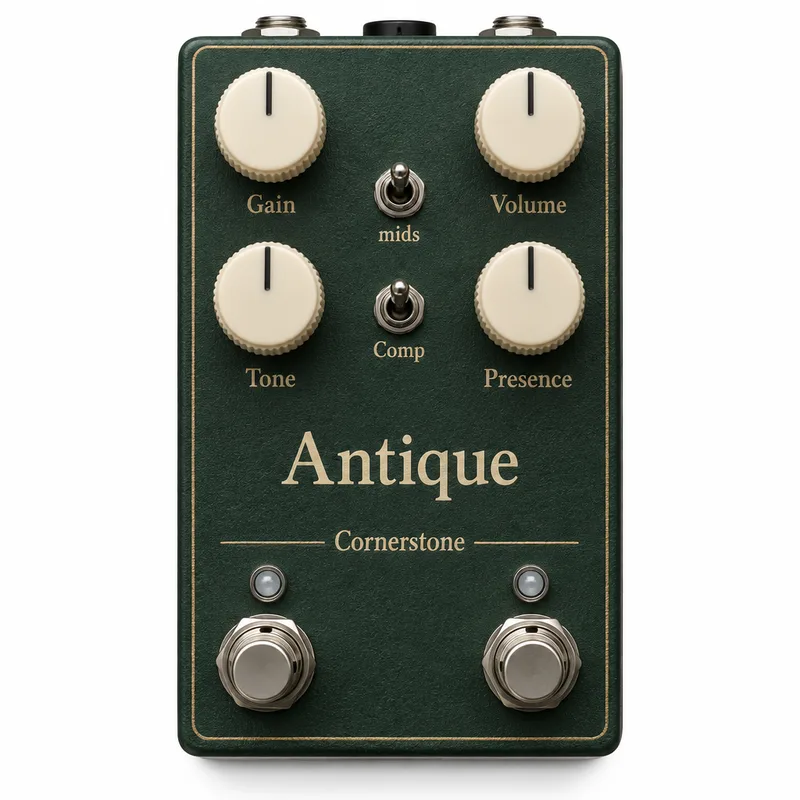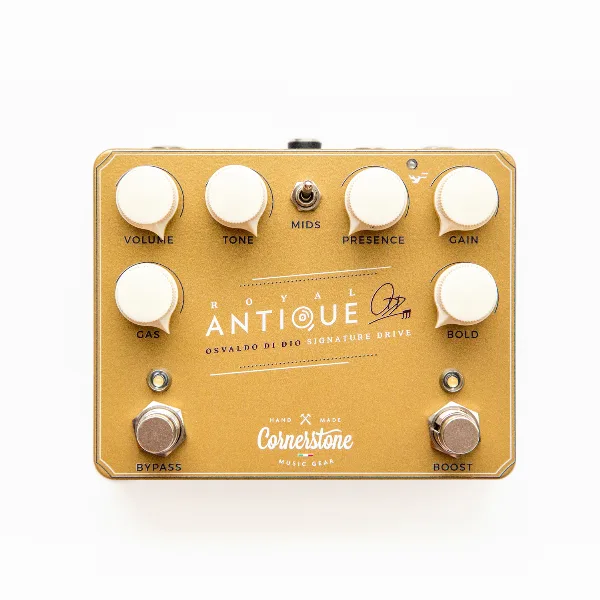



The Cornerstone Royal Antique is a signature drive pedal designed together with Italian guitarist Osvaldo di Dio, marketed as the "Osvaldo di Dio Signature Drive" and described by the maker as an all-in-one solution for overdrive needs. Its main circuit is the same as the Cornerstone Antique, the company's classic drive circuit, with a dual boost and a Flame booster channel built around it1. The pedal carries a list price of 289,00 euros1.
Bypass, Standard, Boost and Flame modes
The Royal Antique runs through four operation modes: Bypass, Standard, Boost and Flame1.
- Bypass: the pedal is true bypass, so in bypass mode there is no signal loss and no buffer applied to the signal1.
- Standard: the main overdrive circuit, controlled by its standard Gain, Tone, Presence, Volume and Mids controls1.
- Boost: hitting the boost footswitch brings in two different boosts at the same time, one before and one after the overdrive circuit, each with its own gain control1.
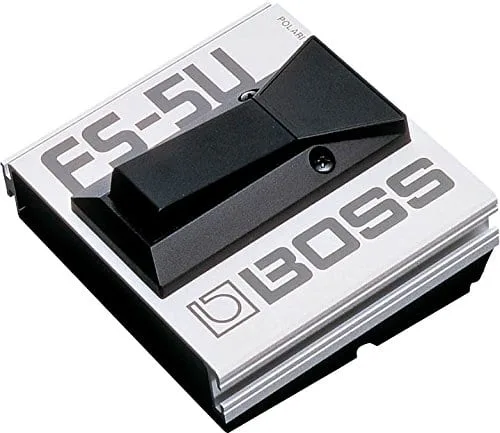
- Flame: a Flame booster already embodied in the Royal Antique's circuitry, enabled by an external momentary footswitch, giving up to 20dB of boost1.
Controls
| Control | What it does |
|---|---|
| Gain | Main overdrive gain in standard mode1 |
| Tone | Main overdrive tone in standard mode1 |
| Presence | Main overdrive presence in standard mode1 |
| Volume | Main overdrive volume in standard mode1 |
| Mids | Main overdrive mids in standard mode1 |
| BOLD | Gain of the boost before the overdrive; unity volume is at 01 |
| GAS | Gain of the boost after the overdrive; unity volume is at noon, and it also acts as the master output volume of the boosted channel1 |
The BOLD and GAS knobs are worth understanding together, because each has its own unity volume point. Turning BOLD up from 0 pushes the boost before the overdrive harder, while GAS at noon is unity for the boost after the overdrive, and above or below noon it sets the boosted channel's overall output level1.
Power and switching
The Royal Antique requires a standard 9V DC negative power supply only1. The Flame channel is engaged with an external momentary footswitch, so using it means connecting a separate switch to the pedal1.
A user manual for the Royal Antique is available from the downloads tab of the product page1.
Where it sits in Cornerstone's range
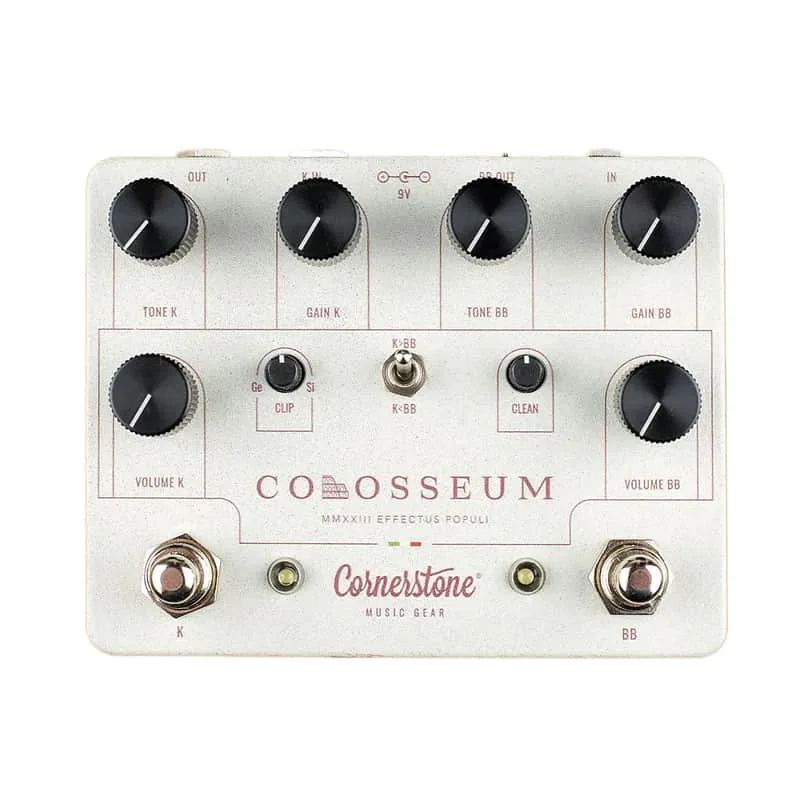
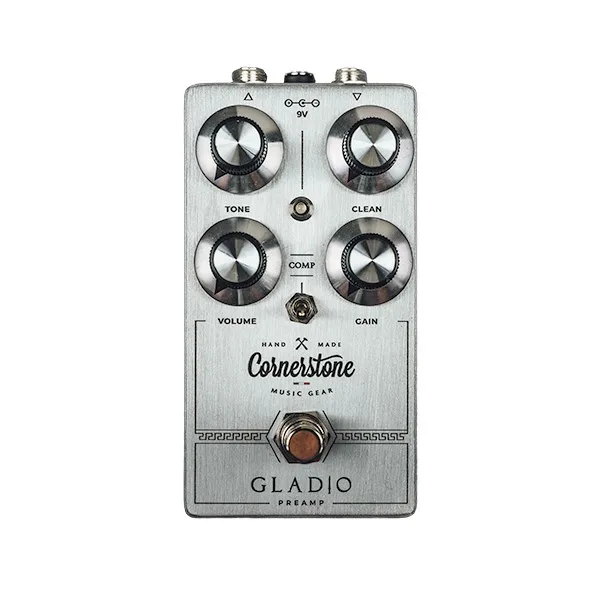
The Royal Antique shares its main circuit with the Cornerstone Antique, and it sits in a maker's range that also includes the dual-drive Cornerstone Colosseum, the Cornerstone Gladio SC and the Cornerstone Centurio Dual Overdrive. For more on the effect type, see the site's guide to Overdrive Pedals1.
Videos
Sam Vilo
GC ROCKBOARD
Max Guitar Store
Questions
Who designed the Cornerstone Royal Antique?
The Royal Antique was designed together with Osvaldo di Dio, and it is sold as his signature drive pedal. Its main circuit is the same as the Cornerstone Antique, the company's classic drive circuit, with the boost and Flame features added around it.
Is the Cornerstone Royal Antique true bypass?
Yes. Cornerstone describes the Royal Antique as a true bypass pedal, so in bypass mode there is no signal loss and no buffer applied to the signal.
What does the Flame mode do on the Royal Antique?
Flame mode engages a Flame booster that is already embodied in the Royal Antique's circuitry. It is enabled by an external momentary footswitch and gives up to 20dB of boost on top of the pedal's other modes.
What do the BOLD and GAS knobs do?
BOLD sets the gain of the boost before the overdrive, with unity volume when it is at 0. GAS sets the gain of the boost after the overdrive, with unity volume when it is at noon, and it also acts as the master output volume of the boosted channel.
What power supply does the Royal Antique need?
The Royal Antique requires a standard 9V DC negative power supply only. Cornerstone does not list a battery option or a current draw figure for the pedal.
Sources (1)
- Royal Antique, Cornerstone