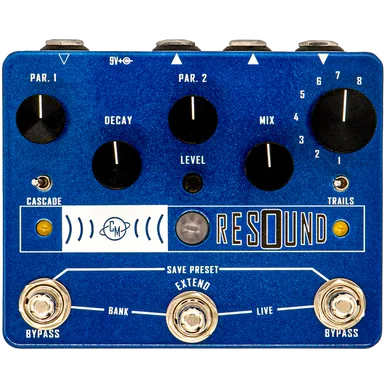


The original Resound is now discontinued, and Cusack Music sells the redesigned Resound V2 at a list price of $280.001. This page covers both versions, with the differences spelled out below.
What the Resound does: eight reverb programs with presets
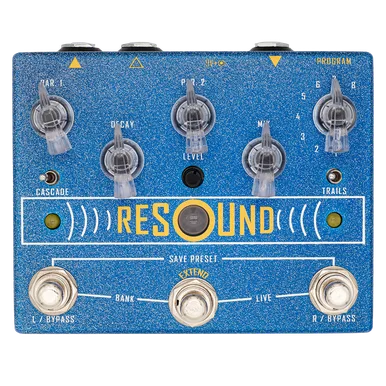
The Program knob switches between the eight reverb programs, with the program names printed on the front of the pedal1. Each program has its own three parameter controls: Parameter 1, Parameter 2, and Decay, so the two parameter knobs do something different in every program5. The pedal ships with factory presets loaded so you can hear each program quickly in preset mode5.
The programs, as described in the manuals and product pages:
| Program | What it does | Parameters |
|---|---|---|
| Room | Very short closet-type reverb up to larger room sizes | Pre-Delay, Tone26 |
| Plate | Brighter textured plate reverb sounds | Pre-Delay, Tone52 |
| Cathedral | Big spacious reverb with as much decay as you'll ever need | Pre-Delay, Tone52 |
| Modulated | Chorus and reverb paired for a clearer, more useable combination | Chorus Depth, Chorus Rate52 |
| Hall/Freeze | Everything from hall reverb to a dry freeze, and blends in between | Cascade Amount, Tone52 |
| Glisten | Twelve-string sparkle and chime; with Extend, streaming, stacking infinite decays | varies5 |
| Shimmurmur | Shimmer with independent control of upper and lower voicings, ominous or choir-like | varies5 |
| Swell (V2) | Replaced the fifth program in the V2 update | varies6 |
On the JHS Pedals list of extraordinary reverbs, Josh Scott singled out the glisten setting: "My personal favorite setting is called glisten, just because it's really unique. I'd say it's in the same ballpark as shimmer" with LFO movement like a tremolo and low and high octaves like a Hammond organ7.
The signature feature is the Extend footswitch, which Cusack describes as a way "to help create complex ambient landscapes"1. Pressing Extend maxes out the decay for the current program, and the Cascade toggle decides whether new notes you play are added to that extended reverb or stay dry1. Guitar.com summed up the workflow: hit the Extend footswitch, and with Cascade on, new notes layer into the stretched decay3.
The controls
The original Resound's control set, from the maker's product page1:
| Control | What it does |
|---|---|
| Program | Switches between the eight reverb programs |
| Decay | Controls how long the reverb effect lasts |
| Parameter 1 | Varies by program |
| Parameter 2 | Varies by program |
| Mix | Dry/wet mix; fully counterclockwise is 100% dry, noon is 50/50, fully clockwise is 100% wet |
| Level | Boosts or cuts overall output; noon is unity gain |
| Cascade | With Extend engaged, sets whether new notes join the extended reverb; left off, right on |
| Trails switch | Sets whether the decay completes after bypassing, or cuts off |
The V2 keeps the same idea with relabeled knobs: the numbered program knob, MIX, LEVEL, CASCADE, and a TRAILS switch that lets the reverb trail decay naturally when bypassed or cut it off immediately2.
Live and Preset modes
The pedal has three main modes: Bypass, Live, and Preset, and it ships set to Preset mode5. In Preset mode, the eight presets live in four banks (Red, Green, Blue, Violet on the original; red, green, blue, and pink on the V2), each storing a preset for the left and right footswitches52. A large 10mm four-color center LED shows the bank, and the footswitch LEDs show which preset within it is selected4.
In Live mode, preset recall is disabled and every knob works in its physically set position, with the center LED alternating white2. The original's three footswitches (L, M, R) do the bank and preset work: L and M cycle banks, L or R selects a preset, M engages Extend, L and R together enter Save Mode, and holding M and R about two seconds toggles between Live and Preset modes5. On the V2, saving is a matter of holding both bypass footswitches about a second until the yellow LEDs alternate, cycling to the bank you want, then choosing the left or right location2.
Power and connections
The input is mono2. On the original, the right output jack is configured by internal jumpers to serve as either a stereo output or an expression pedal input1. The V2 instead has dedicated left and right outputs plus a dedicated expression pedal input, and an internal select switch on the right output offers three options: DRY (dry signal only), WET (reverb only), or MIX (matching the MIX knob)26. An expression pedal can be assigned to any one of the Resound's parameters8.
Power is a standard 9V DC center-negative supply, not included, with no internal battery connection14. Current draw is around 80mA on the original and around 85mA on the V212. The V2's input impedance is 350k Ω and output impedance is under 100 Ω2.
No battery option: the Resound needs a 9V DC center-negative supply from the start, so plan for a power supply rather than a battery14.
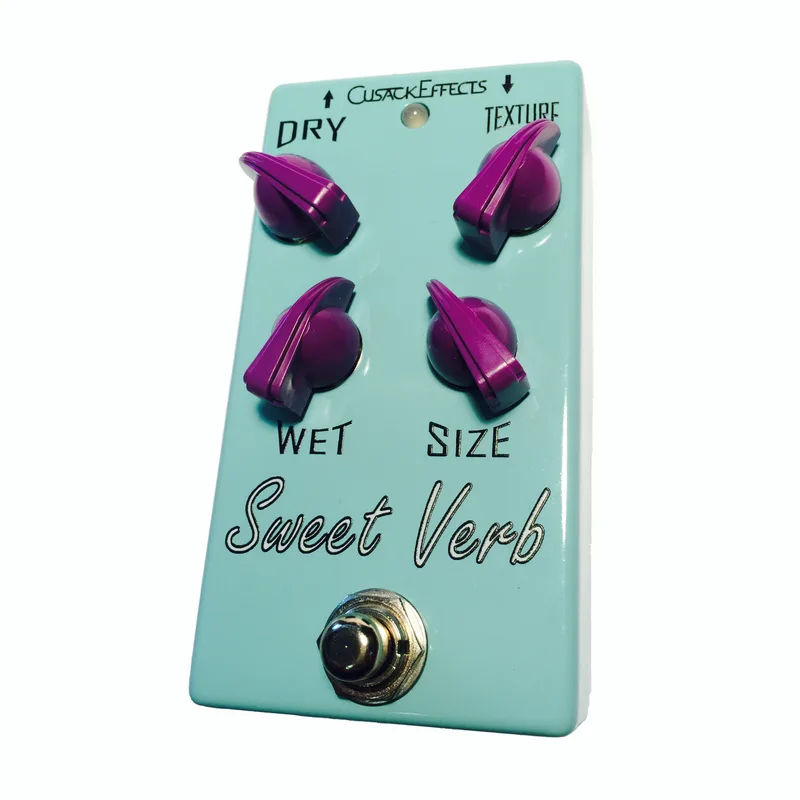
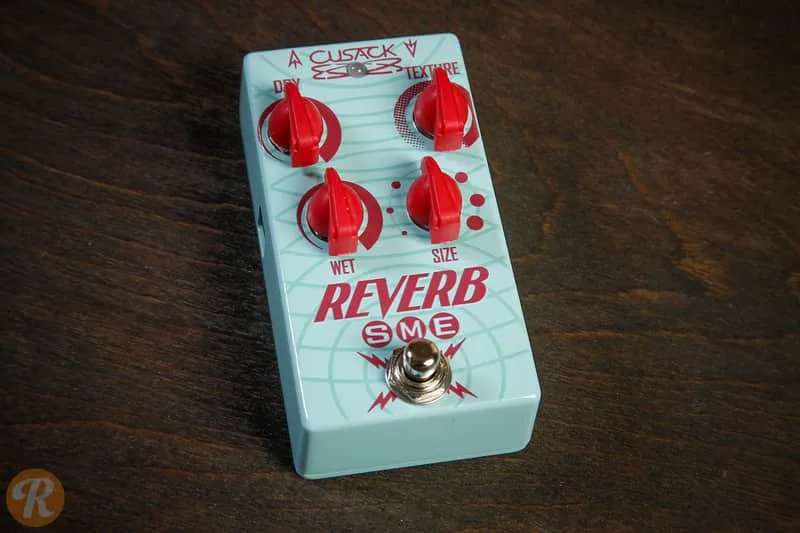
History and versions: from the Sweet Verb to the Resound V2
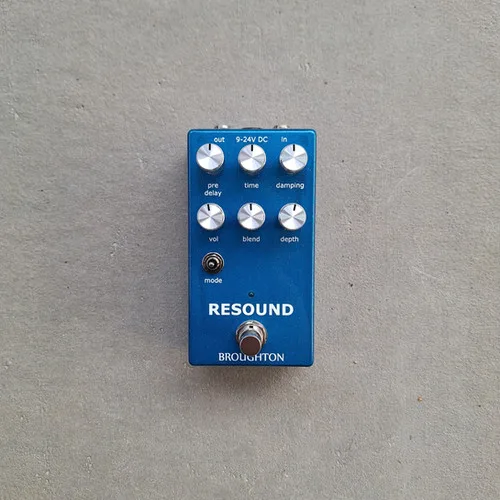
A related pedal worth knowing about: the Broughton Audio Resound, built by Broughton Audio, which differs from the Cusack original in using a true bypass switch rather than buffered bypass9.
What reviewers said
Premier Guitar reviewed the original Resound in August 2021 and found:
"It's a digital reverb unit with exceptionally strong fundamental tones, major sonic flexibility, and cool switching options"8
Premier Guitar reviewer, on the Resound's sound and features8
The same review noted that Cusack "used their formidable DSP programming chops to create the Resound," and highlighted the expression pedal assignment across the pedal's parameters as a flexibility point8.
Videos
Premier Guitar
Mike Hermans
Do Noise
Questions
Does the Cusack Resound run on a battery?
No. The Resound runs on a 9V DC power supply only and has no internal battery connection, so you need a center-negative 9V supply on your pedalboard. Current draw is around 80mA on the original and around 85mA on the V2, well within what a standard isolated power supply delivers.
Is the Cusack Resound stereo?
Yes. The input is mono, but the pedal has two outputs. On the original Resound the right output jack is set by internal jumpers to work as either a stereo output or an expression pedal input. The Resound V2 has dedicated left and right outputs, and an internal select switch on the right output chooses dry, wet, or mix.
Can I use an expression pedal with the Cusack Resound?
Yes. On the original Resound the right output jack doubles as an expression pedal input, chosen with internal jumpers, and an expression pedal can be assigned to any one of the pedal's parameters. The Resound V2 adds a dedicated expression pedal input, so the second output stays free for stereo use.
Is the Cusack Resound true bypass?
No. The Cusack Resound and Resound V2 use a buffered bypass based on the Cusack More Louder. A trails switch decides whether the reverb decay finishes naturally after you bypass the pedal or cuts off immediately. The related Broughton Audio Resound, by contrast, uses true bypass.
Sources (9)
- Resound Reverb Pedal with Presets and Extend, Cusack Music
- Resound v2 draft.ai, Cusack Music, 2023
- Cusack Music unveils digital reverb pedal, Guitar.com, 2018-07-27
- Cusack Music Unveils the Resound Reverb, Premier Guitar, 2018-07-26
- Microsoft Word, Cusack Music, 2022
- Resound V2 Reverb Pedal with Presets, Cusack Music
- 10 EXTRAORDINARY REVERBS, JHS Pedals
- Cusack Resound Review, Premier Guitar, 2018-11-06
- Resound | Broughton Audio, Broughton Audio