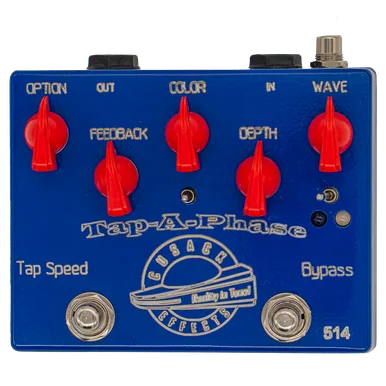


The Cusack Music Tap-A-Phase is an analog phaser pedal with tap tempo. Cusack Music describes it as "the tap tempo, analog 'Tap-A-Phase' phaser pedal," and its phasing circuit is built on vactrol opto-couplers, the light-dependent resistor parts used in classic opto-based phase designs1. Tapping the footswitch twice sets the sweep speed, and a blue tempo LED gives a visual readout of both the tempo and the waveform2.
The pedal was originally discontinued because the vactrols it depends on became unavailable; Cusack Music says "it was the extinct vactrols that put this pedal out of production"1. When the maker rediscovered a batch of the rare opto-couplers, there were only enough to build 13 circuit boards, which were paired with B-stock enclosures from the maker's vault for a limited run priced at $220.00 USD as of October 2026. That run is now sold out1.
What it does: a vactrol phaser with tap tempo
The Tap-A-Phase is an analog phaser, meaning the phase shifting happens in the analog signal path rather than in a digital processor1. Its phasing circuit uses vactrol opto-couplers, components that combine a light source and a light-dependent resistor to control the frequency notches that create the phasing effect1.
What sets it apart from most analog phasers is tap tempo. Instead of only turning a speed knob, you tap the footswitch twice to set the sweep rate in time with the music, and the blue tempo LED blinks in time so you can see the tempo and waveform at a glance2. The tap can also be divided against your tapped tempo, from 1/4 and 1/3 subdivisions up to multiples of 2, 3, 4, and 6, which lets a single tap produce faster or slower sweeps than the tempo you tapped2.
The pedal holds 24 waveforms in total, organized into three banks selected by the Bank switch2:
- Bank A, B, and C: each bank holds 8 waveforms, selected by the Wave knob2
- Bank C: contains rhythmic patterns, where the Depth knob changes the balance of accented and unaccented beats rather than just sweep depth2
An internal Mode jumper sets how the pedal handles those waveforms. In Preset mode, changing the waveform loads saved parameters and any changes are temporary; in Live mode, all current knob settings apply to every waveform. Changes to the jumper take effect only after cycling power with the input jack2.
The controls
The front panel combines knobs, switches, and a multi-function tap footswitch2.
| Control | What it does |
|---|---|
| Tap Switch | Tap twice to set the tempo. Also a modified brake control: holding it slows the tempo, holding again speeds it up. Defaults to slowing down when the effect is engaged2 |
| Color knob | Controls the center frequency of the phasing; all the way down is low frequency, all the way up is high frequency2 |
| Depth knob | Acts like a standard depth knob from 0 to about noon; above noon the waveform starts to clip and becomes asymmetrical. With Bank C rhythmic patterns it changes the balance of accented and unaccented beats2 |
| Wave knob | Selects one of 8 waveforms in the current bank2 |
| Bank switch | Selects between banks A, B, and C2 |
| Tap Divide | Controls how the tap is divided: 1/4, 1/3, 1/2, 1, 2, 3, 4, and 6, set with the Option knob while the effect is engaged and the tap switch is not held down2 |
| Bypass footswitch | Kicking the switch changes from Bypass to Engaged2 |
Two internal adjustments round out the control set: an internal Mode jumper for Preset or Live operation, and an internal Volume control for setting the output level2.
The LED behavior is worth knowing. The status LED is off when the pedal is bypassed and red when the effect is engaged, and it blinks when the battery is going dead. The blue tempo LED shows the tempo and waveform visually2.
Power and connections
The Tap-A-Phase runs on a standard center negative 9V DC supply, which is not included, and draws approximately 18mA1. The DC power jack has the same pin-out as most standard pedal supplies: tip is ground, sleeve is 9V2. The pedal can also run on a battery, and the blinking status LED warns when that battery is going dead2.
The input jack disconnects power, so the input cable should be unplugged when the pedal is not in use. Leaving a cable plugged in will drain the battery2.
Connections on the pedal are simple: a mono input, a mono output, and an external RCA tap jack on the back that works as either a Tap IN or Tap OUT2. That tap jack opens up two useful options:
- External tap switch: an external momentary switch can be plugged into the RCA jack to set the tempo remotely, useful if the pedal sits off your board's front row2
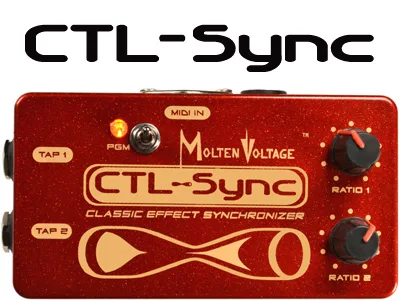
- Synchronization: the Tap-A-Phase can sync with other gear using CTL-Sync through its Tap Input Jack. Molten Voltage listed it among pedals with a tap input jack that can sync together with MIDI-clock devices even though the pedals themselves do not use MIDI Clock3
Videos
Cusack Music
Cusack Music
Cusack Music
Questions
Does the Cusack Tap-A-Phase run on a battery?
Yes. The manual describes a battery that can go dead and be unplugged, and the status LED blinks when the battery is dying. The pedal also takes a standard 9V DC supply with the same pin-out as most pedals: tip ground, sleeve 9V. Note that the input jack disconnects power, so the input cable should be unplugged when the pedal is not in use.
Can the Tap-A-Phase sync to MIDI clock?
Not directly through MIDI Clock, but it can sync with MIDI-clock devices using CTL-Sync through its Tap Input Jack. Molten Voltage listed it among pedals with a tap input jack that can sync together even though they do not use MIDI Clock. An external momentary switch can also be plugged into the RCA tap jack to set the tempo remotely.
How many waveforms does the Tap-A-Phase have?
There are 24 waveforms in total, spread across three banks labeled A, B, and C. The Bank switch selects the bank, and the Wave knob selects one of 8 waveforms within the current bank. Bank C holds rhythmic patterns, where the Depth knob changes the balance of accented and unaccented beats.
Why was the Tap-A-Phase discontinued?
Cusack Music discontinued it because the vactrol opto-couplers used in its phasing circuit became unavailable. The maker says it was the extinct vactrols that put the pedal out of production. When a batch of the rare opto-couplers was rediscovered, only enough parts existed to build 13 circuit boards, which were paired with B-stock enclosures for a limited run that has since sold out.
Can I use an external tap switch with the Tap-A-Phase?
Yes. The back of the pedal has an external RCA jack that works as a Tap IN or Tap OUT. An external momentary switch can be plugged into it to set the tempo remotely, and the same jack is what allows CTL-Sync synchronization with other tap-equipped pedals and MIDI-clock devices.
Sources (3)
- Tap-a-Phase Tap Tempo Phaser Pedal, Cusack Music
- on:, Cusack Music, 2011-07-21
- MIDI PedalBoard Devices: 28 Effects that can sync to MIDI Clock with CTL-Sync, Molten Voltage (blog.moltenvoltage.com), 2014-06-12