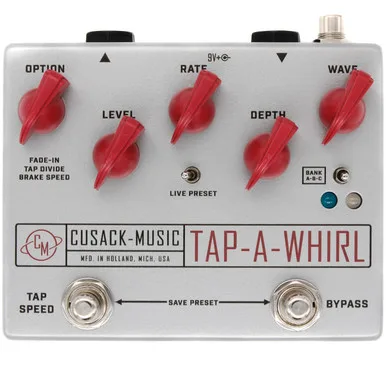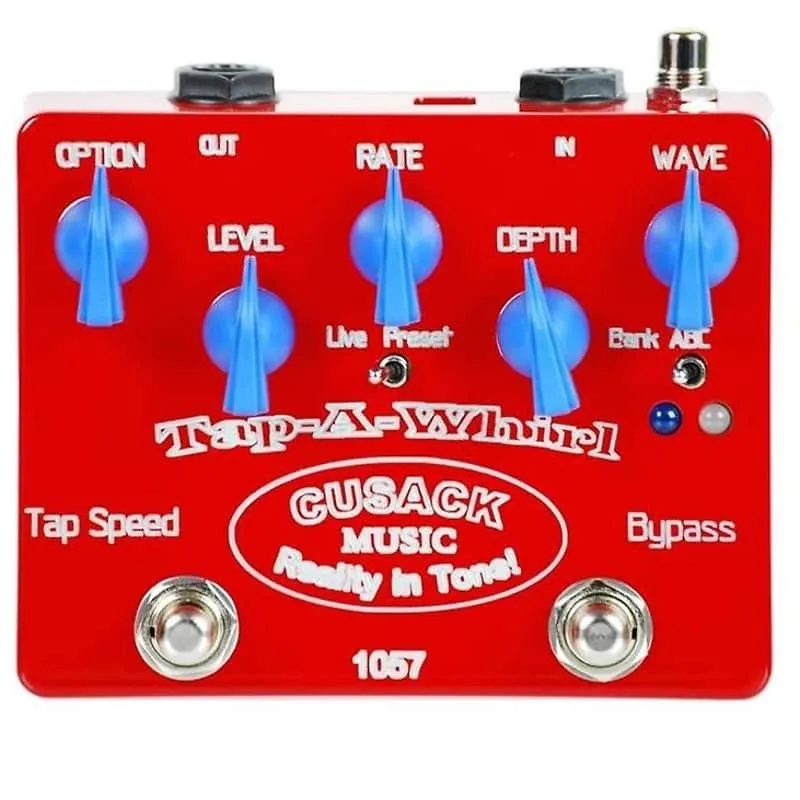


The Cusack Tap-A-Whirl is an analog tremolo pedal with tap tempo built in, made by Cusack Music. The company describes it as the world's first analog tremolo pedal with tap tempo, a claim echoed in the press: Delicious Audio calls it "the first tremolo pedal with tap tempo"1, and in a JHS Pedals demo Joshua Scott called it "the first ever pedal tremolo with tap tempo"2. The line has gone through four versions, and the current V4 sells for $300.003.
The core idea is a tremolo whose speed you set by tapping a footswitch in time with the music rather than turning a knob and hoping it lands on the beat. Cusack describes the effect itself as "a smooth, pristine tremolo effect, with the added benefit of tap-tempo"4. The audio path is fully analog on the V4, with digital control on top for presets and waveform selection3.
What it does to your sound
A tremolo raises and lowers the volume of your signal in a repeating cycle. What sets the Tap-A-Whirl apart from most analog tremolos is that the cycle's speed is set by tapping: tap the footswitch twice and the pedal locks to that tempo. On the original version, the tap switch also worked as a brake. Holding it slowed the wave down, and holding it again after letting go sped it back up, with the tempo staying wherever you released5. The V3 kept this behavior, defaulting to slowing down when the effect is engaged6.
The pedal also shapes how the volume moves, not just how fast. The original's Wave knob selected eight waveforms in this order: sine, ramp, blip, long blip, square, waver, echo, and ping pong5. The V3 and V4 expanded this to 24 waveforms34, and on the V4, Delicious Audio notes that the odd time signatures in bank C are especially useful, with each waveform interacting with the tempo divide feature1.
A small detail from the original manual that players still find handy: the LED blinks to show the current tempo, and at slower settings you can literally see the waveform as the LED's brightness tracks the volume5.
The controls
The control set has grown with each version. The original kept it simple, while the V4 adds digital presets, 4 banks with two presets each, and an Option knob for tempo divide, fade in control and more3.
| Control | What it does |
|---|---|
| Depth | Sets the depth of the tremolo effect5 |
| Level | Sets the output volume34 |
| Rate | Sets the speed, overridden by tapping35 |
| Wave | Selects the waveform; on the V3 it works in combination with the Bank switch45 |
| Tap footswitch | Tap twice to set tempo; hold for brake; on the V4 it also engages and disengages the effect36 |
| Option knob (V4) | Tempo divide, fade-in control and more3 |
| Brake Speed | Sets how fast the tempo changes when you hold the Tap switch; counter-clockwise is slowest56 |
| Fade-In | Emulates the fade-in of old Fender amps; all the way right takes 4 seconds for the wave to take full effect5 |
| Live/Preset toggle (V3) | Switches between Preset and Live modes4 |
On the original, the fourth knob was either Fade-In or Brake Speed depending on an internal jumper setting5. By the V2, Fade-In, Brake Speed, Tap Divide and Tempo were all programmable for each waveform independently7, and the V3 stored these settings in EEPROM so they survive power loss and an unplugged battery6.
The V4's preset system works like this: each of the four banks stores a preset for the left and right footswitches, for a total of eight presets, with the banks cycling red, green, blue, and pink8. In Preset mode, tapping the footswitch engages the stored preset; in Live mode, your current settings apply to all waveforms6.
Power and connections
The V4 runs on a standard 9V DC center negative supply and draws about 22mA3. The V3 also accepted a 9V battery (not included) and drew about 15mA46. Earlier versions used the common pedal pin-out, tip ground and sleeve 9V, and the input jack doubled as the power switch: unplugging it when not in use preserved battery life57.
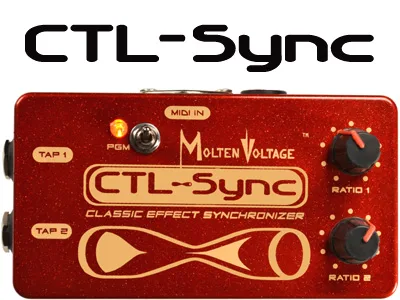
The V4 has a dedicated Exp./Tap/Sync input that auto-detects what is plugged in and supports configurable expression3. The V3 used an RCA jack for external tap tempo4. For synchronization beyond tap, Molten Voltage documented the Tap-A-Whirl among pedals that can sync to MIDI Clock using its CTL-Sync device9.
History and versions
The Tap-A-Whirl dates back to at least 2003, when Jon Cusack signed the original manual5. The line developed through four versions:
- V1: Eight waveforms, battery power, Fade-In or Brake Speed on an internal jumper5
- V2: 24 waveforms available with the optional bank switch; per-waveform programmable settings; Preset and Live modes7
- V3: 24 waveforms, stereo output, RCA tap jack, EEPROM storage; now discontinued46
- V4: Full stereo path, eight presets in four banks, buffered bypass, red enclosure; the current version31
What reviewers said
Guitar World reviewed the Tap-A-Whirl in its Holiday 2006 issue, finding it "innovative, versatile, and terrific-sounding"10. More recently, Delicious Audio covered the V4's return to production1.
A published reviewer found the Tap-A-Whirl to be innovative, versatile, and terrific-sounding10.
Related Cusack pedals
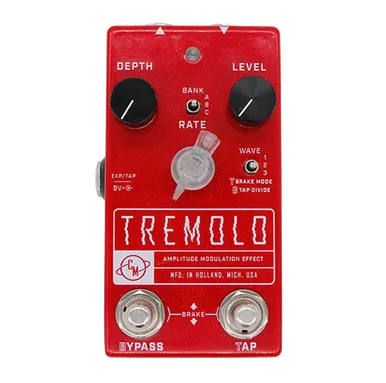
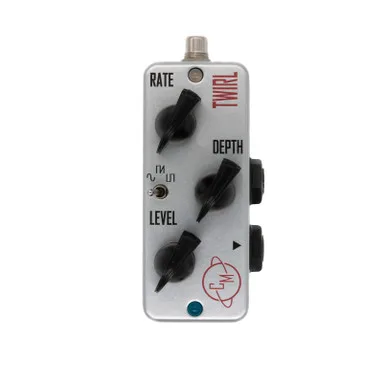
Cusack Music has built other pedals on the Tap-A-Whirl's tap-tempo foundation. The Cusack Tremolo AME is described as based on the renowned Tap-A-Whirl, the world's first analog tap tremolo pedal, with the AME listing at $300.0011. The Cusack Twirl is a related compact option.
Videos
Cusack Music
musictoyznetwork rasch
TheToneShack
Questions
Does the Cusack Tap-A-Whirl run on a battery?
The original Tap-A-Whirl and the V2 and V3 ran on a 9V battery, with the input jack doubling as the power switch so you unplug it when not playing to save battery life. The V3 also lists a standard center negative 9V DC supply or a 9V battery, neither included. The V4's power listing specifies a standard 9V DC center negative supply.
Is the Tap-A-Whirl true bypass?
The V4 uses a buffered bypass based on the Cusack More Louder circuit, not true bypass. On the V3, the manual states that in stereo mode both outputs are true bypassed. The original V1 simply bypassed the audio when switched off.
Can the Tap-A-Whirl sync to MIDI clock?
Yes, with added hardware. Molten Voltage documented the Tap-A-Whirl among pedals that can sync to MIDI Clock using its CTL-Sync device, the Classic Effect Sync. The V4 also has a dedicated Exp./Tap/Sync input that auto-detects the input type.
Is the Tap-A-Whirl stereo?
The V3 and V4 are. The V4 has a full stereo signal path, and the V3's right output is a modified inversion of the left channel, which Cusack describes as useful for ultra-wide soundscapes. The V3 has an internal stereo/mono jumper, and using a mono plug in stereo mode loads down the bypassed signal.
What waveforms does the Tap-A-Whirl have?
The V3 and V4 offer 24 waveforms. The original had eight, selected by the Wave knob in order: sine, ramp, blip, long blip, square, waver, echo, and ping pong. On the V2, 24 waveforms were available with the optional bank switch, and the V4's bank C contains odd time signatures that interact with the tempo divide feature.
How many presets does the Tap-A-Whirl V4 store?
Eight. The V4 has four banks, each storing a preset for the left and right footswitches, and the banks cycle red, green, blue, and pink. The pedal runs in Live mode or Preset mode, and in Preset mode tapping the footswitch engages the stored preset.
Sources (11)
- Cusack Tap-a-Whirl V4 Tremolo, Delicious Audio, 2024-06-10
- The JHS Pedals KODIAK Tap Tempo Tremolo is HERE! (2018), JHS Pedals (YouTube), 2018-09-13
- Tap-a-Whirl V4 Analog Tap Tempo Tremolo, Cusack Music
- Tap-a-Whirl Analog Tremolo with Tap Tempo, Cusack Music
- Date: 12/13/03, Cusack Music, 2003-12-13
- on:, Cusack Music, 2011-07-21
- Microsoft Word, Cusack Music, 2023
- TaW v4 Manual.ai, Cusack Music, 2023
- MIDI PedalBoard Devices: Guitar Effect Pedals that Sync to MIDI Clock, Molten Voltage (blog.moltenvoltage.com), 2014-10-07
- Cusack Screamer & Screamer Fuzz, Guitar World, 2008-03-27
- Tremolo AME with Tap: Mini Tap Tempo Tremolo, Cusack Music