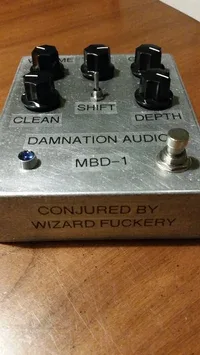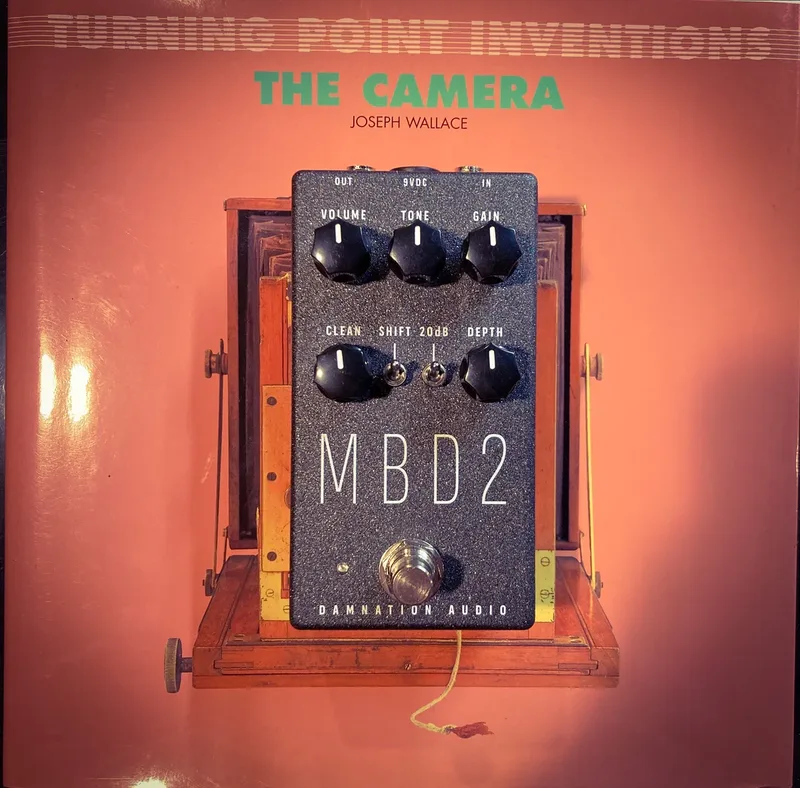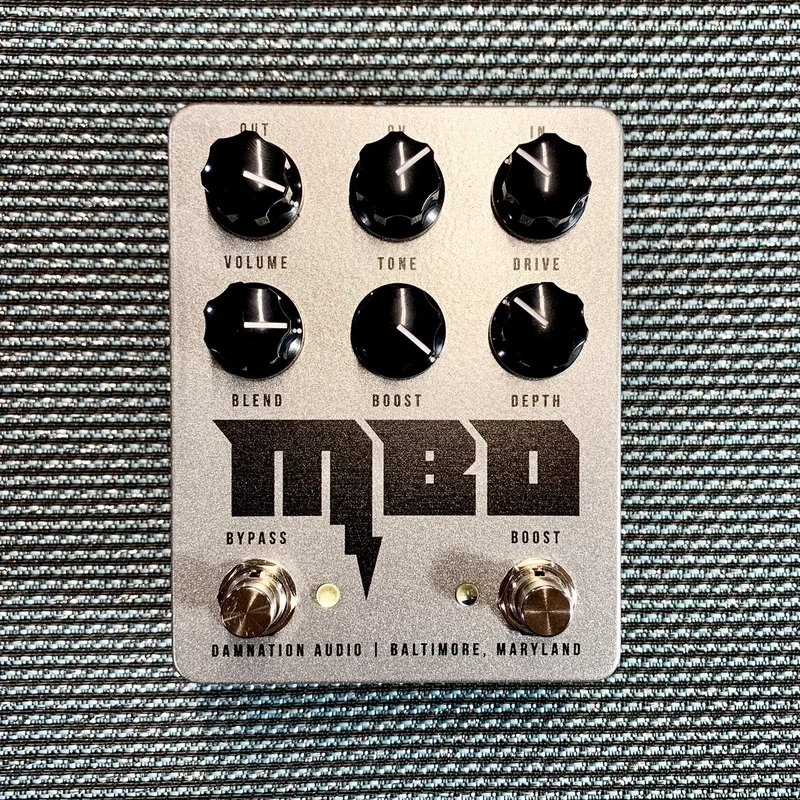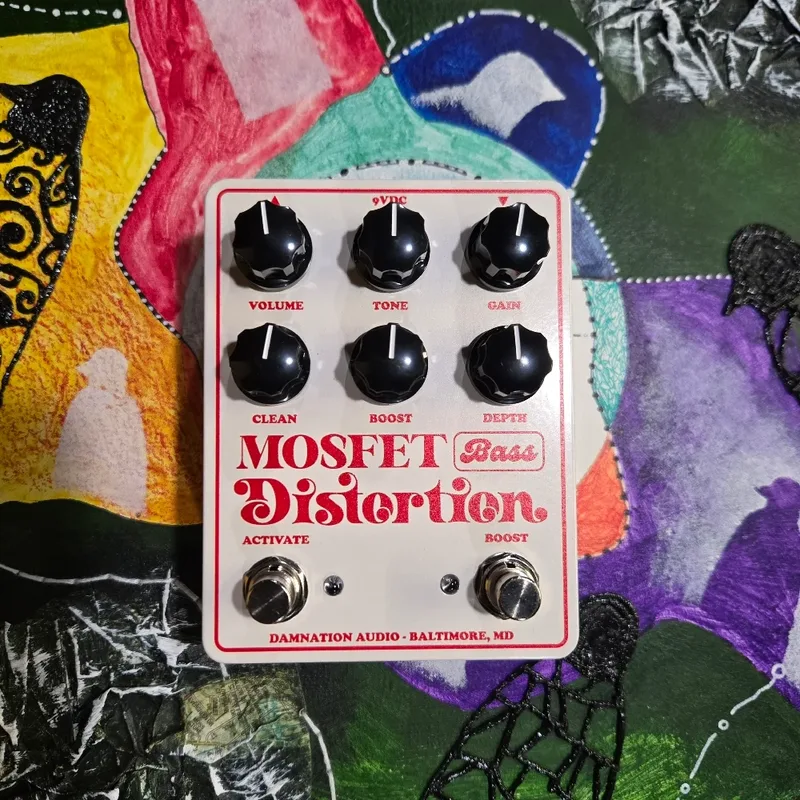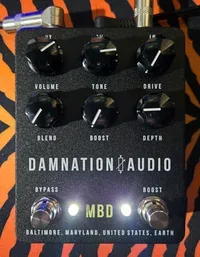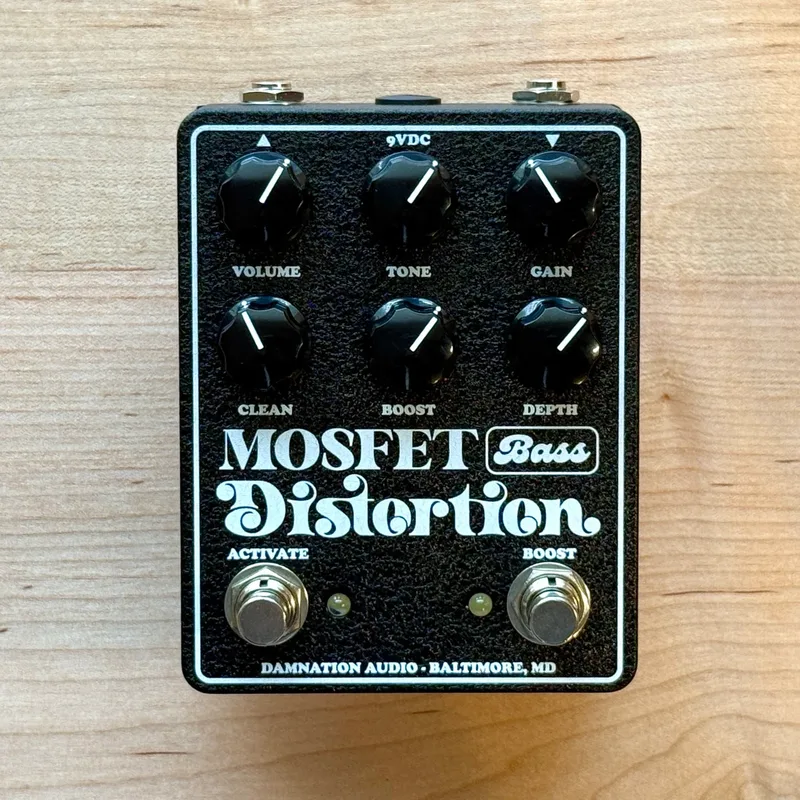


The Damnation Audio MBD is a bass overdrive and distortion pedal, the follow-up to the maker's original MBD-1 and MBD2 pedals. Damnation Audio describes it as keeping the same bass-loving MOSFET distortion at its heart as the original, while adding enhancements customers had asked for, most notably a newly designed contoured clean blend and a boost footswitch with a boost control providing over 30dB of additional gain1.
The core idea is a two-channel design: a distortion channel with its own volume, gain and tone controls, running in parallel with a contoured clean channel that keeps your low end intact while the distortion does its work. As of late October 2026 the MBD is listed as sold out on Damnation Audio's product page, at a list price of $249.001.
The controls
The MBD's front panel splits between the distortion channel and the parallel clean channel, plus the boost function. Here is what each control does, as described by Damnation Audio1:
| Control | What it does |
|---|---|
| Volume | Controls the output level of the distortion channel |
| Gain (Drive) | Controls the amount of gain in the distortion channel, from a smooth and transparent low gain overdrive to a screaming bass distortion |
| Tone | Tilt-style tone control for the distortion channel, centered around 600Hz |
| Clean (Blend) | Controls the output level of the parallel contoured clean channel |
| Boost | Adds additional boosted signal into the gain stages; does not affect the clean blend circuitry |
The clean channel deserves a note of its own. Damnation Audio describes it as your clean tone but with an emphasis on low end and a de-emphasis on what it calls disruptive mids and highs1. In practice that means the blend knob is not a simple dry/wet mix: the clean side is already voiced to sit under the distortion, keeping fundamentals solid while the distorted channel carries the grind.
The tone control is a tilt design centered at 600Hz1, so a single knob trades brightness against thickness around that point rather than cutting or boosting one fixed band.
The boost
The boost footswitch is the MBD's headline addition over its predecessors. The boost control provides over 30dB of additional gain1, and Damnation Audio is specific about where that gain goes: it feeds the gain stages, not the clean blend. The maker says that with the help of the depth control, the boost takes the MBD from distortion to close to fuzz territory1. For a bassist, that means one pedal can cover low gain overdrive, full distortion and near-fuzz without touching the clean blend setting.
Power
The MBD runs on a 9VDC power adapter with a 2.1mm center negative, boss-style plug1, the same standard used by most modern pedals and pedalboard power supplies.
Damnation Audio pedals do not accept 9V batteries, and the maker warns that going above 9VDC may damage the pedal and void any warranties1. A regulated 9V supply is required; there is no battery option.
Versions: the MBD-1, MBD2 and this follow-up
The MBD sits at the end of a line of three pedals. The MBD-1 MOSFET Bass Distortion came first; Damnation Audio now lists it in its retired category, posted for posterity and long discontinued2. The MBD2 MOSFET Bass Distortion 2 followed as what the maker calls the long awaited follow up to the original MBD-13.
The MBD2 brought its own changes, which Damnation Audio lists as:
- A smaller enclosure with top jacks
- An external boost switch capable of adding 20dB
- Silent bypass switching
- A new look3
The MBD2 also carries over the depth control, which Damnation Audio describes as controlling the amount of low end injected into the distortion channel: settings below 12:00 tighten the distortion for drop-tuned basses, while higher settings thicken bright basses and add mass to standard-tuned instruments3.
The current MBD then refined the formula again. Damnation Audio says the heart of the MBD is the same bass-loving distortion as the original, but with a few enhancements customers have longed for, including the newly designed contoured clean blend1. Compared with the MBD2's external 20dB boost switch, the MBD moves to a boost footswitch with a control providing over 30dB of additional gain13.
Finishes and the 10th Anniversary edition
The MBD has appeared in more than one finish. The Silver MBD and Red Text MBD are both listed by Damnation Audio as MOSFET Bass Distortion pedals in the MBD line, both sold out as of October 2026, with the Silver at $249.00 and the Red Text at $224.10 to $249.0045.
There is also the MBD 10th Anniversary edition, a limited batch made to celebrate 10 years of building MBDs. Damnation Audio describes it as V3 specs with V1 aesthetics, meaning the current circuit in the look of the original pedal, priced at $249.006. Like the standard versions, it runs on 9VDC center negative power only, with no battery option6.
Where it sits in the range
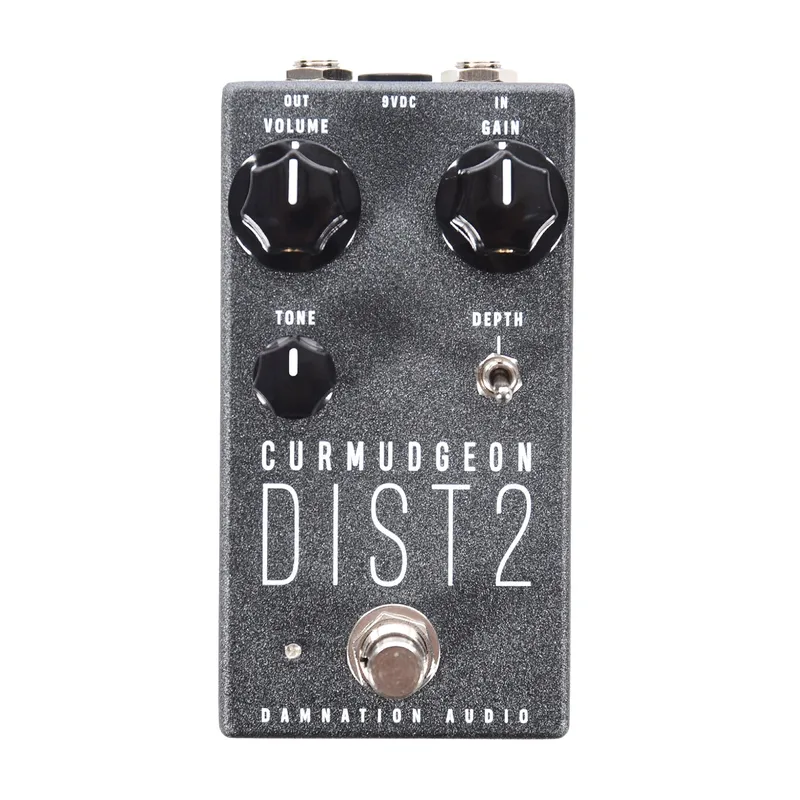
Damnation Audio builds a wider line of bass dirt pedals than the MBD family alone, including the Curmudgeon 2, the Retro Bass Distortion and the Pet Symmetry BIG Pedal. Within that range the MBD is the maker's parallel-clean-blend overdrive and distortion: the pedal to look at if you want distortion and a contoured clean low end in one box, with a boost that pushes toward fuzz1.
Videos
Damnation Audio
MrExcane
MrExcane
Questions
Can the Damnation Audio MBD run on a 9V battery?
No. Damnation Audio states plainly that its pedals do not accept 9V batteries, and the MBD is no exception. It needs an external 9VDC power adapter with a 2.1mm center negative, boss-style plug. There is no battery compartment, so a pedalboard power supply or a standalone adapter is required.
What power supply does the Damnation Audio MBD need?
Use only a 9VDC adapter with a 2.1mm center negative (boss-style) plug, the same standard as most modern pedals. Damnation Audio warns that going above 9VDC may damage the pedal and void any warranties, so higher-voltage supplies should be kept away from it.
Is the Damnation Audio MBD still available?
As of late October 2026 the MBD is listed as sold out on Damnation Audio's own product page, at a list price of $249.00. The Silver MBD and Red Text MBD finishes are also sold out. The original MBD-1 is long discontinued and posted on the maker's site for posterity.
What is the difference between the MBD and the MBD-1?
Damnation Audio describes the MBD as having the same bass-loving distortion at its heart as the original MBD-1, but with enhancements customers asked for, including a newly designed contoured clean blend and a boost footswitch with its own control. The MBD-1 itself is long discontinued.
How much extra gain does the MBD boost add?
The boost footswitch has its own boost control providing over 30dB of additional gain. Damnation Audio says the boost feeds the gain stages rather than the clean blend, and that with the depth control it can take the MBD from distortion to close to fuzz territory.
Sources (6)
- MBD | Bass Overdrive & Distortion Pedal | Damnation Audio | Heavy Bass Effects, Damnation Audio
- MBD-1 MOSFET Bass Distortion, Damnation Audio
- MBD2 MOSFET Bass Distortion 2, Damnation Audio
- RED TEXT MBD, Damnation Audio
- SILVER MBD, Damnation Audio
- MBD 10th Anniversary, Damnation Audio