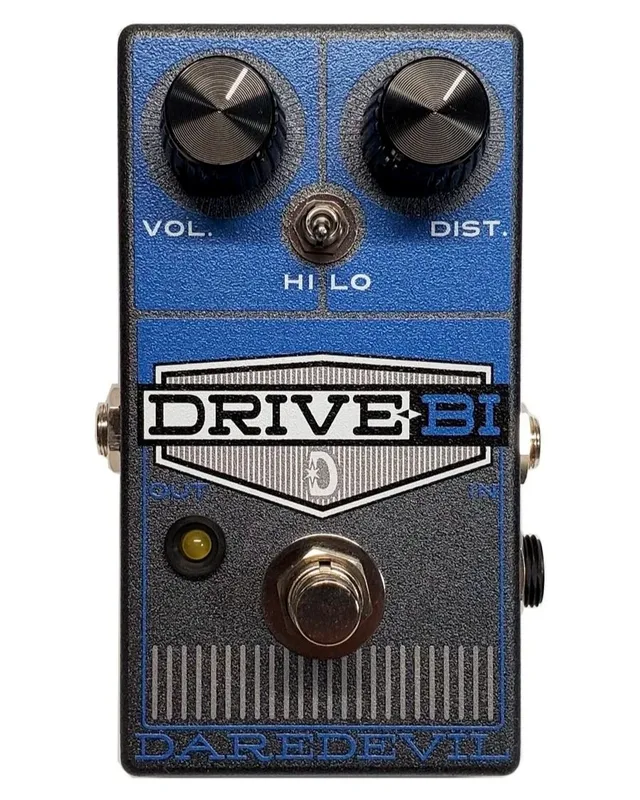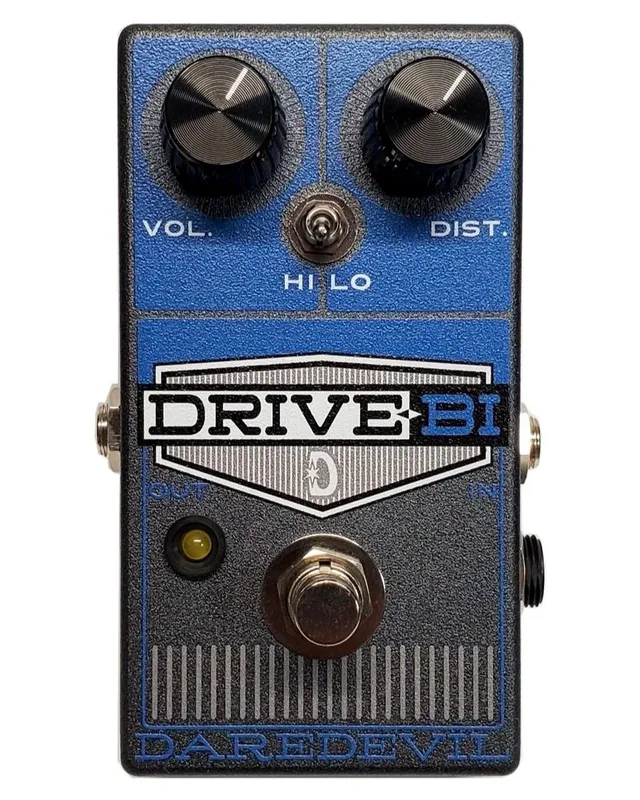


The Daredevil Pedals Drive-Bi is a dual gain distortion pedal built around an op-amp gain circuit, with two channels of distortion, low and Hi, selected by a switch. It sits in the same territory as other overdrive pedals and distortion pedals: a gain stage in front of the amp that can go from added grit to heavier saturation. Daredevil describes it as keeping a natural amp sound with rich harmonics, and lists it at $169.00 USD as of 26 October 20261.
Two channels of op-amp distortion
The Drive-Bi is, in Daredevil's words, "a dual channel, op-amp gain circuit"1. Op-amp based drive pedals use an operational amplifier chip as the gain stage, an approach that goes back to many of the classic overdrive and distortion designs, and it gives the pedal its two channels of distortion, low and Hi1. The two channels are not separate footswitchable voices in the way a preset pedal might be: the HI/LOW switch selects between them, so the pedal covers two levels of drive from one enclosure1.
Daredevil describes the two channels this way:
- Low channel: "adds grit, sustain, and overdrive to your amp while still pushing output"1
- Hi gain mode: "expands low end, saturation, and output compression for huge warm tones"1
The maker also notes the pedal is "Great for solo boosts as well"1, meaning it can be run with the Gain low and the Volume up to push the amp louder, in the manner of a dedicated boost pedal.
The controls: Volume, Gain and a Hi/Low switch
The Drive-Bi keeps its panel simple: two knobs and a switch1.
| Control | What it does |
|---|---|
| VOLUME | Controls effect output1 |
| GAIN | Amount of circuit drive1 |
| HI / LOW | Selects between both channels of gain1 |
That is the whole layout. The controls are the VOLUME knob, which controls effect output, the GAIN knob, which sets the amount of circuit drive, and the HI / LOW switch, which selects between both channels of gain. There is no tone control, so the pedal's voicing is set by the two channels and the amp it feeds, and players who shape top end on the pedal itself will do it with the guitar's tone knob or an equalization pedal elsewhere on the board1.
Power and bypass
The Drive-Bi is true bypass and runs on a 9V battery or a DC supply1. True bypass means the effect is removed from the signal path entirely when off, which matters on a crowded board. Because it takes a battery as well as DC, it can be used without a power supply, and a standard DC connection covers pedalboard use.
Daredevil's product page gives the power options as a 9V battery or DC supply but does not list a current draw or a barrel polarity for the DC input1. If your board's power supply labels its outputs by current, that figure is not published on the maker's page.
Related circuits
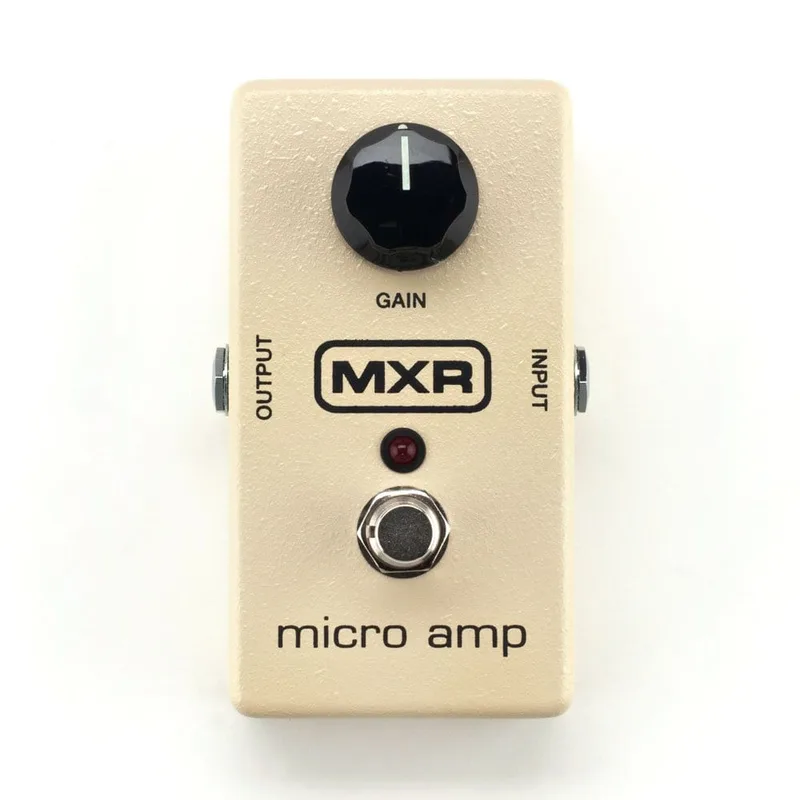
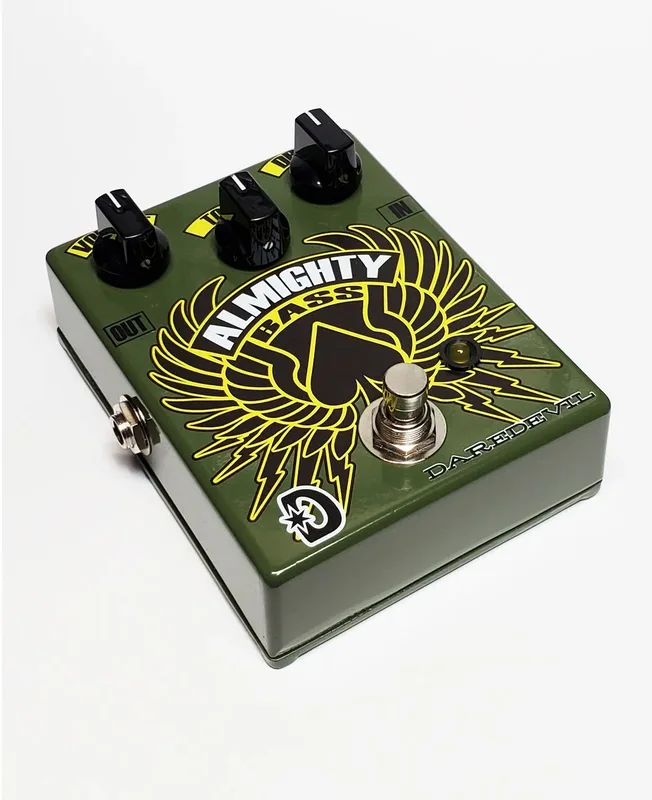
Daredevil's dual gain distortion design has traveled further than this pedal. Jim Dunlop's manual for the Jail Guitar Doors Drive describes how that pedal's circuit came to fuse Daredevil's Drive-Bi Dual Gain Distortion with the MXR Micro Amp, putting the two circuits in one box2. Players interested in that pairing can read about it in the Jail Guitar Doors Drive manual, and Daredevil's range also includes bass-oriented designs such as the Daredevil Pedals Daredevil Almighty Bass1.
Videos
Daredevil Pedals
Daredevil Pedals
R.J. Ronquillo
Questions
Does the Daredevil Drive-Bi take a 9V battery?
Yes. Daredevil Pedals states the Drive-Bi runs on a 9V battery or a DC supply, so it can be powered either way. That makes it easy to try on a bench or a small board without a dedicated power supply, though a standard center-negative DC supply is the usual choice once the pedal lives on a pedalboard.
Is the Daredevil Drive-Bi true bypass?
Yes. According to the maker's product page, the Drive-Bi is true bypass, so when it is switched off the signal passes through without the pedal's circuit loading it. That matters on a pedalboard where several pedals sit between the guitar and the amp.
Can the Drive-Bi be used as a solo boost?
Daredevil Pedals says the Drive-Bi is great for solo boosts as well. With the Gain knob backed off and the Volume knob up, the pedal can push the amp's front end louder without heavy distortion, which is a common way players use a two-channel drive on a board.
What is the difference between the Low and Hi channels on the Drive-Bi?
The HI/LOW switch selects between the pedal's two channels of gain. Daredevil describes the Low channel as adding grit, sustain, and overdrive to your amp while still pushing output. The Hi gain mode expands low end, saturation, and output compression for huge warm tones, so it is the heavier of the two settings.