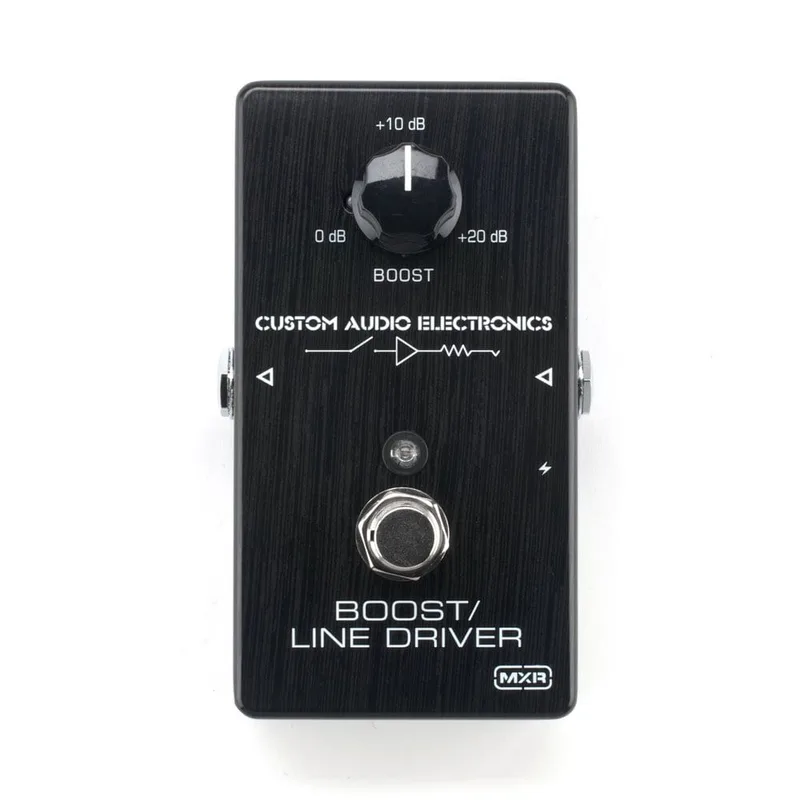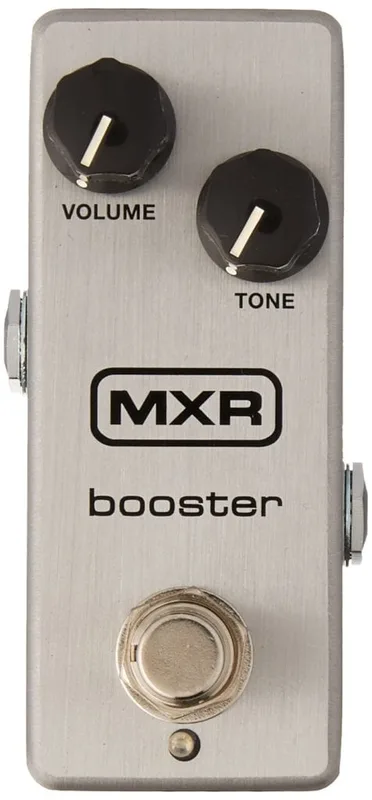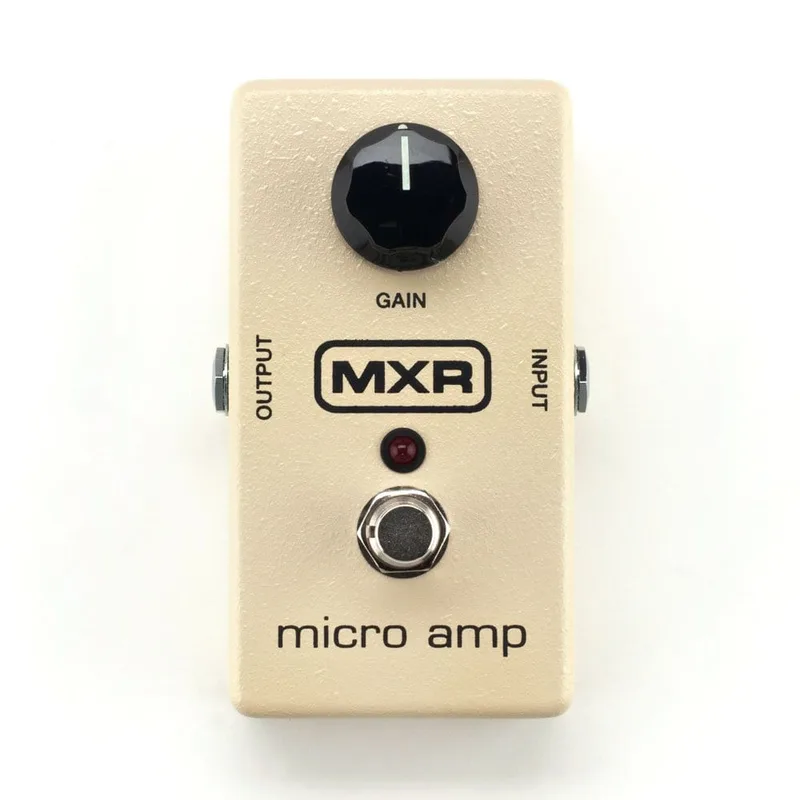


The MXR Micro Amp is a clean boost pedal made by MXR that raises your guitar signal by up to +26dB without adding distortion or changing your tone. It is about as simple as a pedal gets: one knob, one footswitch, one op-amp. MXR describes it as a way to "boost your signal with a preset amount of gain up to +26dB," and notes it can also serve as a permanent boost in a long effects chain where signal drop off is a problem1.
The design goal, according to GuitarPCB's technical analysis, is transparency: "The MXR Micro Amp is designed to be a transparent clean volume booster; it does not color or modify the guitar tone." The whole circuit uses only one op-amp and one potentiometer2. MXR says it has been a staple among top artists for more than 20 years3.
What it does to your sound
The Micro Amp is a flat, clean volume boost. Its circuit is, as Guitar.com's boost pedal guide puts it, "a simple op-amp, dialled in with enough headroom to give a big boost of signal without any extra clipping"10. That makes it useful in two very different ways, and Premier Guitar's tone advice lays out both:
"Hit the front end of your clean amp with it and it'll raise your volume substantially. Hit the front of an already dirty amplifier and you can pummel your amp into submission!"
So into a clean amp it is a solo or volume switch; into an amp already breaking up it pushes the front end harder for more saturation. The M133 manual adds a practical use: it is "perfect for switching between guitars with unmatched output," letting you level up a quieter instrument6.
Controls, switching and jacks
The control surface is minimal:
| Control | What it does |
|---|---|
| GAIN knob | Controls the overall amount of signal boost, +0.5 dB to +26 dB; clockwise increases it, counterclockwise decreases it65 |
| FOOTSWITCH | Toggles effect on/bypass; a red LED indicates on6 |
| INPUT jack | Connects a cable from your guitar6 |
| OUTPUT jack | Connects a cable to your amplifier6 |
The manual suggests starting with the control at 12 o'clock and adjusting from there6. Guitar World's buying guide describes the same behavior in plainer terms: "To increase the gain, turn clockwise (with up to 26dB of gain on tap); to reduce it, turn counterclockwise"5.
Note that the original 1970s release had neither the LED nor a power adapter jack. MusicRadar reports it "was originally issued without an on/off LED, or the means to accept an external power supply," and that its TL061 op-amp was chosen specifically for its low current draw, which let it run a long time on a battery8.
The M133's bypass is Hardwire, not true bypass6. Players who want true bypass switching should look at the MXR Micro Amp +, which has it.
Power
The Micro Amp runs on 9 volts DC and draws only 2.5 mA6. Power options, per the product page and manual16:
- One 9-volt battery (remove the bottom plate to install)
- A Dunlop ECB003 or ECB003E 9-volt adapter
- Dunlop DC Brick, Iso-Brick and Mini Iso-Brick power supplies (not included)
That 2.5 mA draw is low enough that the pedal is easy on a shared power supply, and the battery option means it works on a board with no power distribution at all6.
History: the M133 and its Distortion+ cousin
The Micro Amp belongs to MXR's first Reference Series, released between 1973 and 19842. MusicRadar dates it to the early 70s as part of that series8, while Guitar World's buying guide gives 1978 for the first M133 Micro Amp pedal5. TONEHOME's page for the vintage unit records it as made in Rochester, New York, in 1980, with a 1982 German list price of 142,50 DM12. The dates differ across accounts, so the mid-to-late 1970s is the window to keep in mind.
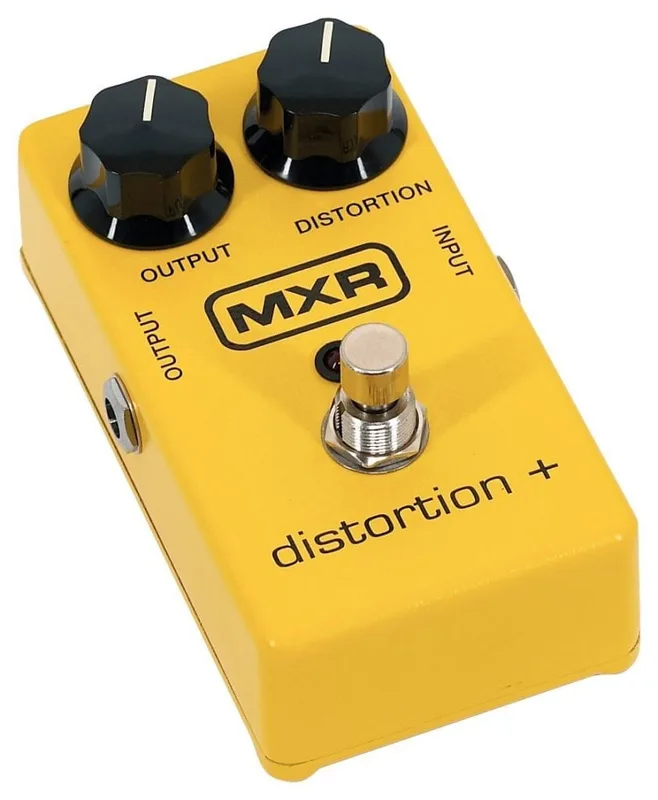
Its family relationship is with MXR's Distortion+. MusicRadar calls the Micro Amp "a close non-distorting cousin, of MXR's Distortion+"8, and Delicious Audio's review coverage notes that these classic 70s and 80s pedals, along with the DOD 250, "have the same basic circuit"13. The difference is intent: the Micro Amp's op-amp is set up for headroom and clean boost, not clipping.
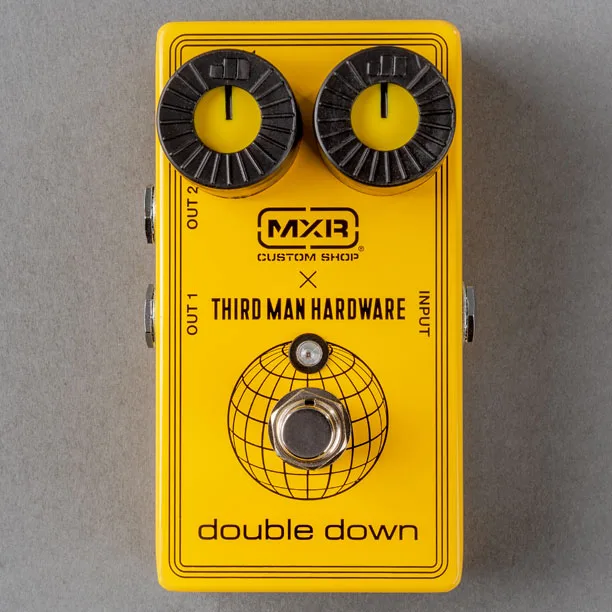
The circuit has stayed in production and in circulation. Gearnews notes "the original Micro Amp became famous for its simple one-knob boost sound" as a studio and live favorite14, and the circuit was reused in 2022 in the Third Man Hardware Double Down, a stereo two-channel take on the Micro Amp built with MXR for Jack White's Third Man Records1415.
The Micro Amp+ difference
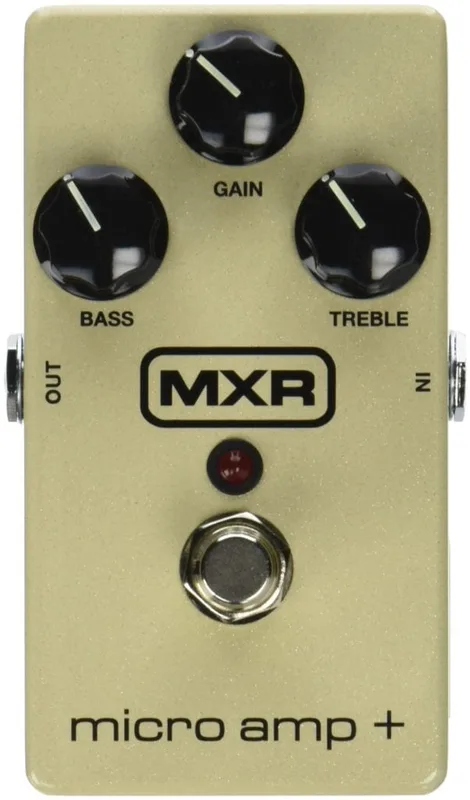
The MXR Micro Amp + (M233) builds on the original with EQ and other upgrades4. Side by side:
| Micro Amp (M133) | Micro Amp+ (M233) | |
|---|---|---|
| Maximum gain | +26dB125 | +26dB4 |
| Controls | GAIN only51617 | GAIN, BASS, TREBLE51617 |
| Bass control | none | cuts or boosts low frequencies, ±14 dB at 33 Hz4 |
| Bypass | Hardwire6 | True bypass314 |
| Current draw | 2.5 mA6 | 6.5 mA4 |
Guitar.com describes the Micro Amp+ variant as adding "a clean, active two-band EQ for extra shaping"10, and MusicRadar notes it also brings a lower-noise circuit8. Gearnews reports MXR upgraded the circuit with low-noise op-amps and true-bypass switching14. The Plus was shown at the Jim Dunlop booth at NAMM 201418.
What reviewers said
Published reviewers have been consistent about what the Micro Amp does well, with some reservations about price. Guitar World's 2026 boost pedal buying guide found it "great for coaxing extra saturation from a Big Muff or getting your leads to jump out in a band mix," while also noting it is no longer the cheapest option in its class5. Premier Guitar has referred to the Micro Amp as "its legendary Micro Amp" circuit in review coverage19.
On bass, the evidence is direct: Flea of the Red Hot Chili Peppers uses an MXR Micro Amp as a clean boost for slapping and leads, per Premier Guitar's rig rundown of his setup20.
Jack White and the Micro Amp
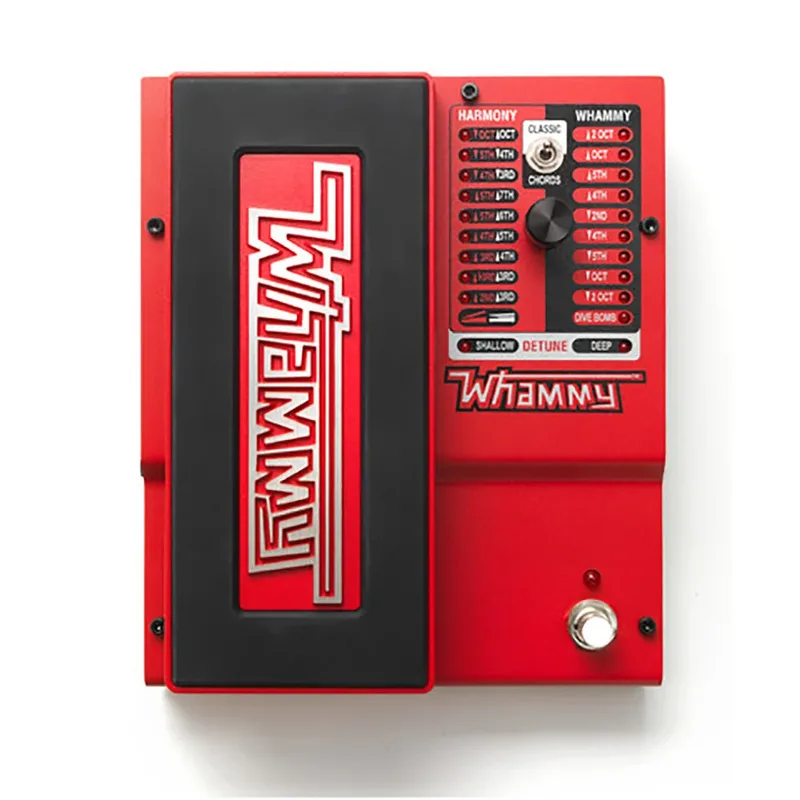
Jack White is a long-time user of the pedal. Guitar World reports his "own personal affinity for the original Micro Amp, which he estimates he switched to in 1997," after moving away from the DigiTech Whammy, and describes the original as "featuring a sole output, gain level control and single bypass footswitch"16. That affinity led to the Third Man Hardware Double Down with MXR, which Premier Guitar describes as "a stereo take on MXR's classic Micro Amp preamp pedal"15.
Videos
ProGuitarShopDemos
Reverb
Jack Griffiths
Questions
Is the MXR Micro Amp true bypass?
No. The M133 Micro Amp's manual lists its bypass as Hardwire, not true bypass. The Micro Amp+ (M233) is the version with true bypass switching, along with low-noise op-amps and EQ controls. If true bypass matters to your rig, the Micro Amp+ is the version that has it.
Does the MXR Micro Amp work on bass?
Yes. Flea of the Red Hot Chili Peppers uses an MXR Micro Amp as a clean boost for slapping and leads, according to Premier Guitar's rig rundown. The pedal's flat frequency response means it does not thin out low notes. The Micro Amp+ goes further, with a Bass control offering plus or minus 14dB at 33Hz.
Where should a Micro Amp go in the signal chain?
It depends what you want from it. Into a clean amp it raises volume substantially; into an already dirty amp it can drive the front end harder, as Premier Guitar's tone advice puts it. MXR also notes it can sit in a long effects chain as a permanent boost where signal drop off is a problem.
What is the difference between the Micro Amp and the Micro Amp+?
The Micro Amp+ (M233) keeps the same +26dB maximum gain but adds a clean, active two-band EQ with Bass and Treble controls, low-noise op-amps, and true bypass switching. The original M133 has a single Gain knob, hardwire bypass, and draws 2.5mA versus the Micro Amp+'s 6.5mA.
Is the Micro Amp the same circuit as the Distortion+?
They are close relatives but not identical. MusicRadar calls the Micro Amp a close, non-distorting cousin of the Distortion+, and Delicious Audio notes the classic 70s and 80s pedals share the same basic circuit. The Micro Amp is built for clean boost with no clipping, where the Distortion+ is a distortion pedal.
Sources (20)
- MXR® MICRO AMP, Dunlop (www.jimdunlop.com)
- MXR MicroAmp Analysis, GuitarPCB (guitarpcb.com)
- MXR® MICRO AMP+, Jim Dunlop (jimdunlop.com)
- M233.pdf, Dunlop Manufacturing, Inc., 2019
- Best boost pedals 2026: including the best clean boost pedals for guitar, Guitar World, 2020-07-01
- M133.pdf, Dunlop Manufacturing, Inc., 2019
- MXR™ MicroAmp™ Clone: DIY Boost Pedal Kit, PCB & Schematic, General Guitar Gadgets, 2014-05-12
- Meet your maker: MXR at 40, MusicRadar, 2014-12-04
- MXR® PRIME DISTORTION, Jim Dunlop (jimdunlop.com)
- Need a lift in signal? Boost pedals explained, Guitar.com, 2025-08-28
- Guide to Overdrives, Distortions, and Boost Pedals, Premier Guitar, 2016-02-22
- TONEHOME, TONEHOME, 1982
- Pedal Review: VFE Distortion3, Delicious Audio, 2012-08-02
- The 7 Best Boost Pedals of 2026: Make it Louder Better!, www.gearnews.com, 2026-05-11
- Jack White & MXR Unveil Double Down Preamp, Premier Guitar, 2022-12-09
- Jack White delivers a pedal demo for the ages as Third Man Hardware partners with MXR for the Double Down, Guitar World, 2022-12-09
- The 10 best boost pedals for guitarists 2026, from budget to boutique, Guitar.com
- NAMM 2014 Video: Jim Dunlop Pedals -MXR Phase 99, Micro Amp Plus, La Machine, Way Huge Swollen Pickle, Fuzz Face Mini and More, Guitar World, 2014-02-03
- Quick Hit: MXR Booster Mini Review, Premier Guitar, 2017-12-28
- Rig Rundown, Premier Guitar, 2012-06-03
 Jack White