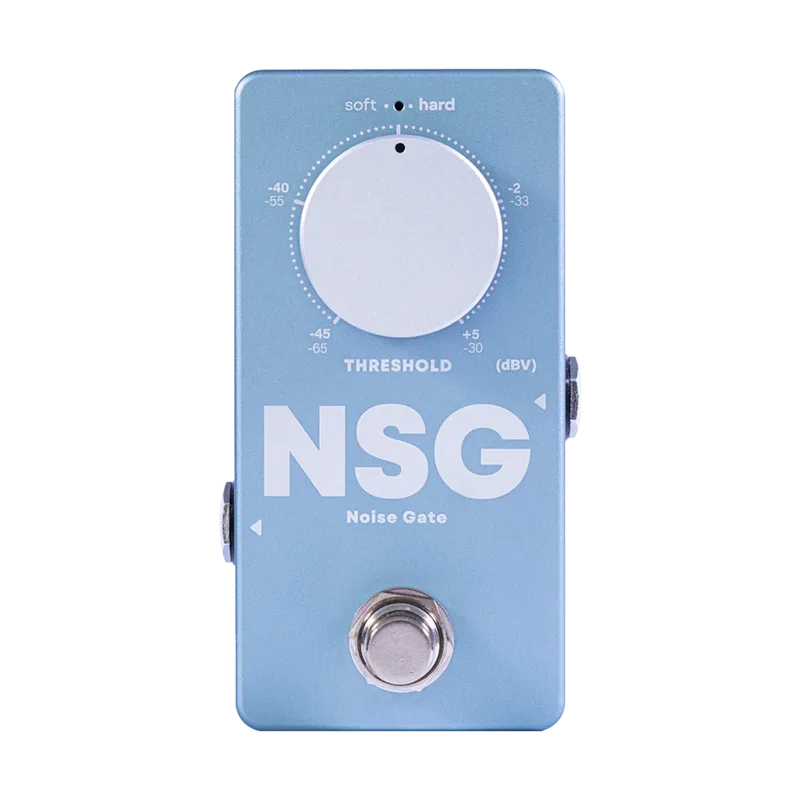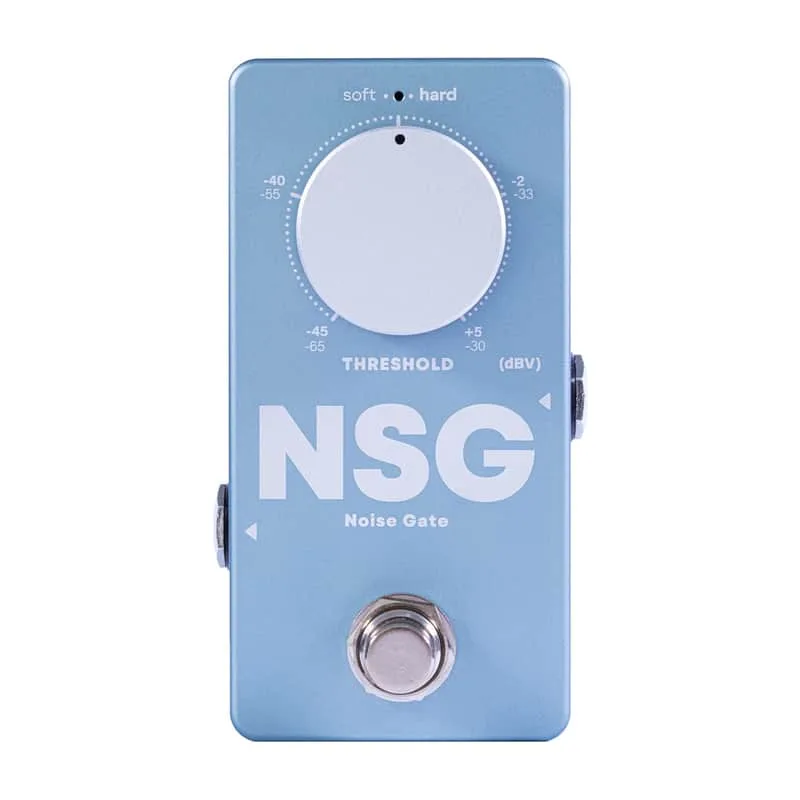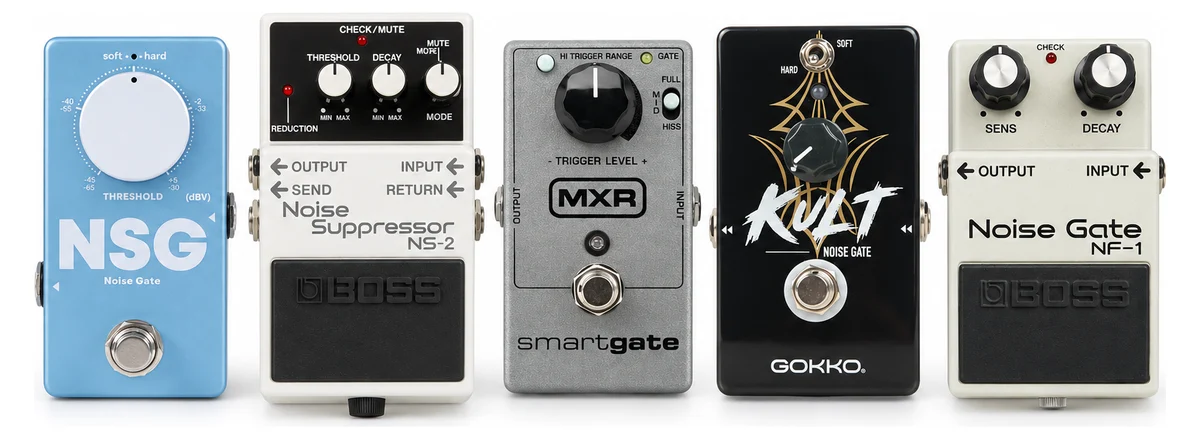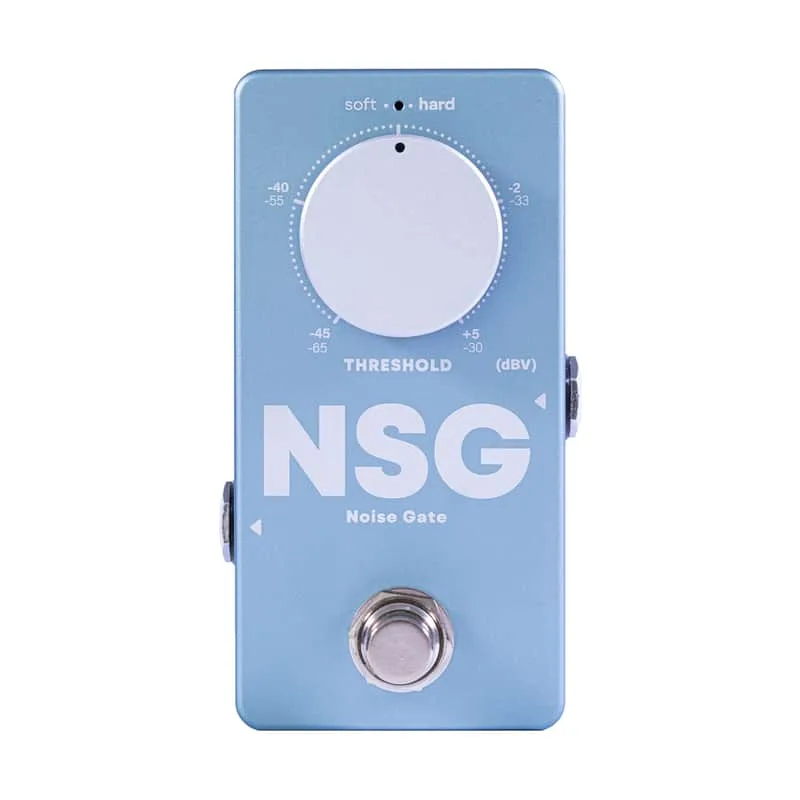


The Darkglass Noise Gate is a noise gate pedal from Darkglass, the Finnish maker best known for bass preamps and distortion pedals. A noise gate does one job: as BOSS's own guide puts it, it "clamps down and eliminates any signal below a certain threshold," which makes it a more abrupt tool than a noise suppressor1. Place it in your chain and it silences the hiss, hum and handling noise that appears whenever you stop playing, especially with high-gain distortion or a cranked amp.
What sets this pedal apart is how little there is to it. The whole interface is one push knob: turn it to set the threshold, press it to change modes. GuitarPlayer's buying guide describes it as having "a simple threshold control acting as your sole control option"2.
How the gate works
A threshold control, as Guitar World explains, "sets the level at which the gate will 'open' and let signal through"5. Signal above the threshold passes; signal below it is cut. For a player, that means setting the knob just above your noise floor: quiet enough that your playing flows through untouched, high enough that hum and hiss disappear between phrases.
The trade-off with any gate is abruptness. Kit Rae's technical analysis of gating notes that "a poor quality noise gate, or one set too high, can cause the sound to have a pronounced on-and-off rather than a smooth fade off or on"6. That is the problem the Darkglass pedal's two modes address.
The controls: one push knob
The single control does both jobs. From the manual: "Use this push knob to control the threshold of the noise gate. Press the knob to switch between the 'Soft' mode (Blue LED color) for softer gain reduction and 'Hard' (Red LED color) for the more aggressive gate operation"4.
| Control | What it does |
|---|---|
| Threshold knob (push) | Turn to set the level where the gate opens; press to switch between Soft and Hard modes3 |
| Soft mode (blue LED) | Softer gain reduction3 |
| Hard mode (red LED) | More aggressive gate operation3 |
The threshold range depends on which mode you are in:
Soft mode reaches down to very low thresholds and tops out at -30 dBV, which suits gentler gating of a modest noise floor. Hard mode extends up to +5 dBV, so it can be set to open only at genuinely loud signal levels, the kind of firm gating high-gain players often want between chords3.
Soft and Hard mode compared
The two modes differ in both character and range. Soft mode applies softer gain reduction, so the volume falls away more gradually rather than snapping off. Hard mode is the more aggressive gate operation, cutting noise more decisively3.
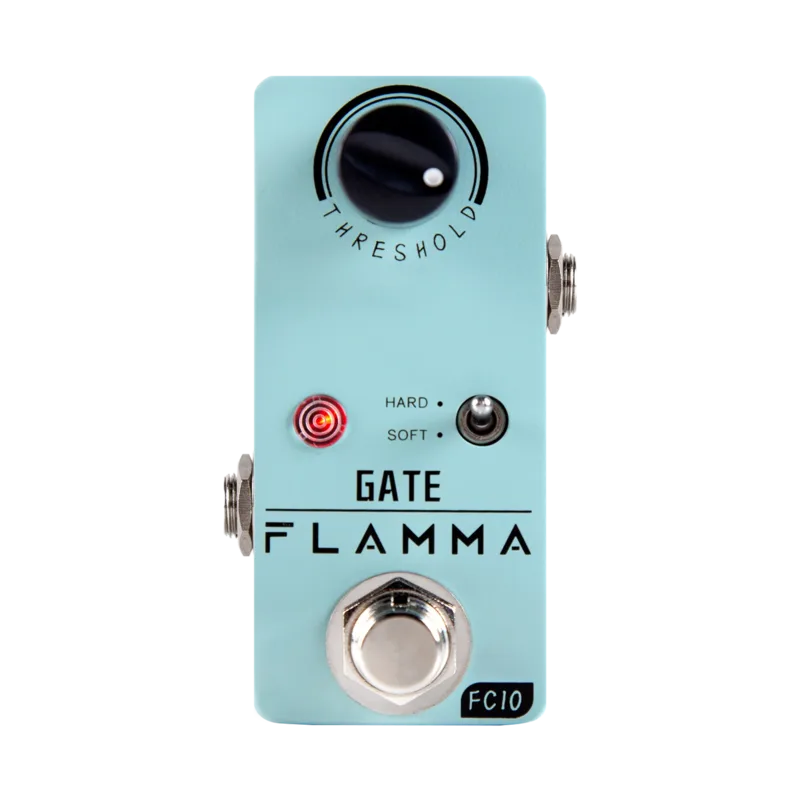
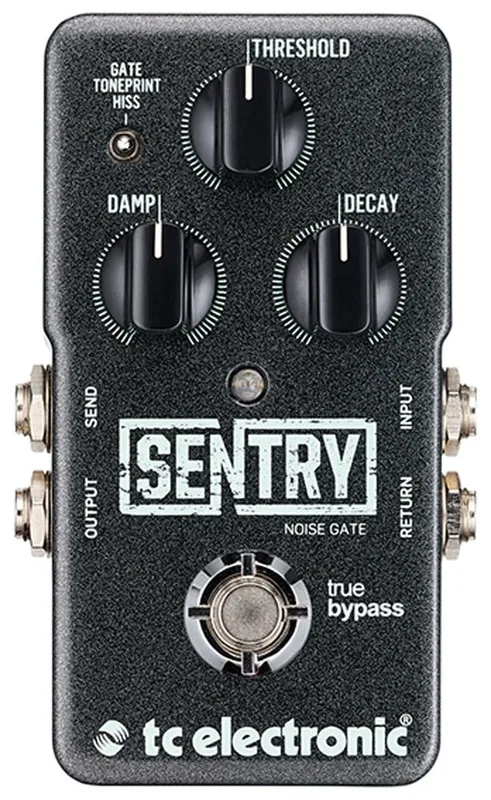
The two-mode idea is not unique to Darkglass. The Flamma Innovation FC10 Noise Gate uses a toggle switch that "goes between Hard and Soft modes, for varying degrees or noise reduction"7, and the TC Electronic Sentry offers a hard-gate mode aimed at "heavy players who demand instant noise" removal. Where those pedals use a separate switch, Darkglass folds the mode change into the knob itself, keeping the enclosure small: 50 mm wide, 36,5 mm long and 45 mm tall, at 205 g3.
Power and connections
The Darkglass Noise Gate has no battery option. The manual instructs: "Only use a regulated 9V DC adapter with a center-negative plug"4. Unregulated supplies or higher voltages "may result in suboptimal noise performance and even damage your unit, voiding the warranty"4.
Power requirements are 9V DC center negative with a current consumption of about 60mA3, a figure GuitarPlayer's buying guide corroborates at 60mA2. That draw is modest by pedalboard standards, and the pedal is specified for a regulated adapter only, with no battery option. The pedal presents a 1MΩ input impedance and a 100kΩ output impedance3, the high input value meaning it does not load down passive pickups when placed first in a chain.
Warranty and registration
To activate the warranty, Darkglass asks you to register the pedal at mypedal.darkglass.com using the serial number on the back of the unit4. If a pedal ever needs to go back to the maker, contact support@darkglass.com by email before shipping anything3.
The manual also notes that "in the interest of continuous improvement, specifications are subject to change without notice"3, so the figures on this page reflect the manual as published. The pedal is declared compliant with FCC Part 15 as a Class B digital device and with the European EN55013, EN55020, EN60555-2 and EN60555-3 standards, plus RoHS and WEEE directives4.
Videos
Darkglass Electronics
Erik Arkö
Simon Meunier
Questions
What is the difference between Soft and Hard mode on the Darkglass Noise Gate?
Soft mode, shown by a blue LED, applies softer gain reduction, while Hard mode, shown by a red LED, is the more aggressive gate operation. The threshold range also changes: Soft mode sweeps from -65 dBV to -30 dBV, and Hard mode sweeps from -45 dBV to +5 dBV, so Hard mode can be set to open at much higher signal levels.
Does the Darkglass Noise Gate take a battery?
No. The manual describes powering the pedal only with a regulated 9V DC adapter with a center-negative plug, and there is no battery operation. You will need a pedalboard power supply or a standalone 9V adapter to run it.
What power supply does the Darkglass Noise Gate need?
A regulated 9V DC adapter with a center-negative plug. The manual warns that unregulated power supplies or higher voltages can result in suboptimal noise performance and even damage the unit, voiding the warranty. Current consumption is about 60mA.
How do I register the Darkglass Noise Gate for warranty?
Register the product at mypedal.darkglass.com and enter the serial number printed on the back of the pedal. If you ever need to ship a product to Darkglass, contact support@darkglass.com by email first.
What are the threshold ranges of the Darkglass Noise Gate?
In Soft mode the threshold ranges from -65 dBV to -30 dBV. In Hard mode it ranges from -45 dBV to +5 dBV. Turning the single knob sets where the gate opens within the range of whichever mode is active.
Sources (7)
- The Complete Guide to Noise Gate and Suppressor Pedals, BOSS (articles.boss.info), 2023-11-30
- Best noise gate pedals: control your tone, GuitarPlayer (www.guitarplayer.com), 2024-09-24
- Noise Gate Manual, Darkglass
- Noise Gate Manual, Darkglass
- Best noise gate pedals 2026: clean up your signal, Guitar World, 2021-03-19
- David Gilmour Tone Building, Kit Rae (Kit's Secret Guitar, Gear, and Music Page), 2019-12
- Flamma Innovation FC10 Noise Gate, Pedal of the Day, 2021-08-27