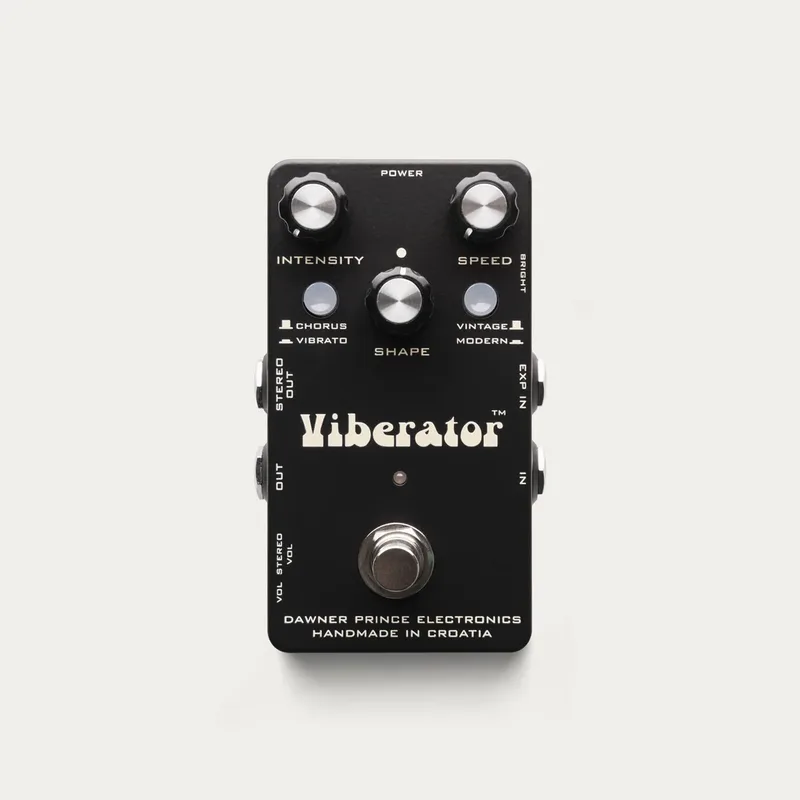



The Dawner Prince Viberator is a stereo Uni-Vibe type phaser pedal: an all-analog recreation of the vintage Uni-Vibe circuit, built with an actual light bulb and matched photocells, the same way the original was made1. Dawner Prince positions it as a premium, stereo version of that classic design, packed into what the maker calls the most compact vibe pedal with true stereo outputs2. It covers both halves of the original's personality: the watery chorus/phasing sound and the de-tuning pitch bend vibrato, selected by a front panel switch2.
The circuit is the bulb-and-photocell design at the heart of every Uni-Vibe clone. A lamp driven by an oscillator lights up a set of photocells, and the changing resistance of those cells sweeps the phase of the signal. The Viberator keeps that mechanism intact, with 100% analog circuitry and matched photocells, and adds modern conveniences the original never had: true bypass, stereo outputs, an expression input, and internal voltage regulation21.
The maker's product page listed the Viberator as Sold Out as of October 20262. The page does not state whether the pedal is discontinued or simply between production runs.
A stereo, all-analog Uni-Vibe
The Viberator's foundation is the original Uni-Vibe circuit, and Dawner Prince is specific about what that means: real light bulb, matched photocells, no digital processing in the signal path1. Where the original was a mono unit in a large chassis, the Viberator is a compact pedal with true stereo outputs, which Dawner Prince says produce a real 3D, rotating speaker sound. In Chorus mode, the signal at the stereo output is a mirror image of the signal at the mono output, so the two outputs sweep against each other rather than in unison2.
The maker also extended the speed range beyond what the original Uni-Vibe offered, and tuned the circuit so the rotary tones stay balanced even at the maximum speed setting, where vintage units could get uneven2. On the tone side, Dawner Prince describes the pedal in its own words:
"Viberator impeccably delivers all those deep, natural and watery phase and shivering vibrato sounds."
RockBoard's PedalPedia listing categorizes the pedal under vibe, phaser and vibrato, with an analog circuit type, and links the maker's English-language manual for anyone who wants the full documentation3.
The controls
The front panel keeps the Uni-Vibe's familiar layout and adds a few controls of its own. Here is what each one does, per the maker2:
| Control | What it does |
|---|---|
| Speed | Adjusts the rate of the pulsations of the vibe (chorus) or vibrato effect |
| Chorus / Vibrato switch | Selects between classic Uni-Vibe chorus and de-tuning pitch bend vibrato mode |
| Vintage / Modern switch | Vintage engages the original Uni-Vibe input circuitry for a warm, slightly darker tone; Modern engages an input FET buffer for a brighter overall tone |
| Shape | Modifies the waveform that drives the internal light bulb, from a perfectly symmetrical sine wave in the middle position to distorted waveforms at either end |
| Volume (per output) | Separate volume controls on the output channels; fully clockwise the outputs sit slightly above unity gain |
Two internal settings round out the picture. The Gain and Offset trims, which set the intensity range and the balance of the sweep, are factory preset and not meant for user adjustment. The Bright side trimmer lets a player fine tune the brightness of Modern mode2.
The Shape control is the one control the original never had. Because it changes the waveform feeding the bulb, it changes the character of the sweep itself: a clean sine in the middle gives the smooth, classic pulse, while the distorted end positions push the sweep toward something more aggressive2.
A bi-color status LED doubles as a visual tempo reference: it flashes in time with the speed setting, and lights yellow when the effect is bypassed or blue when it is engaged2.
Expression control and stereo outputs
The Exp In jack allows the speed of the effect to be controlled with an expression pedal. The Viberator accepts any standard expression or volume pedal with a 10K pot, and Dawner Prince names the Roland EV-5 as an example. Plugging one in automatically disengages the Speed knob, so the pedal takes its rate entirely from the expression pedal, which is useful for ramping into fast rotary swirls or pulling back to a slow throb by foot2.
The stereo outputs are the Viberator's main structural difference from a standard mono vibe pedal. Run into two amps, the mirrored chorus signal in the two channels creates the rotating speaker image the maker describes; in vibrato mode the pitch bend effect applies to the output signal2.
Power: 9V in, 15V inside
The Viberator runs on a standard 9V DC supply through a 5.5mm / 2.1mm barrel connector, center negative2. Inside the pedal, that 9V is converted and regulated up to 15V DC, which is the operating voltage of the original Uni-Vibe circuit. Running the analog circuit at its native voltage from an ordinary pedalboard supply is the point of this arrangement: the player gets Uni-Vibe operating conditions without needing a special 15V power supply2.
Current draw is about 75mA2, which is modest by modern standards but worth noting for anyone planning a daisy chain, since the bulb-driven circuit draws more current than a simple op-amp pedal. The pedal also has internal reverse power polarity protection, so a reversed polarity plug will not damage it2.
Videos
ProGuitarShopDemos
Premier Guitar
Brett Kingman
Questions
Is the Dawner Prince Viberator true bypass?
Yes. Dawner Prince states the Viberator uses a true bypass switching system on both the mono and stereo channels, so the dry signal passes through untouched when the effect is off. The status LED lights yellow when the pedal is bypassed and blue when the effect is engaged, and it flashes in time with the speed setting.
Can I control the Viberator's speed with an expression pedal?
Yes. The Exp In jack accepts any standard expression or volume pedal with a 10K pot, such as a Roland EV-5. Plugging one in automatically disengages the Speed knob, so the pedal sweeps its rate from the expression pedal instead. This works for both the chorus and vibrato modes.
What does the Vintage/Modern switch on the Viberator do?
It selects between two input stages. Vintage mode engages the original Uni-Vibe input circuitry, which Dawner Prince describes as warm and slightly darker. Modern mode engages an input FET buffer for a brighter overall tone, and the brightness in Modern mode can be further adjusted with a Bright side trimmer inside the pedal.
Is the Dawner Prince Viberator discontinued?
The maker's product page listed the Viberator as Sold Out as of late October 2026, with a regular price of $299.95 USD. The page does not say whether production has ended permanently, so availability from the maker or retailers is the practical question for anyone looking for one.
Sources (3)
- FAQs - Dawner Prince Electronics, Dawner Prince Electronics
- VIBERATOR Stereo Uni-Vibe, Dawner Prince Electronics
- Viberator by Dawner Prince, RockBoard PedalPedia, 2026