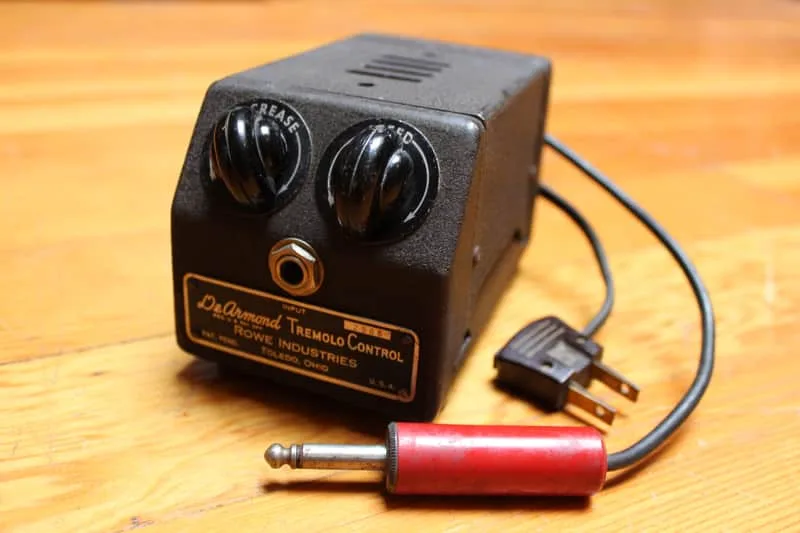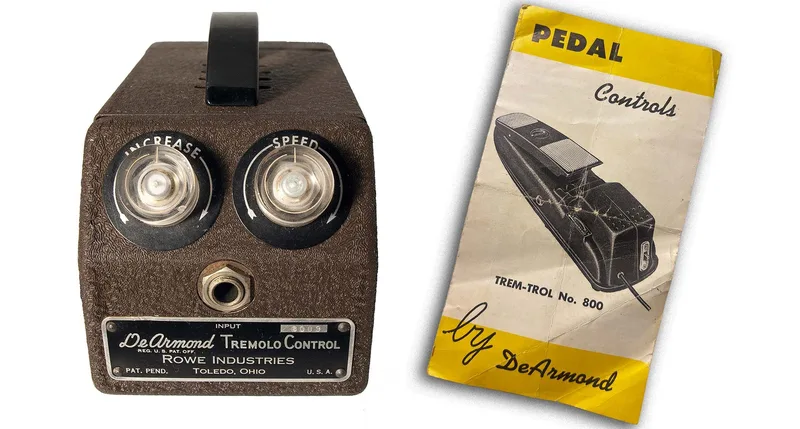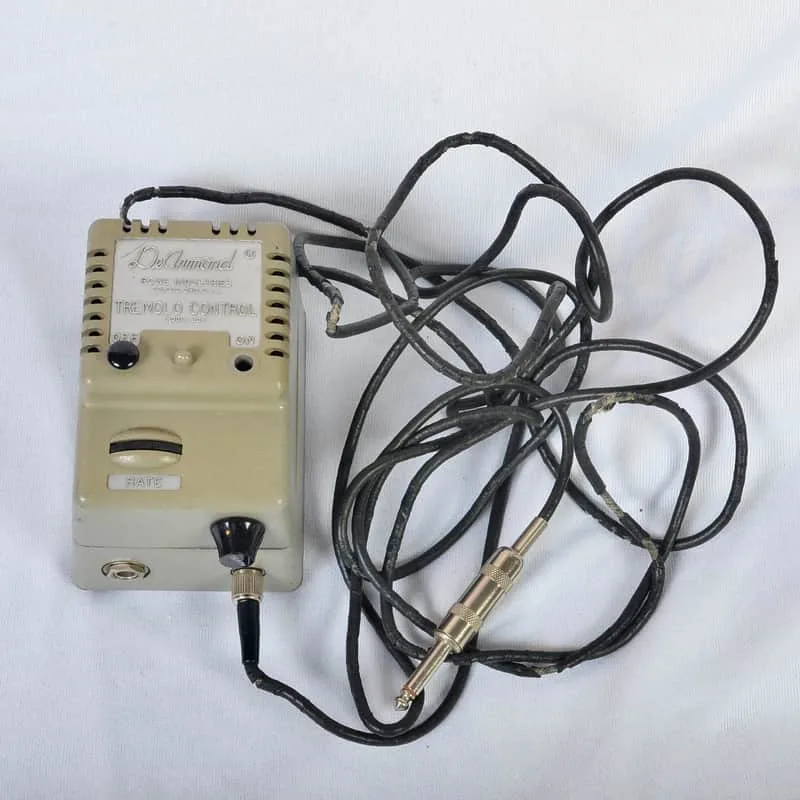
The DeArmond Tremolo Control is the effect that started it all: introduced in 1946 and produced through the mid-1960s, Guitar World's Chris Gill calls it "the O.G. guitar effect" and recognizes it as the first stand-alone guitar effect1. Unlike every tremolo pedal that followed, it creates the effect (volume, or amplitude, modulation) purely by electro-mechanical means rather than with an electronic circuit.
How it works
Inside the box are a motor, rubber flywheels, a pendulum arm and a canister of conductive electrolytic liquid. The motor shakes the canister back and forth, causing the amount of signal reaching the output to fluctuate, which Gill describes as "a very organic-sounding tremolo effect"1.
Two controls shape the effect:
| Control | What it does |
|---|---|
| Rate/Speed | Adjusts the effect's speed via the flywheel and gears1 |
| Depth/intensity potentiometer | A separate control potentiometer adjusts the effect's depth/intensity1 |
The electrolytic fluid in the canister can evaporate over the decades. Gill reports that Windex is an ideal substitute for replacing the original fluid that has evaporated1.
History, versions and the players who used it
DeArmond planned the Tremolo Control as far back as 1941 as an effect device for electric organs and early electric pianos, but World War II parts and materials shortages delayed its introduction until 19461. Once launched, the Model 60 and the related Model 800 Trem-Trol both enjoyed what Gill calls "a pretty long and successful lifespan until the late '50s, mainly thanks to guitarists more enthusiastic about the device than keyboard or accordion players"1.
The DeArmond Tremolo Control was introduced in 1946 and produced through the mid-1960s, making it what Premier Guitar called "the O.G. guitar effect"1. The Model 60 and Model 800 both enjoyed a long and successful lifespan until the late '50s, mainly thanks to guitarists, who were more enthusiastic about the device than keyboard or accordion players1. Modern players who want a stompbox-style means of using the Model 60 or 60B can incorporate the units in their rigs via a loop switcher1.
Players documented as using the DeArmond Tremolo:
- Bo Diddley, frequently during the mid-to-late '50s, including on the hit single "Bo Diddley"1
- Duane Eddy, frequently during the mid-to-late '50s, including on the hit single "Rebel Rouser"1
- Billy Gibbons, frequently on ZZ Top albums starting with Rhythmeen in 1996, often playing through two units at once on stage for a psychedelic, unsynchronized stereo tremolo effect1
Using a Model 60 today
For modern players who want a stompbox-style means of experiencing the vintage character of the Model 60 or 60B, Gill notes the units can be incorporated in a rig via a loop switcher, so the vintage unit can be switched in and out like any pedal1.
Questions
What fluid goes in a DeArmond tremolo?
The original electrolytic liquid in the canister often evaporates over the decades. According to Guitar World's Chris Gill, Windex is an ideal substitute for replacing the original fluid that has evaporated, restoring the conductive liquid the motor-driven canister needs to modulate the signal.
Can you use a DeArmond Model 60 with a modern pedalboard?
Yes. Guitar World notes that modern players who want a stompbox-style means of using the Model 60 or 60B can incorporate the units in their rigs via a loop switcher, letting the vintage unit sit in a loop and be switched in and out like any pedal on a modern board.
What is the difference between the DeArmond Model 60 and 60B?
During the early '60s DeArmond replaced the Model 60 with the 60B, which came in a plastic housing with push-button on/off switches. Both are electro-mechanical tremolo units, and both can be used with a loop switcher in a modern rig.
What tremolo did Bo Diddley use?
Bo Diddley used a DeArmond Tremolo effect frequently during the mid-to-late '50s, including on the hit single Bo Diddley. Duane Eddy used his on Rebel Rouser in the same era.
Sources (1)
- The world's first guitar 'pedal': DeArmond Tremolo Control, Guitar World, 2026-09-13