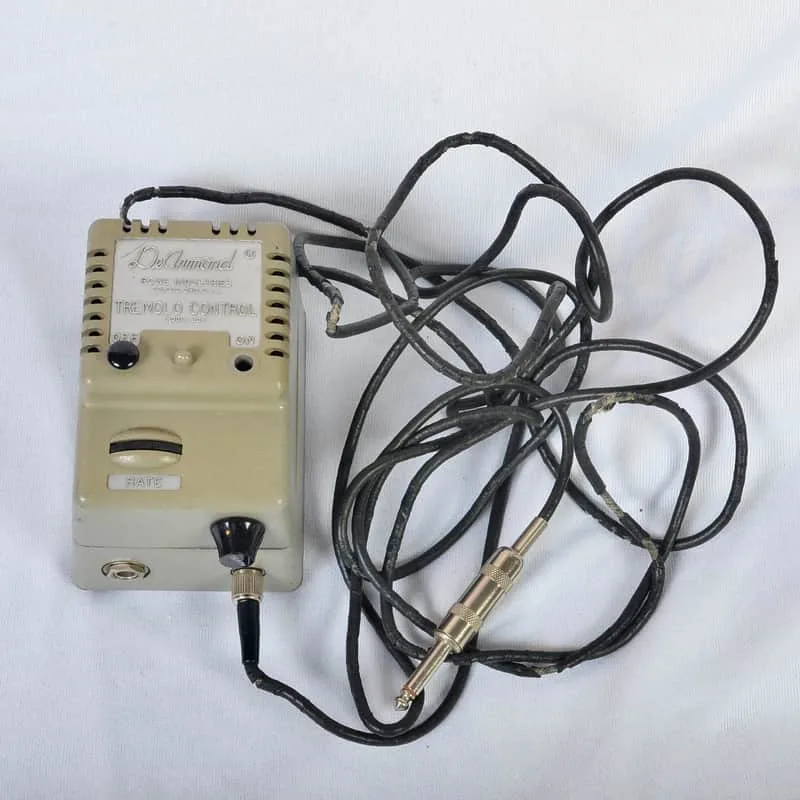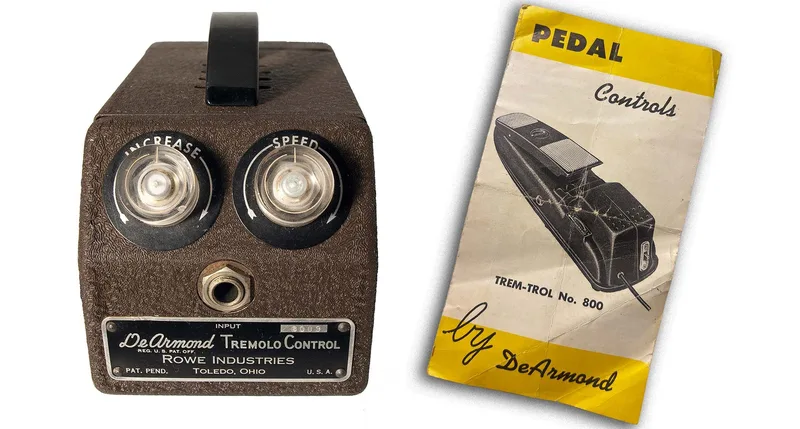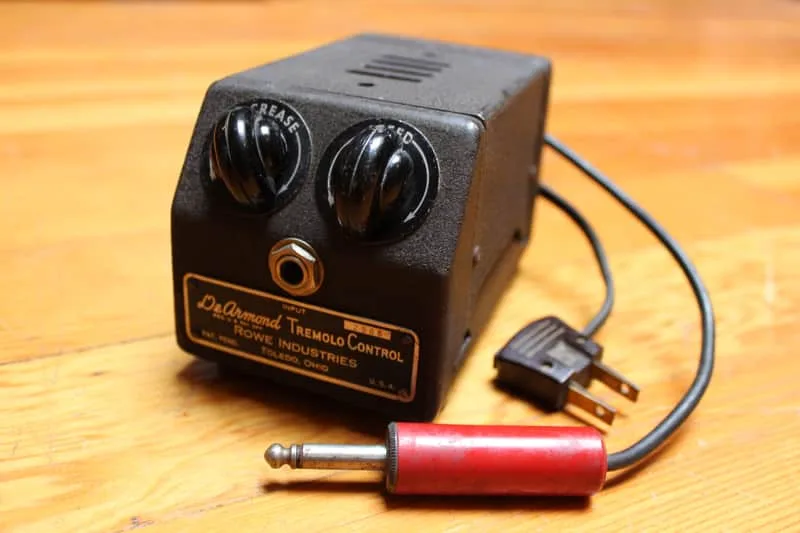

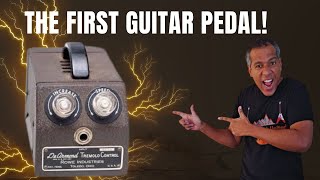
The DeArmond Tremolo Control is an electro-mechanical tremolo unit created by pickup pioneer Harry DeArmond in 1941, originally intended for early pianos and electric organs. By 1948 DeArmond had developed a guitar-friendly version, and it is now recognized as the first stand-alone guitar effect1. Guitar World dates the Model 60's introduction to 1946, after wartime parts and materials shortages delayed a planned 1941 release2. It produces tremolo, meaning volume or amplitude modulation, the effect type you will find on modern tremolo pedals, but it gets there by shaking a canister of fluid rather than with electronics.
How it works: a shaking vial of fluid
Inside the unit is a small canister containing an electrolytic fluid1. The Model 60's signal path runs through a motor, rubber flywheels, a pendulum arm and that canister of conductive liquid. The motor shakes the canister back and forth, causing the amount of signal reaching the output to fluctuate, which Guitar World's Chris Gill describes as creating a very organic-sounding tremolo effect2. Stompbox Book puts it more plainly: in the on mode the vial shakes so the fluid splashes back and forth, changing the electrical signal and varying the volume1.
What the knobs do:
- Rate/Speed: the flywheel and gears let the player adjust the effect's speed2
- Depth/Intensity: a separate control potentiometer adjusts the effect's depth/intensity2
Stompbox Book sums up the controls as knobs that let you control the splashing and volume variations1.
The original electrolytic fluid evaporates over time. Windex is apparently the refilling fluid of choice among contemporary users1, and Guitar World calls it an ideal substitute for the original fluid that has evaporated2.
Versions and timeline
Guitar World's dating is not fully consistent across its own articles: one piece calls the Model 60, introduced in 1946, the O.G. guitar effect2, while another describes "this early Fifties contraption, the first mass-produced external effect device for the electric guitar"3. The 1946 date for the Model 60 and the 1948 guitar-friendly version are the more specific figures given.
Who played through one
- Bo Diddley and Duane Eddy used their DeArmond Tremolo effects frequently during the mid-to-late 1950s, including on the hit singles Bo Diddley and Rebel Rouser2.
- Big Bill Broonzy was an early user, playing one with Roosevelt Sykes1.
- Billy Gibbons has used DeArmond Tremolo effects frequently on ZZ Top albums starting with Rhythmeen in 1996, and he often plays through two at once on stage for a psychedelic, unsynchronized stereo tremolo effect2.
Legacy
The Tremolo Control established tremolo as arguably the oldest electric guitar effect4, and the design's fluid-based approach has no equivalent in modern tremolo pedals. DeArmond later offered the Model 800 Trem-Trol in the same family. The unit remains a piece of history: produced through the mid-1960s and gone from the market by the 1970s2, it survives in the rigs of players like Gibbons and in the lineage of every stand-alone effect that followed.
Videos
scott51381
Jeff-NWAudioGuy
Desert Rock United
Questions
What fluid goes in a DeArmond Tremolo Control?
The original electrolytic fluid often evaporates over the decades, and contemporary users commonly refill the canister with Windex. Guitar World's Chris Gill called Windex an ideal substitute for the original fluid, and Stompbox Book notes it is apparently the refilling fluid of choice among players who keep these units running today.
Who played through a DeArmond Tremolo Control?
Bo Diddley and Duane Eddy used their DeArmond Tremolo effects frequently during the mid-to-late 1950s, including on the hit singles Bo Diddley and Rebel Rouser. Blues guitarist Big Bill Broonzy was an early user, playing one with Roosevelt Sykes. Billy Gibbons has used DeArmond Tremolo effects on ZZ Top albums starting with Rhythmeen in 1996.
Where was the DeArmond Tremolo Control made?
According to Guitar World, the DeArmond Tremolo Control was manufactured in Toledo, Ohio, where pickup pioneer Harry DeArmond's company was based.
Is the DeArmond Tremolo Control the first guitar effects pedal?
Stompbox Book states that by 1948 DeArmond had developed a guitar-friendly version, and it is now recognized as the first stand-alone guitar effect. Guitar World calls the Model 60, introduced in 1946, the first outboard guitar effect device, though another Guitar World piece dates the first mass-produced external effect to the early Fifties.
Sources (4)
- DeArmond Tremolo, Stompbox Book, 2018-12-04
- The world's first guitar 'pedal': DeArmond Tremolo Control, Guitar World, 2026-09-13
- Weird Science: The 10 Strangest Vintage Effects of All Time, Guitar World, 2018-01-12
- Ernie Ball Expression Tremolo Review, Premier Guitar, 2018-09-04
 Billy Gibbons