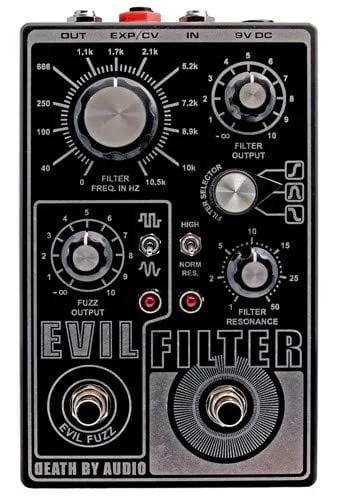


The Death By Audio Evil Filter is a psycho multimode filter pedal with a built-in fuzz, built around what the maker calls a medical-grade IC chip that creates a hyper-precise filter. It offers high-pass, band-pass and low-pass modes, two types of resonance, and a CV/expression input for controlling the cutoff frequency in real time, all in an enclosure Death By Audio describes as ultra-sleek1.
The pedal was first shown at NAMM 2017 as a new Death By Audio release2, and Premier Guitar's reviewer later described it as "DBA's latest affront to blues-bro guitar sensibilities"3. It lists at $380.001.
What it does to your sound
A filter pedal shapes which frequencies of your guitar signal get through. The Evil Filter gives you three ways to do that, selected by a front-panel switch, and then pushes the result through a fuzz circuit. Death By Audio says the pedal covers everything "from subtle tone-shaping to self-oscillation"1.
| Mode | What you hear |
|---|---|
| Low Pass | Only bass frequencies below the Filter Freq setting come through, so you feel the rumble1 |
| Band Pass | High and low frequencies are chopped off, leaving a round, vocal-like midrange similar to a wah1 |
| High Pass | Only frequencies above the Filter Freq setting are heard1 |
The band-pass mode is the one players most often associate with the pedal's lineage: that vocal, wah-like midrange is the territory of the vintage Systech Harmonic Energizer, the effect the Evil Filter is conceptually descended from3.
Controls and how it is powered
The Evil Filter's front panel breaks down into a filter section and a fuzz section. The filter circuit comes before the fuzz in the signal path3.
| Control | What it does |
|---|---|
| Freq knob | Cutoff frequency of the filter, shown in Hz1 |
| Resonance knob | Filter resonance; the maker warns it will self oscillate at high levels1 |
| Resonance switch | Sets the range of the Resonance knob between Normal and High1 |
| Selector switch | Chooses Low Pass, Band Pass or High Pass filter type1 |
| Fuzz Type switch | Down for a cleaner, more driving fuzz; up for a blasted out, blooming, insane fuzz1 |
| Output knob | Volume of the fuzz1 |
| EXP/CV input | Accepts CV control (~0-3.0v) or an expression pedal for external control of the Filter Freq knob; the Filter Freq knob sets the range for this input1 |
The two resonance ranges are a big part of the pedal's character. Premier Guitar's reviewer noted the ability to toggle between normal and high-resonance modes, and the maker's warning about self-oscillation at high resonance levels means the filter can ring and sing on its own, synth-like, when pushed13.
Power comes from a standard 9 VDC supply with a 2.1mm negative center barrel, drawing 21 mA1.
The EXP/CV input expects control voltage in the roughly 0 to 3.0 volt range or a standard expression pedal. The Filter Freq knob on the pedal sets the range that the external control sweeps, so set the knob before plugging in an expression pedal1.
Build quality and what reviewers said
Premier Guitar's reviewer opened the pedal up and found dual circuit boards populated by hand-soldered, through-hole components, with jacks and pots board-mounted, and reported that the Evil Filter is manufactured in the USA3. The review's verdict listed "Extreme fuzz and filter effects. Realtime filter control. Well made." among its pros3.
A Gearphoria review republished by Delicious Audio took a different angle on the pedal's identity, noting that it resists easy classification4:
"But when you come across something that doesn't quite fit into a normal category, it becomes difficult to describe"4
Gearphoria, via Delicious Audio4
That difficulty of description is consistent with the pedal's design: it is neither a straightforward fuzz pedal nor a straightforward filter, but a filter that feeds a fuzz with two distinct characters31.
History and the Systech Harmonic Energizer
The Evil Filter did not appear from nowhere. Premier Guitar's review states that "the concept is similar to that of the Systech Harmonic Energizer, a once-forgotten filter/fuzz from the '70s"3.
The Systech Harmonic Energizer was a 1975 synthesizer band-pass filter with gain/preamp, according to Guitar Pedal X5. It has since become a sought-after vintage piece: Premier Guitar has described it as "the vintage Systech Harmonic Energizer and the modern boutique pedals it inspired"6, and Pedal of the Day called it "legendary and ultra-rare," a lost effect7. Its reputation rests partly on famous users of the era, and its band-pass frequency and gain shaping has inspired modern takes, including boutique reissues and pedals like the Triskelion 30 Harmonic Energizer covered by Guitar Pedal X5.
A B-stock reissue of the Systech Harmonic Energizer distributed by Godlyke was listed as sold out as of October 20268, which gives a sense of how hard the design remains to get hold of in original or reissue form. The Evil Filter is Death By Audio's own take on that concept: a band-pass filter with gain, expanded with low-pass and high-pass modes, a switchable resonance range, and a fuzz stage the original did not have in the same form13.
Where it sits in the Death By Audio lineup
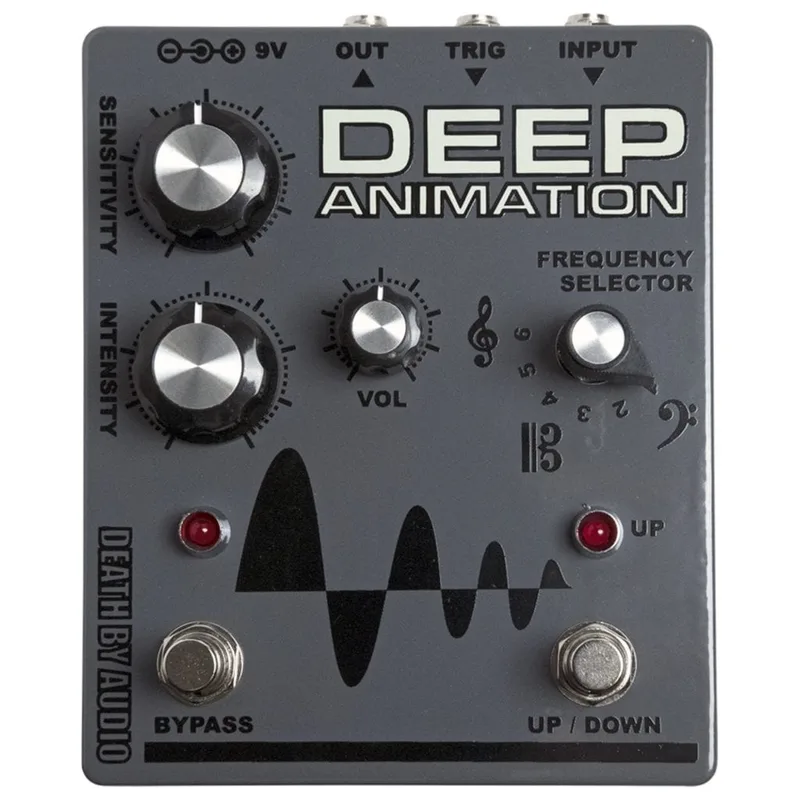
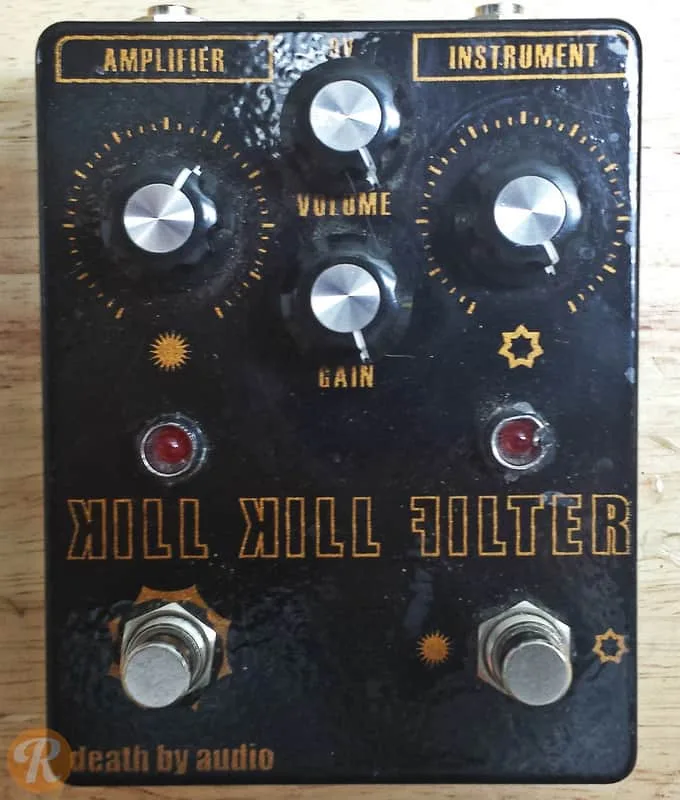
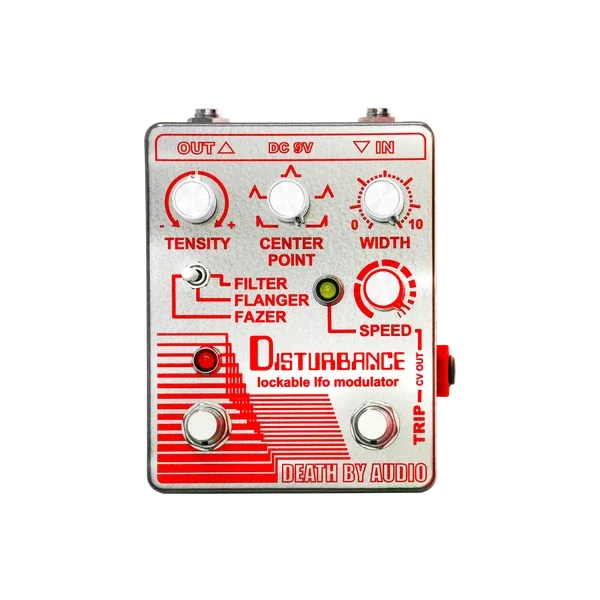
Death By Audio has made filters a recurring theme in its range. Alongside the Evil Filter, the company's filter-based pedals include the Deep Animation, the Kill Kill Filter and the Disturbance, a lockable LFO modulator with filter, flanger and phaser modes. The Evil Filter stands apart within that group by pairing its multimode filter with a fuzz circuit and a CV/expression input, where the Disturbance approaches filter effects through modulation instead13.
Videos
Premier Guitar
Death By Audio
Chicago Music Exchange
Questions
Does the Death by Audio Evil Filter self-oscillate?
Yes. Death By Audio warns that the Resonance control will self oscillate at high levels, and the maker describes the pedal's range as running from subtle tone-shaping all the way to self-oscillation. With the Resonance switch set to High and the Resonance knob turned up, the filter can ring on its own without input.
Can you use an expression pedal with the Evil Filter?
Yes. The EXP/CV input accepts an expression pedal or control voltage of roughly 0 to 3.0 volts for external control of the Filter Freq knob. The Filter Freq knob itself sets the range for the EXP/CV input. Premier Guitar's reviewer confirmed expression pedal control of the filter frequency, noting the pedal is not included.
Is the Death by Audio Evil Filter made in the USA?
Yes. Premier Guitar's reviewer reported that the Evil Filter is manufactured in the USA, and found hand-soldered, through-hole components on dual circuit boards inside, with board-mounted jacks and pots.
How big is the Death by Audio Evil Filter?
The enclosure measures 7.75 by 4.72 by 2.4 inches including hardware, and it weighs 25 ounces. That is a large-format pedal, so plan board space accordingly if you are building a compact setup.
Can you use the Evil Filter without the fuzz?
The fuzz is part of the pedal's signal path, and the filter circuit comes before the fuzz. The Fuzz Type switch does offer a down position described by the maker as a cleaner, more driving fuzz, which is the tamer of the two settings.
Sources (8)
- EVIL FILTER, Death By Audio
- NAMM 2017: Death By Audio Evil Filter & Micro Delay, Premier Guitar, 2017-02-21
- Death By Audio Evil Filter Review, Premier Guitar, 2017-06-21
- Death By Audio Evil Filter, Delicious Audio, 2019-05-10
- Guitar Pedal X, Guitar Pedal X, 2024-04-24
- ToneConcepts The Distillery Review, Premier Guitar, 2013-09-29
- Lone Wolf Audio Outsider V2 Lead Boost Sub-Harmonic Energizer, Pedal of the Day (www.pedal-of-the-day.com), 2019-12-10
- SYSTECH Harmonic Energizer (B-STOCK), Godlyke Distributing, Inc.