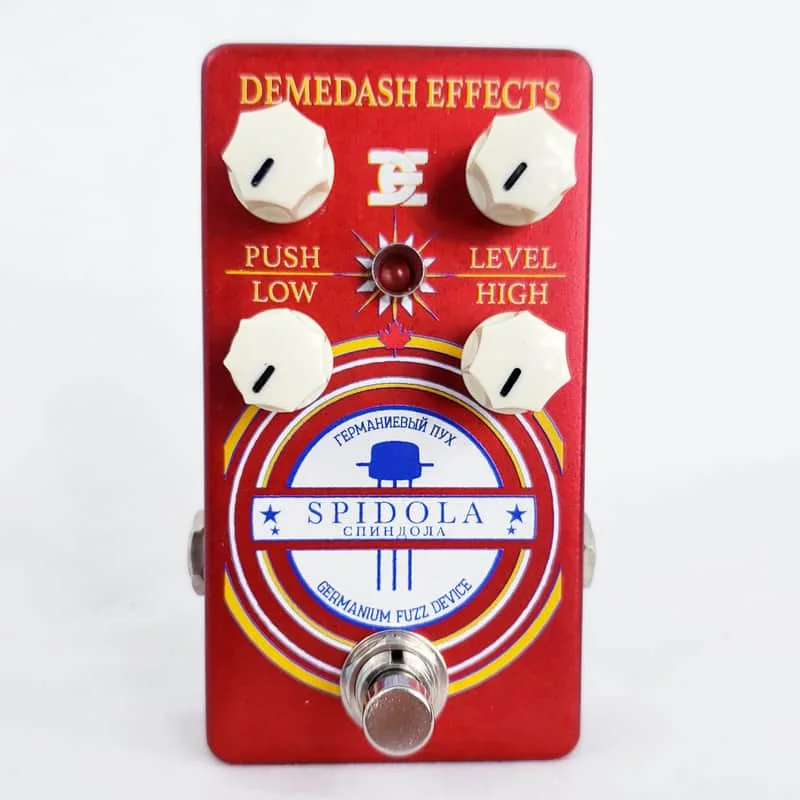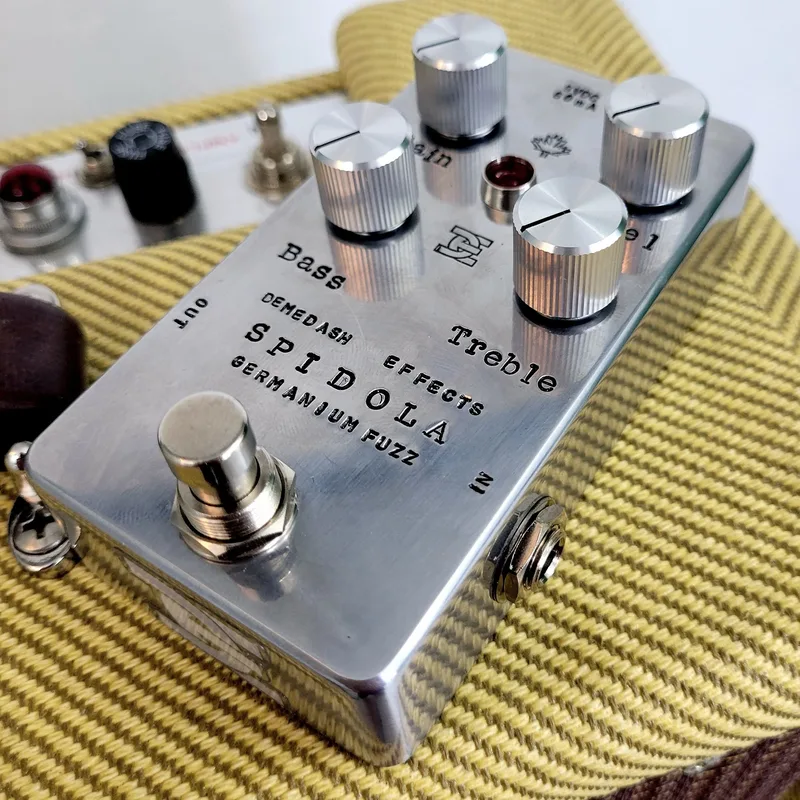


The Demedash Effects Spidola is a germanium fuzz pedal from the Winnipeg, Manitoba maker Demedash Effects, originally released in November 20201. What sets it apart from a straight-ahead fuzz is its split-band design: instead of fuzzing the whole guitar signal at once, it splits the signal into upper and lower frequencies after the first gain stage, runs the top end through a germanium treble booster fuzz and the bottom end through a separate overdrive stage, then mixes the two back together2. Demedash describes the result as "a crisp, articulate low-noise punch like no other"3.
The concept is a recreation of a classic 1970s riff-rock setup: a germanium treble booster driving an overloaded amp, with the overdriven bass mixed back in for thickness. Delicious Audio, covering the pedal in March 2023, described it as the company's first fuzz pedal and noted that the sound cleans up with your guitar's volume knob2.
How the circuit works
The Spidola's topology is unusual enough to be worth understanding before you compare it with other fuzzes. Demedash describes it as "a hot-rodded, mid-heavy Germanium Treble Booster in parallel with a Bass Overdrive"3. In practice the signal path runs like this:
- A high-impedance booster circuit at the input ramps up the signal1.
- The signal splits into two frequency-selective paths: a germanium fuzz for the upper frequencies and a silicon diode overdrive for the low end1.
- The low-frequency side gets its own separate drive stage, controlled by the Low knob, before being reintegrated into the mix2.
- The two paths recombine before a passive volume control1.
The germanium character comes from a vintage germanium PNP transistor that Demedash measures and hand-selects for each build based on its performance characteristics3. That hand-selection matters with germanium, since individual transistors of the same type can behave quite differently.
Delicious Audio framed the design goal in the maker's own terms: the pedal aims at the sound of 1970s germanium treble boosters pushed into overloaded amps, with the overdriven bass mixed back in "giving you a glorious, thick sound" that responds to the guitar's volume knob2.
Controls
Demedash calls the Spidola "a sleek, simple 4-knob interface that has been designed to sound great at any setting"3. The pedal is built around a vintage Germanium PNP transistor, measured and hand-selected for use based on its performance characteristics, and Demedash says its full-frequency approach yields "a crisp, articulate low-noise punch like no other"3.
| Control | What it does |
|---|---|
| Low | Drives the lower-frequency side of the signal through its own separate overdrive stage before it is mixed back in2 |
| Preamp Push | Ramps up gain at the front of the circuit4 |
| Level Output | Sets the output volume4 |
Guitar Pedal X, rounding up notable fuzz pedals of 2020, described the control scheme as a Preamp Push in front "to ramp up gain, and a Level Output control to temper the volume"4.
Versions and enclosure sizes
The Spidola has shipped in two different enclosures since its November 2020 release, and the difference matters if you are planning pedalboard spacing13:
| Version | Enclosure | Dimensions | Jacks |
|---|---|---|---|
| Original (retired) | 1590B | 4.25" x 2.25" | 3 |
| Standard Knob / Blue Knob (current) | 125B | 4.7" x 2.5" | Top-mounted1 |
| Stamped | 1590B | Smaller case | Side-mounted1 |
The current Standard Knob and Blue Knob versions sit in a 125B enclosure with top-mounted jacks, while the Stamped versions come in the smaller 1590B case with side-mounted jacks1. The original 1590B size is listed as retired3. Other build details include Switchcraft jacks and hand-stamped enclosures1.
If you are buying used, check which version you are getting. The original 1590B enclosure (4.25" x 2.25") is retired, and the Stamped versions use side-mounted jacks rather than the top-mounted jacks of the current Standard and Blue Knob versions, which changes how the pedal sits on a crowded board31.
Power and build
The Spidola runs on 9VDC and draws 60mA31. Its input impedance is approximately 500kOhm1. Demedash states that every part is hand-soldered in Winnipeg, Manitoba, Canada, and the pedal carries a lifetime warranty3.
Availability
As of late October 2026, the Spidola is listed as sold out on Demedash Effects' own store page1. The maker has not marked the pedal discontinued, and the product page remains live with a PDF user manual, but no units are listed for sale at the time of writing.
Videos
AndyDemos
Noise Generator
PSQRCL
Questions
Is the Demedash Spidola true bypass?
Yes. Demedash Effects lists the Spidola as true bypass on both its product page and its store listing, so the pedal's circuit is fully out of the signal path when it is switched off.
How much current does the Spidola draw?
The Spidola draws 60mA at 9VDC according to Demedash Effects. That is modest by digital pedal standards but higher than a simple germanium booster, so plan a spot on a powered pedalboard rather than a battery.
Where is the Demedash Effects Spidola made?
The Spidola is hand-made in Canada. Demedash Effects says every part is hand-soldered in Winnipeg, Manitoba, and the enclosures are hand-stamped.
Is the Demedash Spidola still available?
As of late October 2026 the Spidola is listed as sold out on Demedash Effects' own store page. The maker has not marked it discontinued, so it may return, but no units are listed for sale right now.
Is the Spidola an all-analog pedal?
Yes. Demedash Effects describes the Spidola as an all-analog design, built around a vintage germanium PNP transistor that is measured and hand-selected for its performance characteristics.
Sources (4)
- Spidola Germanium Fuzz, Demedash Effects
- Demedash Effects Spidola Germanium Fuzz, Delicious Audio, 2023-03-09
- Spidola - Demedash Effects, Demedash Effects
- Guitar Pedal X, Guitar Pedal X, 2020-12-18