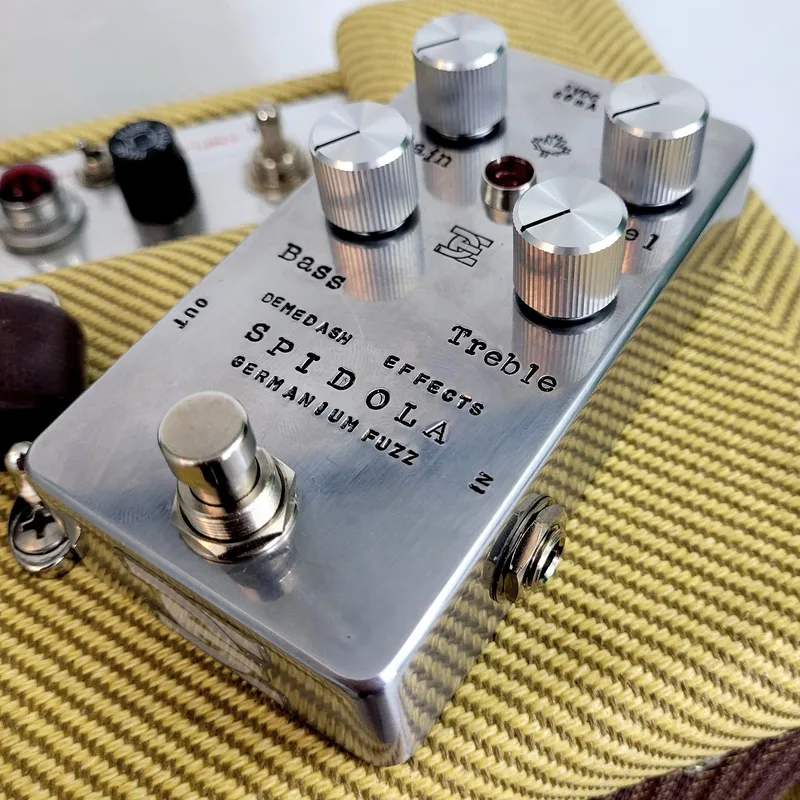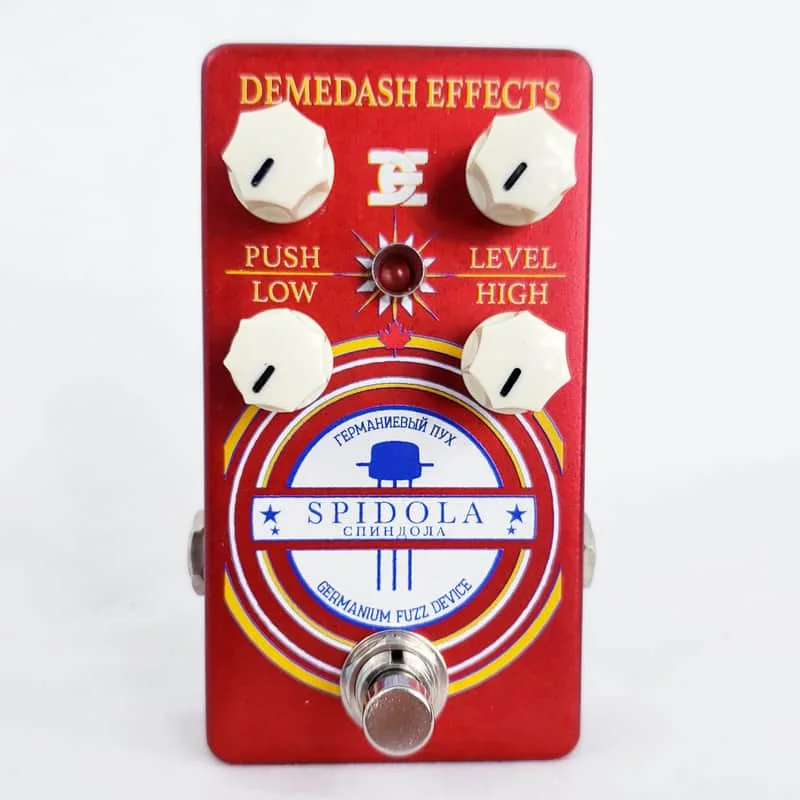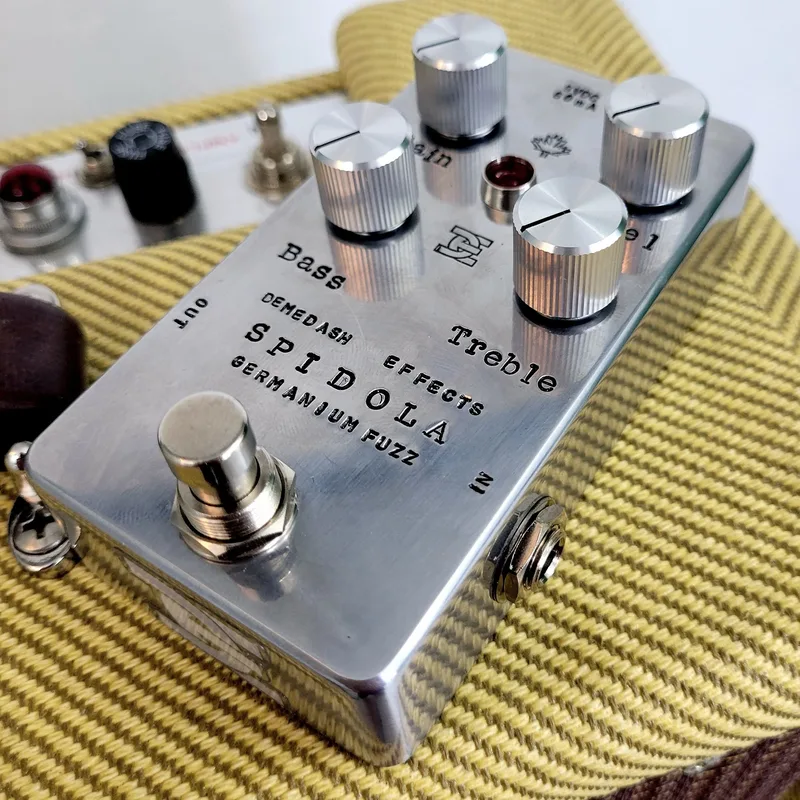


The Demedash Spidola is a hand-made fuzz pedal from Demedash Effects, a builder based in Winnipeg, Manitoba, Canada. Originally released in November 2020, it was the company's first fuzz pedal12. What sets it apart from most fuzzes is that it does not treat your signal as one thing: it splits the guitar into two frequency-selective paths, runs each through its own gain circuit, and mixes them back together.
The treble path is a hot-rodded, mid-heavy germanium treble booster built around a vintage high-gain germanium PNP transistor, measured and hand-selected for its performance characteristics13. The bass path is a silicon diode-based overdrive circuit that muffles everything above the low mids1. Demedash says the result when the two are recombined is "a surprisingly crisp & articulate sound, even when completely fuzzed out"1.
Two paths: a germanium treble fuzz and a silicon bass overdrive
The signal chain inside the Spidola is worth understanding, because it explains why the pedal behaves differently from a straight fuzz. The first thing your signal hits is a high-impedance booster circuit that ramps up the signal, driven by what Demedash calls a premium op amp. From there the signal splits into two frequency-selective paths, and the two are recombined before a passive volume control1.
| Path | Circuit | What it does |
|---|---|---|
| Treble | Vintage high-gain germanium PNP transistor as a treble booster, followed by a low-pass filter | Scoops out everything below the high mids and boosts the rest1 |
| Bass | Silicon diode-based overdrive | Muffles everything above the low mids and drives the bottom end1 |
Delicious Audio's Paolo De Gregorio described the design as recreating 1970s riff rock tones, the sound of germanium treble boosters pushing overloaded amps, with the overdriven bass mixed back in for a thick sound that cleans up when you roll back your guitar's volume knob2. He also noted the split happens after the first gain stage, so the low end gets its own separate drive stage through the Low knob before being reintegrated into the mix2.
Guitar Pedal X's Stefan Karlsson, reviewing the pedal in December 2020, broke the circuit down the same way: the high frequencies come from a single germanium transistor acting as a treble booster into an LPF filter, while the low frequencies are handled by an op amp4.
What about germanium's temperature sensitivity?
Germanium transistors are known for drifting with temperature, which is why vintage germanium fuzzes can sound different from gig to gig. Demedash addresses this directly: because the germanium stage in the Spidola is not responsible for boosting the signal, its temperature sensitivity is irrelevant and does not affect the circuit's sound1. In other words, the transistor colors the treble path, but the heavy lifting of driving the signal is done elsewhere, so the classic germanium drift is not something a player has to worry about here.
The controls
The Spidola has a four-knob interface that Demedash says was designed to sound great at any setting3. Each knob maps onto one part of the split circuit.
| Knob | What it does |
|---|---|
| Gain | Adjusts the amount of boost the premium op amp applies to the input of both the bass and treble channels1 |
| Treble | Varies the cutoff of the low-pass filter on the output of the treble fuzz path. Fully clockwise lets maximum treble through; turning counter-clockwise tames the high end; fully counter-clockwise darkens the signal significantly1 |
| Bass | Adjusts the output level of the bass overdrive section. Increase it to fill out the bottom end for a thick tone; decrease it to let the treble fuzz dominate1 |
| Level | Sets the overall output volume after the bass and treble channels are recombined1 |
Guitar Pedal X lists the controls as Gain (or Push), Level, Bass (or Low) and Treble (or High) across its coverage of the pedal45. Karlsson described the layout as a preamp push in front to ramp up gain, with a level output control to temper the volume4.
Because the Bass and Treble knobs set the balance of the two paths independently, the pedal can lean toward a screaming treble fuzz with the bass backed off, or toward a thick, low-heavy drive with the treble rolled down. The Treble knob's low-pass filter gives a further tonal range, from bright and cutting to significantly darkened1.
Versions, enclosure and power
The Spidola has been offered in several versions over its run1:
- Standard Knob and Blue Knob versions: 125B enclosure, 4.7" x 2.5", with top-mounted jacks1
- Stamped versions: a smaller 1590B case with side-mounted jacks1
- Original 1590B size: retired3
The enclosures are hand-stamped, and every part is hand-soldered in Winnipeg by the builder3. The pedal is an all-analog design with true bypass1.
The Spidola has no battery compartment and draws 60 mA at 9V DC1. That current draw is higher than many simple fuzz circuits, so it needs a proper 9V DC supply rather than a battery, and it is worth checking that a small daisy-chain supply can spare 60 mA for it.
Availability
As of late October 2026, the Spidola shows as sold out on Demedash Effects' store page, where it is listed from $185.001. The original 1590B-size version is retired3. Players hunting one may need to watch for restocks or look at the secondhand market.
Videos
AndyDemos
Noise Generator
PSQRCL
Questions
Is the Demedash Spidola true bypass?
Yes. Demedash Effects lists the Spidola as true bypass on both its store and product pages, so the pedal passes your signal unaltered when it is switched off.
Does the Spidola run on a battery?
No. The Spidola has no battery compartment, so it needs a 9V DC center-negative power supply. It draws 60 mA, which is more than a typical analog fuzz, so plan your pedalboard power accordingly.
Does temperature affect the germanium transistor in the Spidola?
Not in a way you will hear. Germanium transistors are famously temperature sensitive, but Demedash says the germanium stage in the Spidola is not responsible for boosting the signal, so its temperature sensitivity is irrelevant to the sound.
Where is the Demedash Spidola made?
Every Spidola is hand-soldered in Winnipeg, Manitoba, Canada. Demedash Effects describes the pedals as hand-made in Canada, with hand-stamped enclosures.
Is the Demedash Spidola still available?
As of late October 2026 the Spidola shows as sold out on Demedash Effects' store page, listed from $185.00. The original 1590B-size version is retired, though Standard Knob, Blue Knob and Stamped versions appear in the current lineup.
How much current does the Spidola draw?
The Spidola draws 60 mA at 9V DC. That is modest by digital standards but higher than many simple fuzz circuits, and with no battery compartment it must come from a mains or isolated supply.
Sources (5)
- Spidola Germanium Fuzz, Demedash Effects
- Demedash Effects Spidola Germanium Fuzz, Delicious Audio, 2023-03-09
- Spidola - Demedash Effects, Demedash Effects
- Guitar Pedal X, Guitar Pedal X, 2020-12-18
- Guitar Pedal X, Guitar Pedal X, 2021-08-23