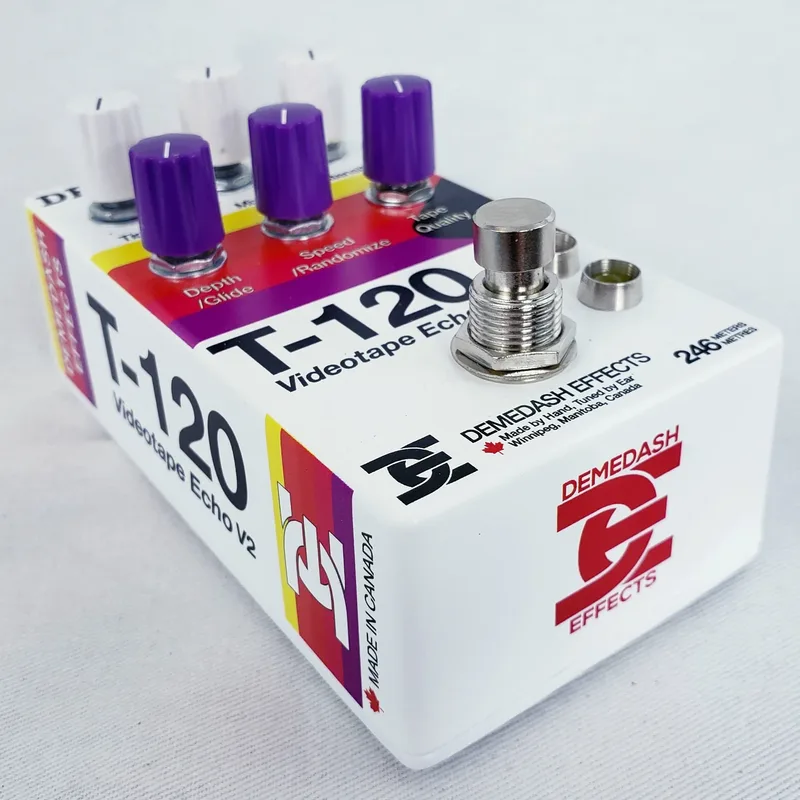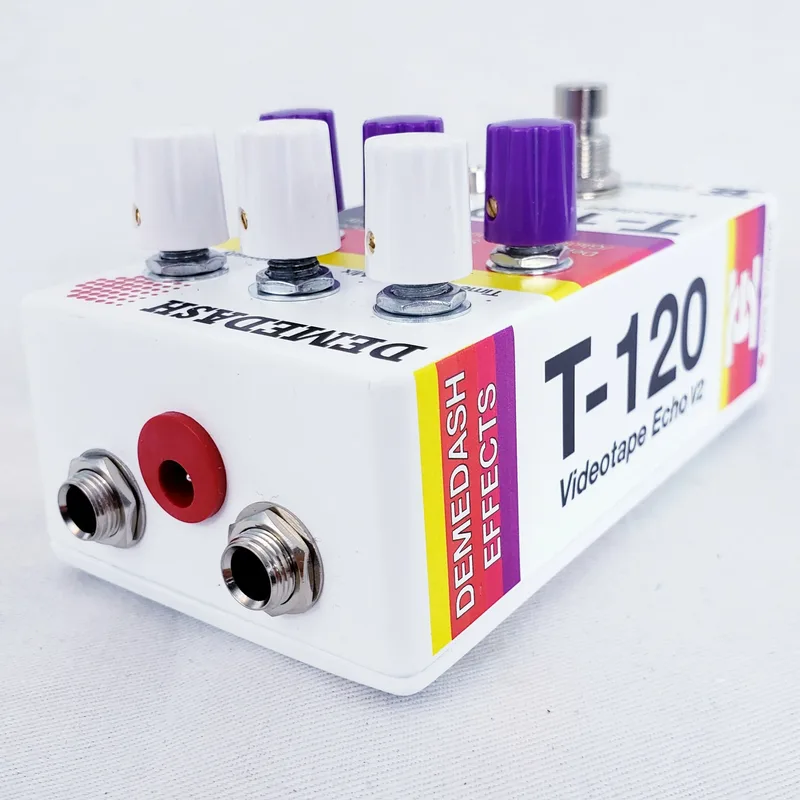


The Demedash Effects T-120 Videotape Echo is a delay pedal from Canadian builder Demedash Effects that takes its voicing not from a revered vintage tape machine but from something far less loved: worn-out home video. Demedash describes it as "inspired by the garbled audio that accompanies worn-out and poorly aged budget bin video tape," and the V2 store page frames the idea as "what if a Roland Tape echo sounded like a worn out wedding video from the early 90s?"12
Where most tape-style echo pedals aim for warm, faithful repeats, the T-120 aims for degradation. Demedash says the recorded playback is "the sound of low bandwidth tape being fed haphazardly through a magnetic read head by an uncalibrated, unbalanced feed mechanism," with pitch wavering from "organic, wandering tape flutter to glitchy pitch jumps"1. Delicious Audio's Paolo De Gregorio placed it in the lo-fi camp, noting that it "emulates the lo-fi sound of VHS tapes" rather than using a vintage machine as its reference3.
What it does to your sound
The T-120 records your playing and plays it back degraded, then re-records the repeats again and again. The Time knob sets the delay length from short slapback to long, grainy echo, which Demedash gives as roughly 60ms to 1200ms on the V22. Pedal of the Day's 2020 review of the earlier version reported a maximum of 1.5 seconds, so the two published figures disagree5. Intensity feeds the delay output back into the input, controlling the level and duration of repeats, up to self-oscillation; Pedal of the Day put it plainly: "Crank this one up, and you're swimming in the glory of w[orn tape]"25.
The modulation section is what sets the pedal apart from a straight echo. Demedash says its four modulation controls, Depth, Rate, Glide and Randomize, "let you sculpt the pitch wavering flutter like nothing else"1. Tape Quality determines how much bandwidth reduction to apply, "scraping off the extremities of the echoes'" fidelity, which is the control that makes repeats sound like a tape that has been played too many times2.
The controls, including the hidden Glide and Randomize
The V2 has two rows of knobs. The top row handles the echo itself; the bottom row handles the modulation and the tape's condition.
| Control | What it does |
|---|---|
| Time | Sets delay length, from short slapback to long, grainy echo, about 60ms to 1200ms2 |
| Intensity | Feeds the delay output back into the input, setting repeat level and duration, up to self-oscillation2 |
| Echo | Mixes wet and dry signals, unity at noon5 |
| Depth | How widely the LFO makes the pitch of the delayed signal swing; Pedal of the Day describes it as the amount of pitch-shifting vibrato induced in the recorded signal25 |
| Speed / Rate | Sets the modulation speed3 |
| Tape Quality | How much bandwidth reduction to apply, reducing the echoes' fidelity2 |
Glide and Randomize are the V2's hidden parameters, and they are not on their own knobs. Demedash explains that the V2 "features two new secondary settings not found on the v1: Glide (under Depth) and Randomize (under Speed)"2. To reach them, hold the footswitch down while the effect is engaged and turn the Depth and Speed knobs respectively1.
- Glide smooths out the transitions of the LFO output, taking a periodic LFO from fully square to fully triangular, or, on a random LFO, from instantaneous jumps to a slowly varying warbling smear2.
- Randomize works alongside Glide to shape how the modulation behaves, letting you move between predictable flutter and glitchy, unpredictable pitch jumps12.
Delicious Audio described the pair in player terms: "These controls let you adjust the smoothness of the modulation transitions (from pitch jumps to smooth pitch glides)"3. The pedal also carries two LEDs, one showing the effect is active and one flashing in unison with the current Speed setting5.
Power and bypass
The T-120 runs on 9V DC with a negative tip, adapter not included, and there is no battery compartment12. Demedash's pages give an 80 mA current draw12, while RockBoard's listing for the V2 gives 30 mA4; plan power around the higher maker figure.
No battery compartment means the pedal needs a power supply from day one, and the buffered bypass means the buffer remains in your signal chain even when the effect is off.
Bypass is soft switching with buffered bypass on the standard V212. That differs from the true-bypass norm among boutique delay builders, and it is worth knowing if you place the pedal early in a long chain.
History and versions: V1, V2 and the Deluxe
The T-120's timeline is short but busy for a hand-built pedal:
- Mid-2018: V1 introduced2.
- July 2020: V2 introduced2.
- June 2022: Delicious Audio reported the release of V2 for both the regular and Deluxe (DLX) versions, with the standard gaining soft switching, momentary activation and secondary parameters, and the DLX gaining internal dip switches for trails and modulation selection3.
- V2 status: both the regular and DLX versions listed as sold out26.
The Deluxe V2 keeps "all the tape-worn sounds of the T-120 v2" and adds soft switching, echo trails configurable on or off, a secondary footswitch for swelling the echo repeats, and stereo outputs, with the left outputting dry plus wet and the right outputting dry minus wet786. Delicious Audio reported in June 2022 that the Deluxe carried an extra $80 over the standard version3. The DLX V2 also moved its trails and modulation options onto two internal dip switches accessed by removing the back panel, selecting between trails on/off and regular or random modulation3. Set the delay time to minimum and the Deluxe can be used as a vibrato7.
The standard V2 has appeared in several finishes: Standard Finish, Black Finish, Flaked Aluminum and Pink1. The Deluxe V2 has appeared in Standard Finish, Flaked Aluminum, Hand-Stamped Red, Black Finish, Hand-Stamped Green and Hand Stamped colorways7.
Availability and what reviewers said
The T-120 is hand-built one at a time. Pedal of the Day reported in May 2020 that the wait list "constantly hovering around a year or so," with small batches released periodically on Reverb5. As of October 2026, Demedash's store lists both the standard V2 and the Deluxe V2 as sold out28.
Pedal of the Day's reviewer liked what the pedal did with the concept, describing the playback as "the sound of low bandwidth tape being fed haphazardly through a magnetic read head by an uncalibrated, unbalanced feed mechanism," and after trying a T-120 Deluxe 1.5 concluded it "sounds sweeeet" while retaining the classic T-120 sound with a couple more options5. Delicious Audio's coverage treated the V2 update as a meaningful one for both versions rather than a cosmetic refresh3.
Videos
aBunchOfPedals
Eirik Stordrange
Noise Generator
Questions
Is the Demedash T-120 analog or digital?
Demedash states that no DSP is used in the T-120, and the Deluxe version is likewise described as DSP-free. RockBoard's listing classifies the circuit as hybrid. In plain terms, the pedal is built without a digital signal processor shaping the repeats, which is central to its lo-fi, worn-tape character.
Is the T-120 Videotape Echo true bypass?
No. The T-120 uses soft switching with buffered bypass, and the Deluxe V2 is also buffered bypass, with mono in and dual mono out in bypass. If you run a long cable run after it, the buffer stays in the signal path when the effect is off.
What is the maximum delay time on the T-120?
Demedash's V2 page gives a Time range of roughly 60ms to 1200ms, from short slapback to long, grainy echo. Pedal of the Day's 2020 review of the earlier version reported a maximum of 1.5 seconds. Expect somewhere around 1.2 to 1.5 seconds at the longest setting.
How do I access Glide and Randomize on the T-120 V2?
Hold the footswitch down while the effect is engaged, then turn the Depth knob to access Glide and the Speed knob to access Randomize. Glide smooths the LFO's transitions, from fully square to fully triangular, or from instantaneous jumps to a slowly varying warbling smear on a random LFO.
What is the difference between the T-120 and the T-120 Deluxe?
The Deluxe keeps the T-120 V2's tape-worn sound and adds soft switching, echo trails configurable on or off, a secondary footswitch for swelling the echo repeats, and stereo outputs, with the left outputting dry plus wet and the right outputting dry minus wet. Delicious Audio reported the Deluxe carried an extra $80 over the standard version in 2022.
Why is the Demedash T-120 so hard to buy?
The pedal is hand-built one at a time, and Pedal of the Day reported in 2020 that the wait list hovered around a year, with small batches released periodically through Reverb. As of late 2026, Demedash's own store lists both the standard V2 and the Deluxe V2 as sold out.
Sources (8)
- T-120 Videotape Echo, Demedash Effects, 2020-06
- T-120 Videotape Echo v2, Demedash Effects
- Demedash T-120 V2 Videotape Echo, Delicious Audio, 2022-06-09
- T-120 Videotape Echo V2 by Demedash Effects, RockBoard PedalPedia, 2026
- Demedash Effects T-120 Videotape Echo, Pedal of the Day, 2020-05-09
- T-120 Deluxe V2 by Demedash Effects, RockBoard PedalPedia, 2026
- T-120 Deluxe V2, Demedash Effects
- T-120 Videotape Echo Deluxe V2, Demedash Effects