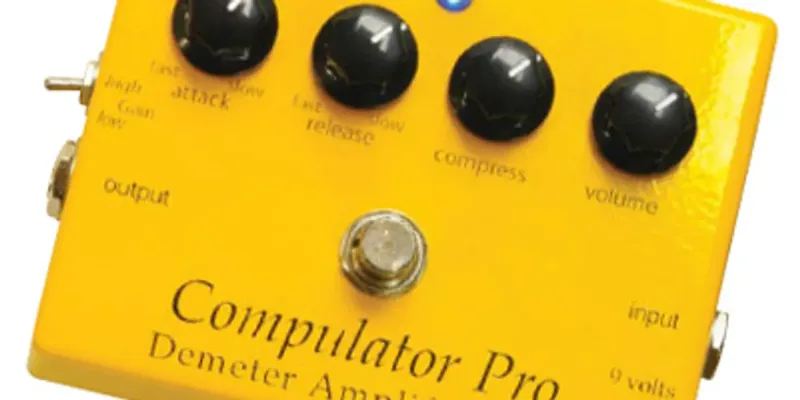


The Demeter Amplification Compro-1 Compulator Pro is a compressor pedal built around optical compression: its circuit is based on a photocell, a design borrowed from vintage studio compressors. Premier Guitar's review credits designer James Demeter with bringing "sophisticated studio compression to stompbox users" with this pedal1. It sits in the wider family of compressor pedals, and Demeter also makes the related COM-2 Compulator Pro.
Controls and what they do
The pedal sports four knobs: Attack, Release, Compress, and Volume. Attack and Release controls let you adjust how fast the compressor turns on and off, and the Volume control is for making up the gain you may have lost after compressing your signal1.
| Control | What it does |
|---|---|
| Attack | Lets you adjust how fast the compressor turns on1 |
| Release | Lets you adjust how fast the compressor turns off1 |
| Compress | Sets the amount of compression1 |
| Volume | For making up the gain you may have lost after compressing your signal1 |
Below the controls are a true-bypass footswitch and a bright blue LED that tells you when the compressor is active. In addition to standard 1/4" input and output jacks, the Compulator Pro has a High/Low Gain switch1.
The boost trimpot
One feature sets the Compulator Pro apart from most stompboxes: an internal boost trimpot. It is accessible with a small screwdriver along the unit's left-hand side, and it is set to 20 dB of boost at the factory1.
Power
The unit runs on a 9-volt battery or an optional power supply1.
Premier Guitar notes that users who experience distortion because of high-gain pickups can safely operate the unit at 12 volts for more headroom, or send the unit in to be modified for less overall gain at no charge other than shipping fees1.
What reviewers said
Premier Guitar reviewed the pedal in 2023 at a street price of $309 and rated it highly recommended. The reviewer praised its noise performance: "I was impressed that the Compulator Pro added no extra noise, its circuit is dead quiet." On the design, the review noted that "because of its big, natural sound, optical compression has been a favorite of studio engineers for decades." The stock unit, the reviewer added, "was designed for 99 percent of the guitars out there"1.
The pedal's enclosure drew comment too: "Housed in a yellow metal case, the Compulator Pro looks sharp and feels solid"1.
Videos
Jack Zucker
musictoyznetwork rasch
SerhioTKM
Questions
Is the Demeter Compulator Pro true bypass?
Yes. Premier Guitar's review describes a true-bypass footswitch below the controls, alongside a bright blue LED that shows when the compressor is active. True bypass means that when the pedal is off, your guitar's signal passes through it without the compression circuit loading or coloring the sound.
Does the Demeter Compulator Pro run on a battery?
It does. The unit runs on a 9-volt battery or an optional power supply. Players with high-gain pickups who experience distortion can also safely run the unit at 12 volts for more headroom, or send it in to be modified for less overall gain at no charge other than shipping fees.
How do I adjust the boost trimpot on the Compulator Pro?
The trimpot is accessible with a small screwdriver along the unit's left-hand side, and it is set to 20 dB of boost at the factory. Adjusting it changes the amount of gain boost the pedal adds, so you can tailor how much level the Compulator Pro pushes into the rest of your chain.
Who designed the Demeter Compulator Pro?
James Demeter. Premier Guitar's review credits him with bringing sophisticated studio compression to stompbox users with the Compulator Pro, an optical compressor design borrowed from vintage studio compressors.
Is the Demeter Compulator Pro an optical compressor?
Yes. The pedal's compression circuit is based on a photocell, a design borrowed from vintage studio compressors. Premier Guitar notes that optical compression has been a favorite of studio engineers for decades because of its big, natural sound.
Sources (1)
- Demeter Compro-1 Compulator Pro Pedal Review 2023, Premier Guitar, 2010-09-21