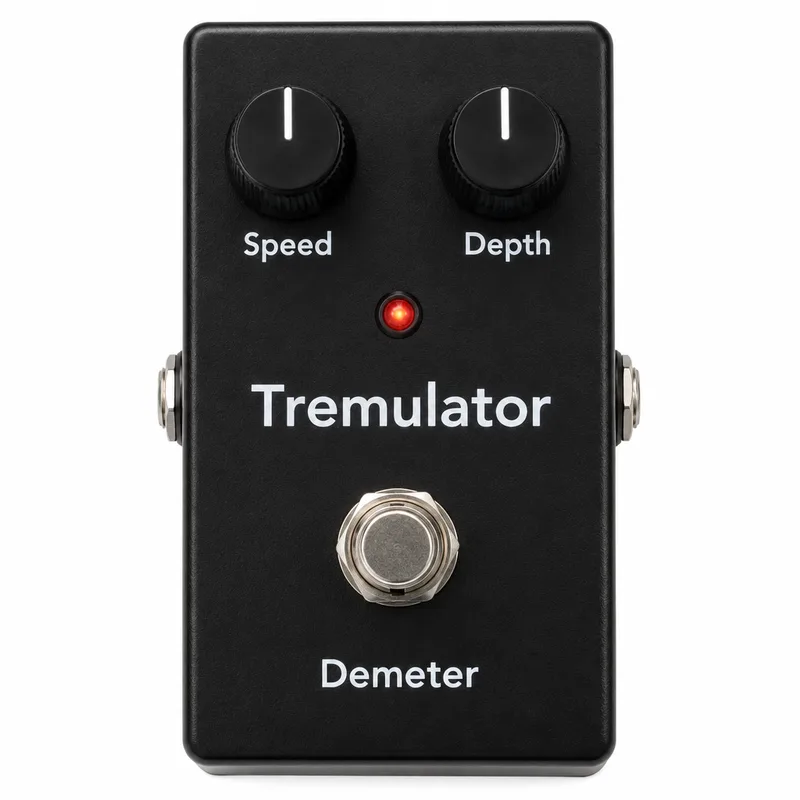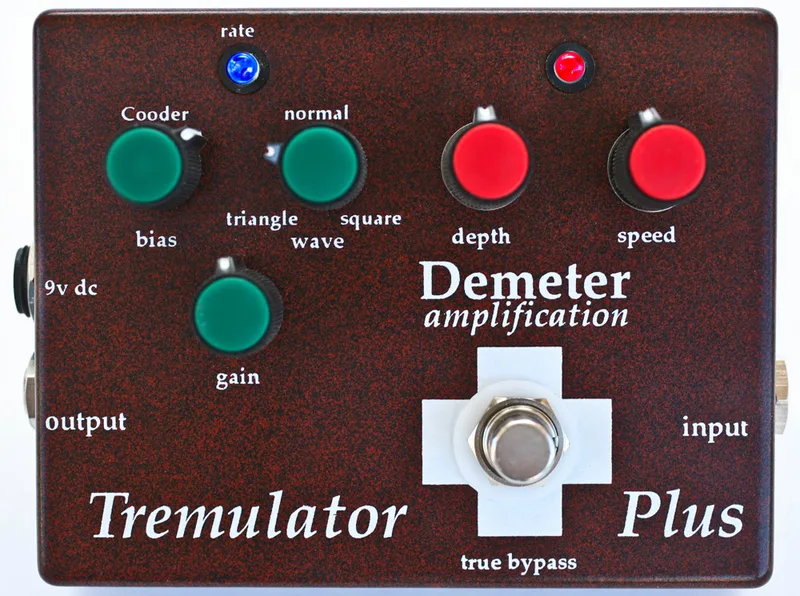


The Demeter Tremulator Plus is a tremolo pedal from Demeter Amplification, an updated version of the company's TRM-1 Tremulator, a design that has been in production for more than a third of a century. James Demeter decided to revisit his first pedal and refine it, keeping the original all-analog optical design while adding new controls. Demeter calls it "the classic pedal from the 80's perfected."1
Tremolo works by varying the volume of your signal rhythmically, and the Tremulator's approach is optical: a modulating waveform drives an optical unit that raises and lowers the volume. On the original TRM-1, Demeter described the result as "lopsided" amplitude modulation with a rounded-off triangular modulant waveform, designed to emulate the classic Fender tremolo effect (often called vibrato on old Fender amps) with less noise and hum and a greater range of speeds and depths. The TRM-1 also incorporates a small amount of gain, about 1dB, to allow for proper "tremulation," and with the Depth control all the way off it functions as a low-noise volume boost.2
What the Plus adds over the TRM-1
The Tremulator Plus is a variant of the original TRM-1, the pedal James Demeter revisited when designing the Plus. MusicRadar noted that the TRM-1 was the result of that earlier design work, and that it ended up on the pedalboards of players including David Gilmour, Eric Clapton and Jonny Green. The Plus carries that platform forward, with a rate LED that blinks to show the speed of the tremolo effect, and it has remained in production more than a third of a century after the original.3
The TRM-1 itself carries a footswitch to bypass the effect, and the Plus keeps that arrangement with a true bypass switch that pulls the Tremulator out of the circuit entirely.12
The controls: speed, depth, bias, waveform and gain
The Tremulator Plus carries over the stock Speed and Depth controls from the original and adds three new adjustments.1
| Control | What it does |
|---|---|
| Speed | Sets the rate of the tremolo; carried over from the original1 |
| Depth | Sets how far the volume swings; carried over from the original1 |
| Bias | Adjusts the on and off ratio of the optical unit; replaces the original's internal trim pot. Pointed straight up, it engages the traditional Cooder setting13 |
| Clock Waveform | Shapes the modulation: a pure triangle wave for a smooth up-and-down volume effect, a flattened triangle wave for smooth volume with a strong on and off, or a square wave for a sharp on and off1 |
| Gain | Sets the effect's level so it can be as loud or soft as needed1 |
A rate LED blinks to show the speed of the tremolo effect, giving a visual reference for the rate even while the pedal is bypassed.1
The bias control is the main practical difference from an original TRM-1: on the older pedal it was an internal trim pot, so changing the on/off character meant opening the unit. On the Plus it is a top-panel knob.3
Buying picture
Demeter's own product listings show the Tremulator Plus at $369.00 USD, currently priced at $329.00 USD as of 26 October 2026.5 At launch in April 2016, MusicRadar reported it available for $299 street.3 The pedal remains in production, more than a third of a century after the original Tremulator design first appeared.1
Videos
Premier Guitar
D K
Questions
Is the Demeter Tremulator Plus true bypass?
Yes. Demeter says the Tremulator Plus has a true bypass switch that pulls the Tremulator out of the circuit when the effect is off, so your guitar's signal runs straight through to the amp. The original TRM-1 Tremulator likewise carried a footswitch to bypass the effect.
What does the bias knob do on the Tremulator Plus?
The bias control adjusts the on and off ratio of the pedal's optical unit, shaping how hard the tremolo chops. On the original TRM-1 this was an internal trim pot; the Plus moves it to the top panel so it can be adjusted quickly. Demeter notes that pointing the knob straight up engages the traditional Cooder setting.
How is the Tremulator Plus different from the original TRM-1 Tremulator?
The Plus keeps the stock Speed and Depth controls and the original all-analog optical design, but adds two things the TRM-1 did not have: a Clock Waveform control that changes the shape of the tremolo from smooth to sharp, and an externally adjustable bias control replacing the original's internal trim pot. It also adds a gain setting so the effect can be as loud or soft as needed.
Is the Demeter Tremulator Plus analog?
Yes. Demeter describes the Tremulator Plus as keeping the original all-analog optical design, in which a modulating waveform drives an optical unit that varies the signal's volume. It is a pedal, not a rack unit or digital modeler.
Where is the Demeter Tremulator Plus made?
Demeter states that the Tremulator Plus is hand built in the USA in its barn in Templeton, California. The company has been building the Tremulator concept for more than a third of a century since the original TRM-1 was introduced.
Sources (5)
- Tremulator Plus, Demeter Amplification
- TRM-1 Tremulator, Demeter Amplification
- Demeter Amps revamps its trademark tremolo with Tremulator Plus guitar effects pedal, MusicRadar, 2016-04-22
- PRS-2 Presence Control, Demeter Amplification
- FZO-1 Fuzzy Octavulator, Demeter Amplification