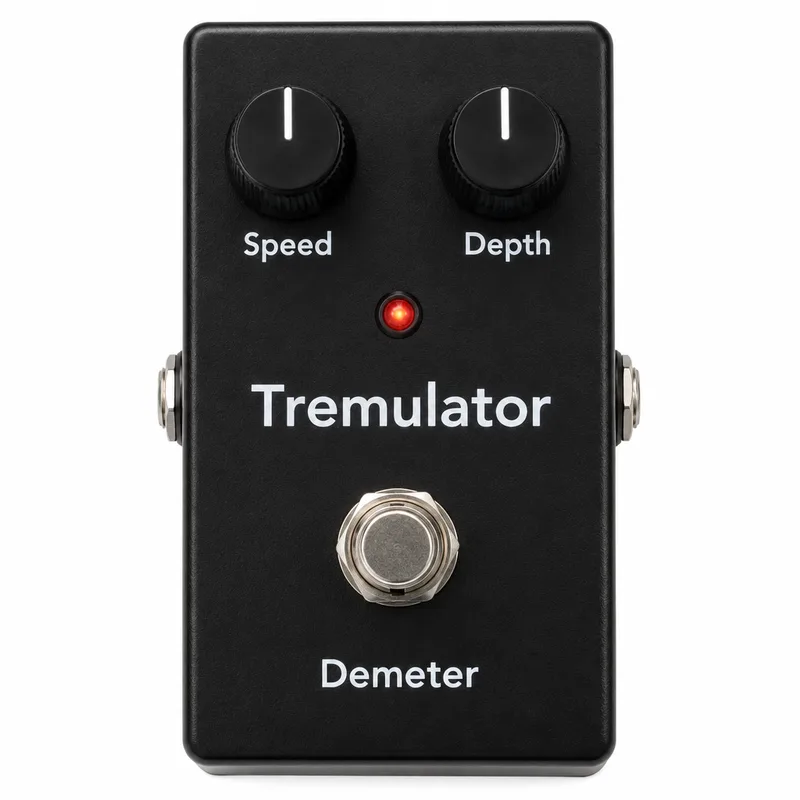


The Demeter Tremulator is a tremolo pedal built by Demeter Amplification, first made in 1982 at the request of Ry Cooder. Demeter describes it as designed to emulate the classic Fender tremolo effect, the wobble players know from old Fender amps, but with less noise and hum and a greater range of speeds and depths1. It is a small, plain black box about the size of an MXR Distortion+ pedal, with two knobs, a bypass footswitch and an LED status indicator2.
What sets it apart from most tremolo pedals is the shape of its modulation. Demeter says the Tremulator features "lopsided" amplitude modulation with a rounded off triangular modulant waveform, the same uneven pulse that gives vintage Fender tremolo its seasick character1. Guitar World's Chris Gill put it in similar terms in 1996:
"It has a wobbly, lopsided modulation that rivals the most seasick sounding Fender trem"
A lopsided, Fender-style tremolo
The Tremulator's character comes from its waveform. Instead of a symmetrical sine or triangle pulse, the optical circuit produces a rounded, lopsided wave, which Demeter says recreates the feel of a vintage Fender amp's tremolo while running quieter and with a wider range of speeds and depths1. Vintage Guitar's 1998 review called the wave "the classic lopsided amplitude modulation… perfect" and held the box up as "a real benchmark among trem boxes"5.
The trim pot on the side of the unit shapes that character further. Demeter explains that it sets the bias of the optical tremolo unit and affects the signal on and off time ratio: turned up it squeezes the signal, turned low it loosens it. The pedal ships preset to Ry Cooder's preferred setting1, a point Guitar Player noted in 1993, reporting that the units are preset to Ry Cooder's favorite trimpot tweak6.
The controls: depth and speed
The original TRM-1 keeps its control surface to two knobs and a footswitch261:
| Control | What it does |
|---|---|
| Speed | Increases and decreases the frequency of the low-frequency oscillator, letting you time the effect as desired1 |
| Depth | Sets how deep the amplitude modulation goes; at minimum the pedal works as a low noise volume boost1 |
| Trim pot (side) | Sets the bias of the optical tremolo unit, affecting the signal on and off time ratio; preset to Ry Cooder's setting1 |
| Footswitch | Bypasses the effect1 |
History: built for Ry Cooder
Demeter's own account of the pedal's origin, from James Demeter:
"In 1982 Ry Cooder came to me asking if I could make him a tremolo pedal, as none were being made at the time."
After some experimentation, and with Ry's old Fender twin amp as a sound model, the Tremulator was born1. MusicRadar recounts the same story: Ry Cooder asked James Demeter for an amp-style tremolo pedal in 1982, and the TRM-1 was the result, ending up on the pedalboards of players from David Gilmour to Eric Clapton and Jonny Greenwood4. Guitar Player's 2008 review noted the little box quickly became a hit in the boutique pedal world7, and the magazine's 2021 list of the top 50 stompboxes of all time gives the Tremulator its debut date as 19828.
James Demeter, who builds high-end guitar amps, preamps and studio processors, was one of the first manufacturers to build a tremolo stomp box at a time when pedal makers were turning out tremolo units to fill the gap left by amp makers2.
The family: Stereo Tremulator and Tremulator Plus
The Tremulator concept has grown into a small line:
| Version | What it adds |
|---|---|
| TRM-1 Tremulator | The original mono pedal, two knobs plus trim pot1 |
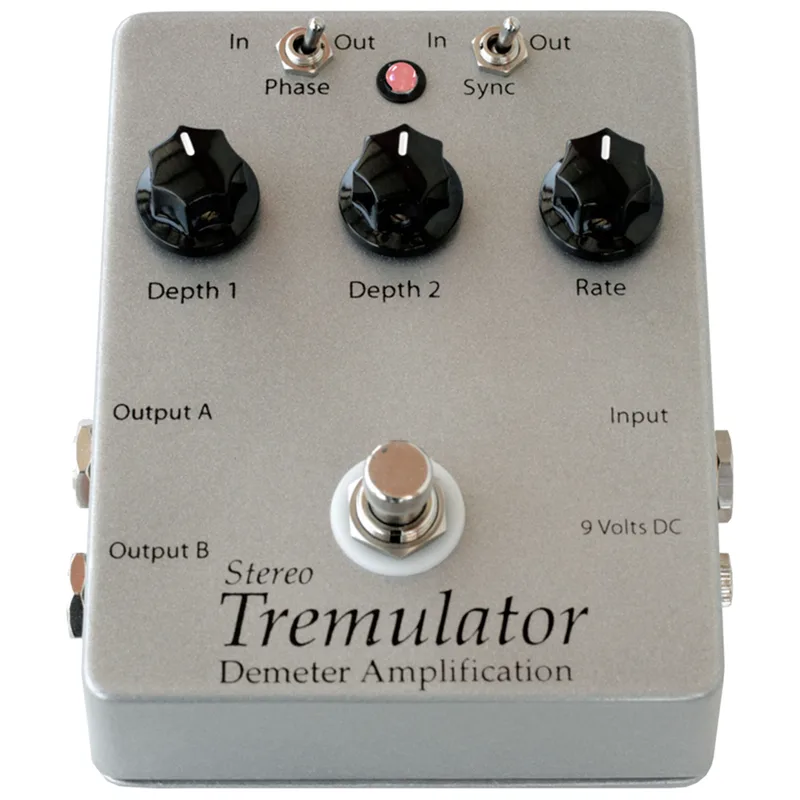
| STRM-1 Stereo Tremulator | The same analog tremolo circuit with added stereo circuitry; in stereo mode it reproduces the tone of a Magnatone amplifier's tremolo9 |
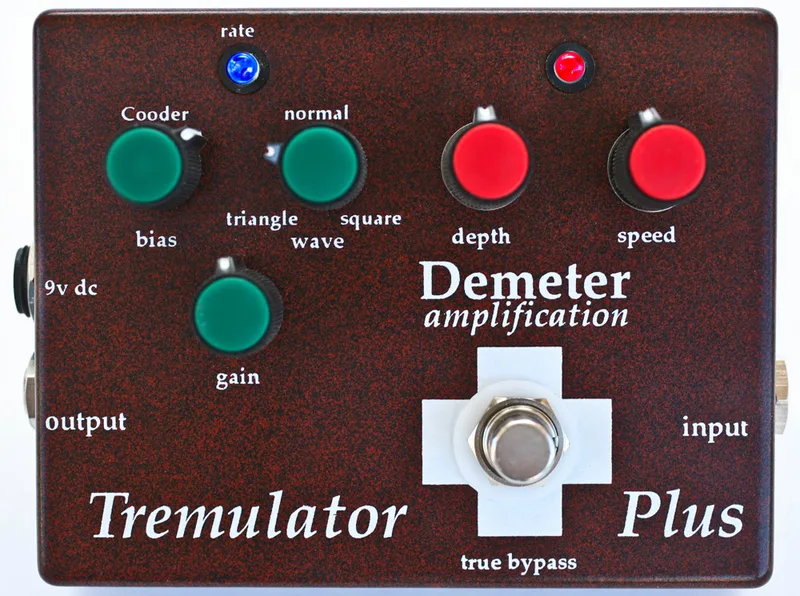
| Tremulator Plus | Keeps the original analog optical design and stock Speed and Depth controls, adds a selectable clock waveform and an externally adjustable bias control43 |
The Stereo Tremulator, reviewed by Guitar Player in March 2008, is preset with a classic triangle wave shape, the same as Cooder's Fender Twin Reverb. Darrin Fox found it is basically the same proven unit, except in stereo, with a Sync control that lets the trem's pulse undulate in mono (in sync) or bounce between two amplifiers in a stereo setup (out of sync), plus two recessed trimpots that fine tune the depth7. Demeter notes the design incorporates a small amount of gain, approximately 1dB, to allow for proper tremulation9.
The Tremulator itself is a small, black, plain box, about the size of an MXR Distortion+ pedal, with depth and speed controls, a miniature LED status indicator, an on/off footswitch, and a plug for a wall wart, though the 9-volt drain is so low that practically no one uses one93. It lists in the low-$200 range, and Ry Cooder's favorite settings are incorporated into the stock settings, which James Demeter says are preset to Cooder's favorite trimpot tweak5.
Who uses it
Vintage Guitar's 1998 review named Ry Cooder, Mark Knopfler and Sonny Landreth among the artists using the Tremulator, and noted that Ry's favorite settings are incorporated into the stock settings of the pedal5. MusicRadar's 2016 report adds David Gilmour, Eric Clapton and Jonny Greenwood as TRM-1 owners4.
What reviewers said
The Tremulator drew consistent praise across two decades of magazine coverage:
- Guitar Player, January 1993: a favorable review comparing the solid-state Tremulator, patched into an amp's front end, against a 1966 Fender Vibro Champ and a T.C. 2290, noting the depth and speed knobs, LED status indicator and mini-phone battery-eliminator jack6.
- Guitar World, September 1996: Chris Gill found the wobbly, lopsided modulation rivals the most seasick sounding Fender trem, with a speed range of about 80 to over 600 beats per minute and +6dB of clean boost2.
- Vintage Guitar, July 1998: the reviewers called it a real benchmark among trem boxes, listing in the low-$200 range, and found the 9-volt drain so low that practically no one uses a wall wart5.
- Guitar Player, March 2008: Darrin Fox reviewed the STRM-1 Stereo Tremulator, praising its stereo depth controls and finding no concerns7.
Videos
THE MUSICIAN NETWORK (TMNtv)
Reverb
Jack Zucker
Questions
Does the Demeter Tremulator take a battery?
Yes. The TRM-1 runs on a 9-volt battery for internal power, and Demeter notes the battery must have at least 7 volts for the unit to work. It also takes an external 9-volt DC regulated supply through a standard Boss type adapter rated at 100 milliamps or more. Vintage Guitar reported the 9-volt drain is so low that practically no one uses a wall wart.
Can the Demeter Tremulator be used as a clean boost?
Yes. Demeter says that with the Depth control turned all the way off, the TRM-1 functions as a low noise volume boost. Guitar World's 1996 review measured this as +6dB of boost with no perceptible tremolo effect. The Tremulator Plus adds a gain setting so the effect can be as loud or soft as needed.
How fast does the Demeter Tremulator go?
Guitar World's September 1996 review found the Tremulator's overall speed range runs from about 80 to over 600 beats per minute. The Speed knob increases and decreases the frequency of the low-frequency oscillator, so you can time the effect as desired against that range.
Is the Demeter Tremulator analog?
Yes. Demeter describes the Tremulator Plus as keeping the original all-analog optical design, and the Stereo Tremulator uses the same analog tremolo circuit as the classic mono pedal. A 1993 Guitar Player review described the original Tremulator as a solid-state unit.
What is the difference between the Tremulator and the Tremulator Plus?
The Tremulator Plus, launched in 2016, keeps the original Speed and Depth controls and analog optical design but adds a clock waveform switchable between triangle, flattened triangle or square wave, and moves the bias control from an internal trim pot to an external knob. MusicRadar reported it handmade in the USA at $299 street.
Sources (9)
- TRM-1 Tremulator, Demeter Amplification
- Guitar World (September 1996), Guitar World, 1996-09
- Tremulator Plus, Demeter Amplification
- Demeter Amps revamps its trademark tremolo with Tremulator Plus guitar effects pedal, MusicRadar, 2016-04-22
- TGA 2 | Vintage Guitar Magazine (July 1998) | Demeter Amplification, Vintage Guitar Magazine, 1998-07
- TRM-1 | Guitar Player (January 1993) | Demeter Amplification, Guitar Player, 1993-01
- STRM-1 | Guitar Player (March 2008) | Demeter Amplification, Guitar Player, 2008-03
- The Best Guitar Effects Pedals of All Time, GuitarPlayer (www.guitarplayer.com), 2021-06-25
- STRM-1 Stereo Tremulator, Demeter Amplification
 Jack White