

The Demeter FZO-1 Fuzzy Octavulator is a fuzz pedal with an octave-up effect built into the same box, made by Demeter Amplification. Demeter pitches it as a way to get "the classic octave tone of the sixties without the noise and instability," with the fuzz side carried over directly from the company's FUZ-1 Fuzzulator1. Two separate footswitches, one for fuzz and one for octave, mean you can run either effect on its own or both together1.
The octave side uses what Demeter describes as a completely new analog circuit to generate the octave sound1. In the maker's own description, the octave by itself has an unusual character: "The octave by itself has an extremely strange, almost ring-mod characteristic, which sounds amazing paired with a reverb," while running it with the fuzz circuit produces what Demeter calls an extremely focused and distinct Hendrix-type sound1.
Fuzz and octave up in one pedal
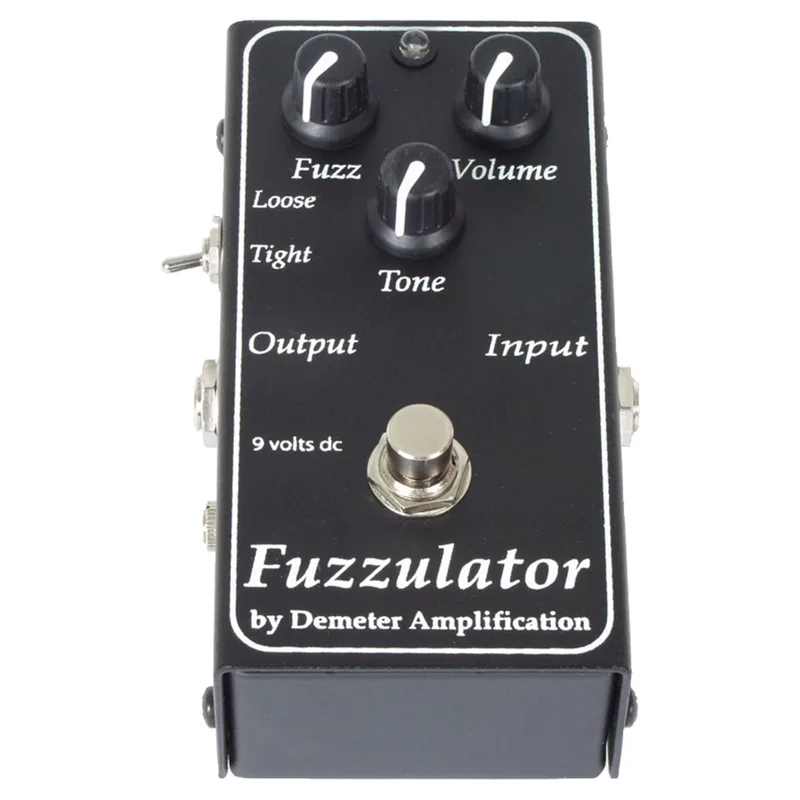
The FZO-1 pairs Demeter's octave-up circuit with the fuzz circuit from the FUZ-1 Fuzzulator, a fuzz pedal Demeter released in 2005 to critical acclaim, according to Premier Guitar31. Demeter states plainly that "the fuzz circuit on this pedal is identical to our FUZ-1 Fuzzulator"1, so a player who knows the Fuzzulator knows the fuzz half of this pedal. Vintage Guitar's June 2014 review likewise described the FZO-1 as using Demeter's "highly regarded Fuzzulator circuit"4.
What sets the FZO-1 apart from a straight fuzz box is the second, independent octave path. Because the two effects have their own footswitches, the pedal covers three jobs in one enclosure: Fuzzulator-style fuzz on its own, a standalone octave-up effect, or both stacked. Demeter notes the octave alone behaves unusually, closer to a ring modulator than a clean octave, which is worth knowing before expecting a polite pitch-shifted tone1.
The controls and the Tight/Loose switch
The FZO-1 carries three knobs, a Tight/Loose switch, and a side-mounted trim pot. Demeter describes each control as follows1:
| Control | What it does |
|---|---|
| Fuzz | Increases the gain of the distortion circuit, which increases the distortion and sustain of the unit |
| Tone | A high cut filter, usable to make the sound warmer and fatter |
| Volume | Sets the overall output, for level matching between the effected and unaffected signal |
| Tight/Loose switch | Switches between light emitting diodes and germanium diodes for the distortion generating devices |
| Trim pot (side) | Sets the gain of the Fuzzulator's output amplifier |
The Tight/Loose switch is the character control. In Demeter's description, the LED position has a tight sound and is a bit louder, while the germanium position has a looser, more classic fuzz sound with less output volume1. Vintage Guitar described the same switch as changing "the character of the fuzz via germanium (Loose) and LED (Tight) clipping stages"4. The same switch appears on the FUZ-1 Fuzzulator, where Demeter calls it a switch between overdrive circuits5.
For the trim pot, Demeter's guidance is to turn it up for the germanium, Loose setting, and turn it down if the unit is too hot for your system1. Since the germanium side has less output volume than the LED side, the trim pot is the tool for balancing the two.
Vintage Guitar found the front-panel controls practical in use, reporting that "all three knobs showed very useable ranges, producing a wide variety of fuzz levels and the ability to match or boost from bypass level"4.
Power: 9V, 100mA
The FZO-1 runs on 9 volts DC, either external or internal1. For external power it takes a standard Boss type supply, 9 volt DC regulated, rated at 100 milliamps or more1.
The internal battery is not reached through a clip-on back plate. Demeter's instructions are to remove the four screws on the sides of the unit and pull it apart, and the battery must have at least 7 volts for the unit to work1.
Build, origin, and what reviewers said
Vintage Guitar's 2014 review commented on the construction, noting "the pedal is very neatly wired, utilizing through-hole construction, which means unlike surfacemount designs, this peda[l is repairable]"4. Demeter's listing shows the FZO-1 at a current price of $349.00, down from an original price of $399.0012.
Demeter builds the FZO-1 with through-hole construction, neatly wired and repairable, unlike surface-mount designs1.
Videos
Best Guitar Effects
Scorpion Imports Reviews
Questions
Can the fuzz and octave on the Demeter FZO-1 be used separately?
Yes. The pedal has two separate footswitches, one for the fuzz and one for the octave, and Demeter states that both effects can be used either in combination or independently of each other. That makes it usable as a straight fuzz, a standalone octave effect, or both stacked together.
Does the Demeter FZO-1 run on a battery?
Yes. It takes an internal 9 volt battery, and Demeter notes the unit must have at least 7 volts to work. To reach the battery you remove the four screws on the sides of the unit and pull it apart. It also runs on a standard Boss type 9 volt DC regulated supply of 100 milliamps or more.
What does the trim pot on the side of the FZO-1 do?
The side-mounted trim pot sets the gain of the Fuzzulator's output amplifier. Demeter's guidance is to turn it up when using the germanium, Loose setting, and turn it down if the unit is running too hot for your system. It is a set-and-forget internal level control rather than a tone control.
Is the Demeter FZO-1 analog?
Yes. Demeter says the pedal uses a completely new analog circuit to generate the octave sound, and the fuzz side is the same circuit as the analog FUZ-1 Fuzzulator. Vintage Guitar's review also noted through-hole construction, neatly wired and repairable.
Where is the Demeter FZO-1 made?
Demeter says the FZO-1 is handmade in the U.S.A., using all locally manufactured components when available. The company builds it at its own operation, and the pedal ships from stock, usually within 48 hours.
Sources (5)
- FZO-1 Fuzzy Octavulator, Demeter Amplification
- TRM-1 Tremulator, Demeter Amplification
- Demeter Amplification Fuzzy Octavulator Pedal Review, Premier Guitar, 2011-06-22
- Demeter FZO-1 Fuzzy Octavulator, Vintage Guitar magazine, 2014-10-24
- FUZ-1 Fuzzulator, Demeter Amplification