

The Demeter FUZ-1 Fuzzulator is a fuzz pedal from Demeter Amplification, first released in 20051. What sets it apart from most fuzz boxes is its Tone Pre-Emphasis Circuit: an EQ stage placed before the distortion generator, rather than after it. Demeter's designer James describes the reasoning in the company's own words:
"The Fuzzulator was designed to be a fuzz with focus."
The problem the circuit addresses is one fuzz players know well: a distorted sound that gets lost in the mix. James explains that he "solved that problem with tonal pre emphasis before the sound hits the distortion generator"2. In practice, that means the signal is shaped before it reaches the clipping stage, so the fuzz that comes out keeps its definition rather than turning into a blur.
Demeter calls the Fuzzulator "a different kind of distortion box," and the pedal is hand built in the U.S.A.2. Premier Guitar has referred to it as "the critically acclaimed FUZ-1 Fuzzulator"1.
What it does: a fuzz with a pre-emphasis EQ stage
Most fuzz pedals run the signal straight into the clipping circuit and shape the tone afterwards. The Fuzzulator inverts that order. Its Tone Pre-Emphasis Circuit is an EQ stage that sits before the distortion generator, and Demeter says this is what gives the distorted sound its focus2. The company describes the FUZ-1 as the first fuzz box to use this circuit2.
For a player, the difference is about where the tone shaping happens. With pre-emphasis, the frequencies that matter are boosted or cut before clipping, so the fuzz circuit reacts to a signal that has already been contoured. Demeter's stated goal is a fuzz that does not get lost in the mix2.
The pedal also carries a foot switch to bypass the effect, plus an LED that lights when the effect is on2.
The controls
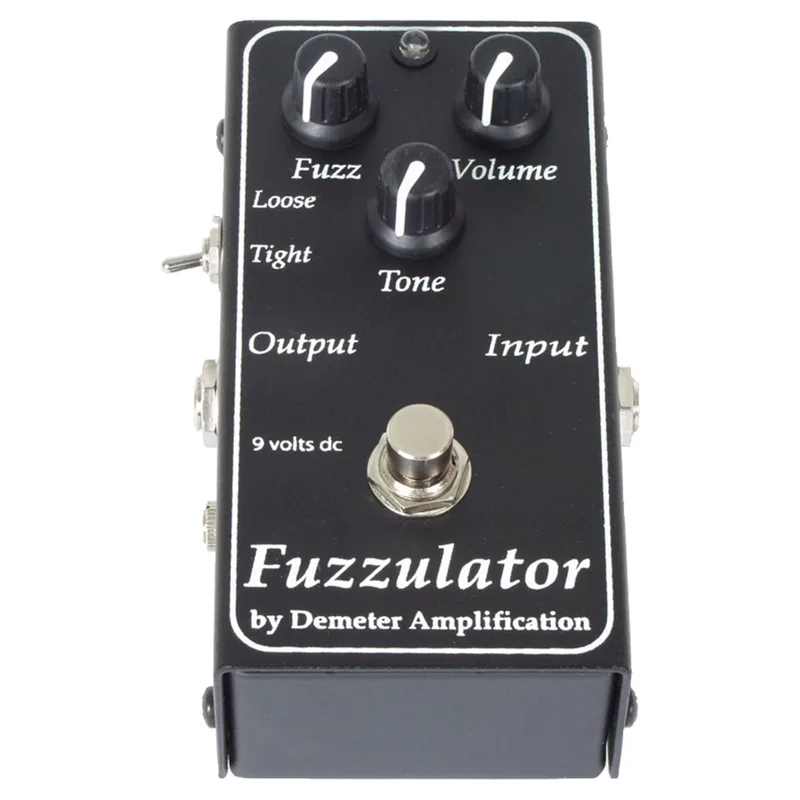
The Fuzzulator has three knobs on top, a tight/loose switch, and a trim pot on the side of the unit. Here is what each one does, in Demeter's own terms2:
| Control | What it does |
|---|---|
| Volume | Sets the overall output of the unit, for level matching between the effected and unaffected signal |
| Fuzz | Increases the gain of the distortion circuit, which clips and sustains the signal |
| Tone | A high cut filter which you can use to make your sound warmer and fatter |
| Tight/loose switch | Switches between light emitting diodes and germanium diodes for the distortion generating devices |
| Trim pot (side of unit) | Sets the gain of the Fuzzulator's output amplifier |
Tight versus loose: two clipping characters
The tight/loose switch is where the Fuzzulator's two personalities live, because it changes the actual devices doing the clipping rather than just reshaping the tone2.
- Tight: uses LEDs as the distortion generator. Demeter says LEDs "have a tight sound and are a bit louder"2.
- Loose: uses a special combination of silicone and germanium diodes. Demeter says germanium diodes "have a looser more classic fuzz sound with less output volume"2.
Because the loose setting produces less output volume, the Volume knob and the side trim pot are the tools for bringing the two settings level with each other and with your clean signal. The Volume knob exists, in Demeter's words, for "level matching between the effected and unaffected signal"2.
Power and bypass
The FUZ-1 runs on 9 volts DC, from either an external supply or an internal 9 volt battery2. The external supply uses a standard Boss type 9V connector, so ordinary pedalboard power supplies will fit it2.
Demeter states the battery must have at least 7 volts for the unit to work. To reach the battery, remove the four screws on the sides of the unit and pull it apart2.
The pedal is true bypass, using an ALCO heavy duty footswitch, so with the effect off the signal passes through without the circuit in the way2.
The Fuzzulator and the Fuzzy Octavulator
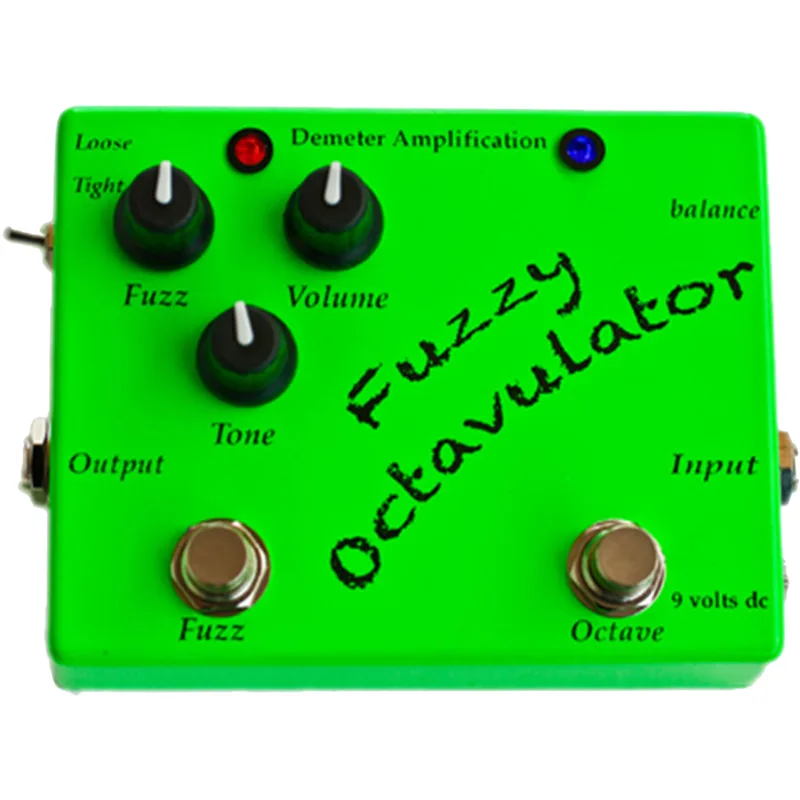
The Fuzzulator's circuit has a second life inside another Demeter pedal. The Demeter FZO-1 Fuzzy Octavulator pairs the same fuzz with an octave effect, and Demeter states plainly that "the fuzz circuit on this pedal is identical to our FUZ-1 Fuzzulator"3. Premier Guitar's 2023 review of the Octavulator noted the family connection, calling the FUZ-1 "critically acclaimed" and dating its release to 20051.
For a player choosing between them, the difference is the octave: the FUZ-1 is the fuzz on its own, while the FZO-1 layers an octave effect over the identical fuzz circuit3.
Availability and price
Demeter lists the FUZ-1 at an original price of $299.00, currently marked at $279.002. The company says its pedals usually ship within 48 hours, and if not immediately available, up to 5 working days2.
Videos
ProGuitarShopDemos
Fusionmusic Studio
TheCigartrader
Questions
Is the Demeter Fuzzulator true bypass?
Yes. Demeter states the FUZ-1 is True Bypass, using an ALCO heavy duty footswitch to switch the effect in and out of the signal path. An LED on the pedal indicates when the effect is engaged.
Does the Demeter FUZ-1 take a battery?
Yes. The FUZ-1 runs on 9 volts DC from either an external supply or an internal 9 volt battery. Demeter notes the battery must have at least 7 volts for the unit to work, and the battery is reached by removing the four screws on the sides of the unit and pulling it apart.
What is the difference between the tight and loose settings on the Fuzzulator?
The tight setting uses light emitting diodes as the distortion generator, which Demeter says have a tight sound and are a bit louder. The loose setting uses a special combination of silicone and germanium diodes, which Demeter describes as a looser, more classic fuzz sound with less output volume.
Is the Fuzzulator the same as the fuzz in the Demeter Fuzzy Octavulator?
Yes. Demeter states that the fuzz circuit in the FZO-1 Fuzzy Octavulator is identical to the FUZ-1 Fuzzulator circuit. The Octavulator adds an octave effect on top of that same fuzz.
Where is the Demeter Fuzzulator made?
Demeter says the FUZ-1 Fuzzulator is hand built in the U.S.A. using the components the company specifies.
Sources (3)
- Demeter Amplification Fuzzy Octavulator Pedal Review, Premier Guitar, 2011-06-22
- FUZ-1 Fuzzulator, Demeter Amplification
- FZO-1 Fuzzy Octavulator, Demeter Amplification