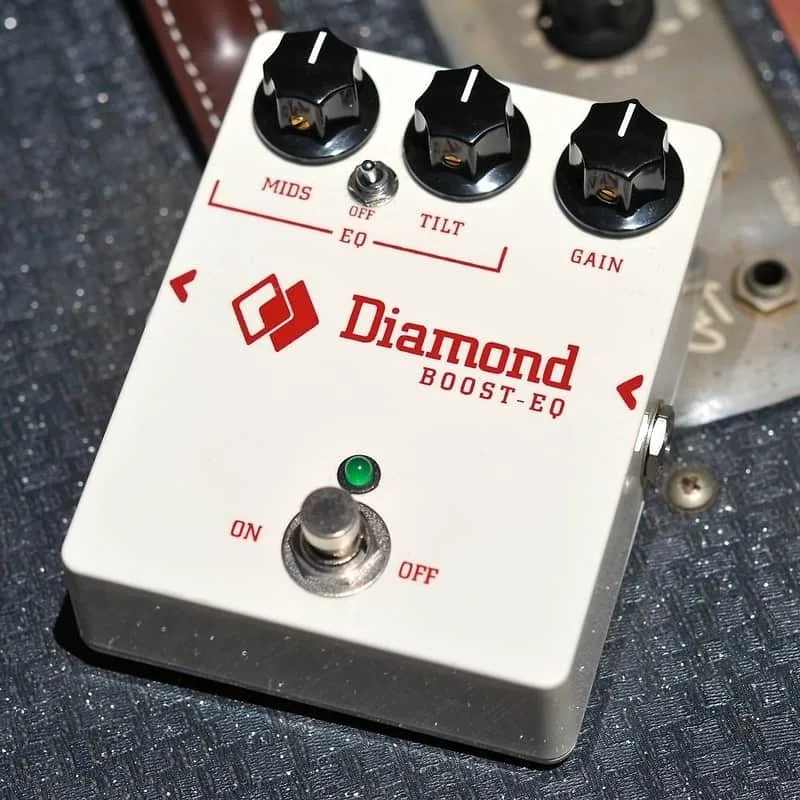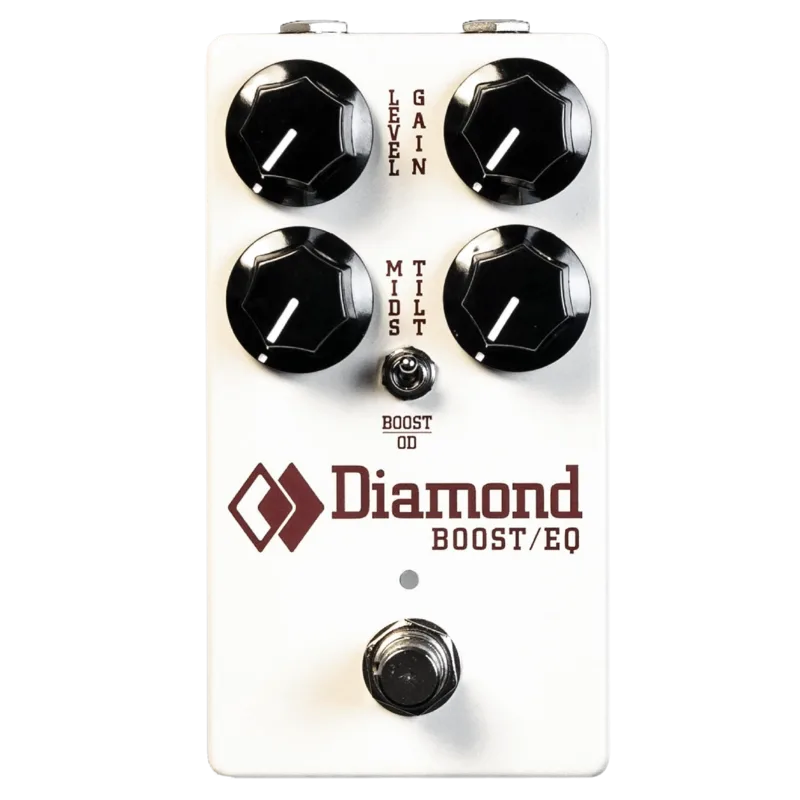

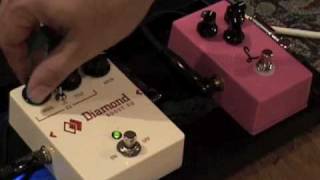

The Diamond Pedals Boost / EQ is a boost pedal that combines clean boost, tone shaping and overdrive in one box. In its default mode it is a clean boost with up to +20 dB on tap, and a Boost/OD switch flips it into a low-gain overdrive built on soft clipping12. Tone shaping comes from a Tilt EQ knob and a Mids control, the same tone-shaping approach Diamond uses on its compressor pedals12.
The pedal was released on 15 May 2025 as the second new overdrive of Diamond Pedals' reissue series, priced at $2092. It revamps an older version of the pedal from circa 2007, and the current model is made in Canada13.
A clean boost with soft-clipping overdrive and a tilt EQ
Diamond describes the Boost / EQ as "combining clean boost, tone shaping, and overdrive into one powerful and versatile pedal," and says it delivers "a punchy, dynamic sound molded for any scenario"1. The two modes are selected by a Boost/Overdrive toggle: one side is a straight clean boost, the other a soft-clipping diode drive23. Diamond calls the overdrive mode "transparent, yet full of character"1.
For a player, that means one box can serve two jobs. In Boost mode it pushes an amp or another drive pedal harder without adding its own character, up to +20 dB2. In OD mode the soft clipping adds a low-gain overdrive texture that Guitar Pedal X's Stefan Karlsson grouped with the pedal's boost function as "essentially a boost / overdrive with a Tilt EQ control and Mids sweep"2.
The controls: Level, Gain, Mids and Tilt
The control set is four knobs, one toggle and one footswitch3:
| Control | What it does |
|---|---|
| Level | Sets the output level |
| Gain | Sets the amount of gain, up to +20 dB of clean boost in Boost mode2 |
| Mids | Sweeps the midrange, working with the Tilt control to sculpt tone12 |
| Tilt | Tilts the EQ balance; Diamond says to "dial in" more sparkle with it1 |
| Boost/OD switch | Selects between straight boost and soft-clipping diode drive3 |
| Bypass footswitch | Relay true bypass on/off13 |
The Tilt and Mids pair is the heart of the tone shaping. Diamond pitches the Tilt knob as the way to add sparkle, with the Mid control sculpting the body of the sound around it1. Gearnews made the point in practical terms: "With the tilt and mid control you can control your sound like have it sound exactly how you need it," adjustable live on the fly4.
Built from the Comp / EQ gain circuit
The Boost / EQ's circuit has a direct lineage in Diamond's best-known pedal. Diamond says the concept began in the early 2000s with a request for a "compressionless" version of the Diamond Compressor, combining a clean boost circuit with that pedal's Tilt EQ1. Nearly 20 years later the idea was re-imagined on the same platform as the Comp/EQ's current version1.
Guitar Pedal X put the circuit relationship plainly: "this pedal is very much based on the Gain engine / circuit from the Comp / EQ - minus the compressions element"2. There was also a 1590BB-size version of the same circuit around 15 years ago, and Guitar World's review notes the 2025 pedal revamps an older version from circa 200723.
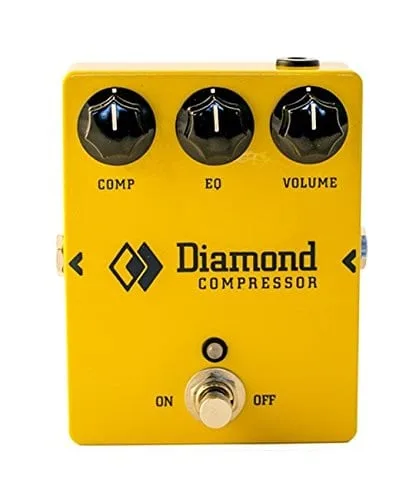
The Comp/EQ itself is a compressor pedal that augments Diamond's original yellow-box design with a Mids boost/cut control, an Attack switch, custom-spec'd opto-isolators and modern quiet switching5. So the practical difference between the two current pedals is simple: the Comp/EQ compresses your signal and shapes tone, while the Boost / EQ keeps the gain engine and tone controls but drops the compression and adds the overdrive mode12.
The circuit has a lineage worth knowing. The Boost / EQ concept began in the early 2000s with a request for a "compressionless" version of the Diamond Compressor, combining a clean boost circuit with the Compressor's Tilt EQ1. A 1590BB size version of the same circuit was released around 15 years ago2, and the current Boost / EQ is a smaller version of that circuit2.
What reviewers said
Guitar World's Trevor Curwen reviewed the pedal and listed "Boost and EQ in one pedal" among its reasons to buy3. In Guitar World's boost pedal buying guide, the verdict on it reads:
"The Diamond Boost/EQ is a supreme utility pedal capable of a host of practical applications in any signal chain."
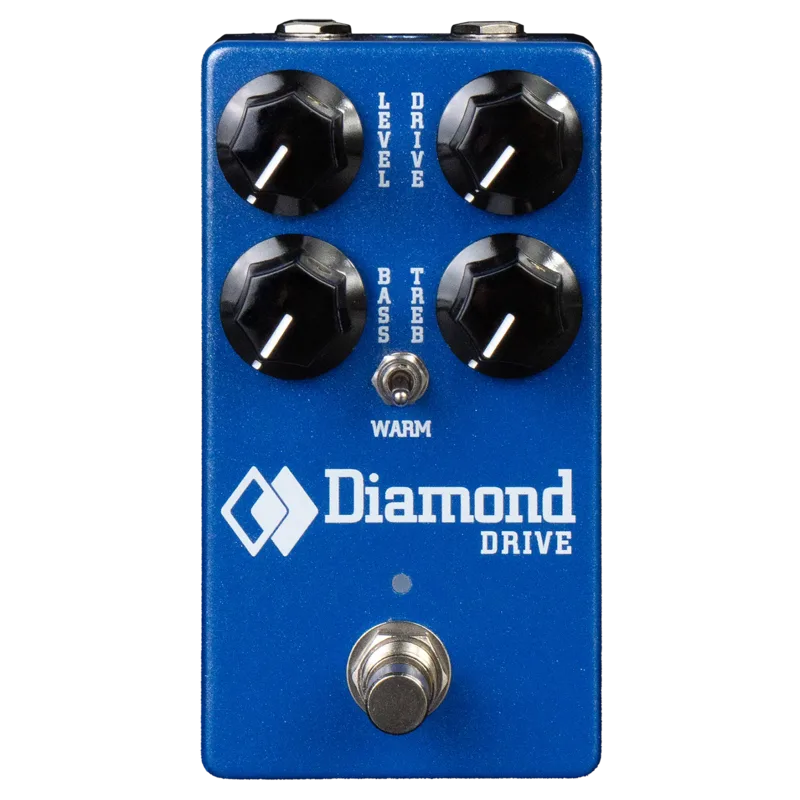
The buying guide also lists its gain as 20 dB6. Among press voices, Stefan Karlsson at Guitar Pedal X said he personally prefers the Tilt + Mids tone stack of this pedal to the Diamond Drive's 2-band EQ tone stack2.
Videos
ProGuitarShopDemos
gearmanndude
The Pedal Zone
Questions
Is the Diamond Boost / EQ true bypass?
Yes. Diamond Pedals specifies relay true bypass switching on the Boost / EQ, so the pedal's circuit is out of the signal path when it is off. Press coverage of the 2025 release also lists true bypass among its features.
How much clean boost does the Diamond Boost / EQ give?
Up to +20 dB of clean boost in Boost mode, according to Guitar Pedal X's coverage of the 2025 release. Guitar World's boost pedal buying guide lists the same 20 dB gain figure for the pedal.
Where are Diamond Pedals made?
In Canada. Diamond Pedals marks the Boost / EQ as made in Canada, and Guitar Pedal X describes it as hand-made in Montreal. The company's product pages say all pedals are designed and built in their own shop in Montreal, Quebec.
What is the difference between the Boost / EQ and the Comp / EQ?
The Boost / EQ uses the gain engine of the Comp / EQ without the compression element. The Comp / EQ is a compressor with a Tilt EQ and a Mids boost/cut control, while the Boost / EQ drops the compression and adds a Boost/OD switch for a soft-clipping low-gain overdrive mode.
What power does the Diamond Boost / EQ need?
A regular 9 to 18 V DC power supply with a center negative 2.1 mm barrel, drawing about 18 mA. That makes it easy to run from a standard pedalboard power supply.
Sources (6)
- Boost/EQ, Diamond Pedals
- Guitar Pedal X, Guitar Pedal X, 2025-05-15
- Diamond Boost/EQ review, Guitar World, 2025-10-05
- Diamond Boost/EQ: Sculpt Your Tone, gearnews.com, 2025-05-15
- Comp/EQ - Diamond Pedals, Diamond Pedals
- Best boost pedals 2026: including the best clean boost pedals for guitar, Guitar World, 2020-07-01