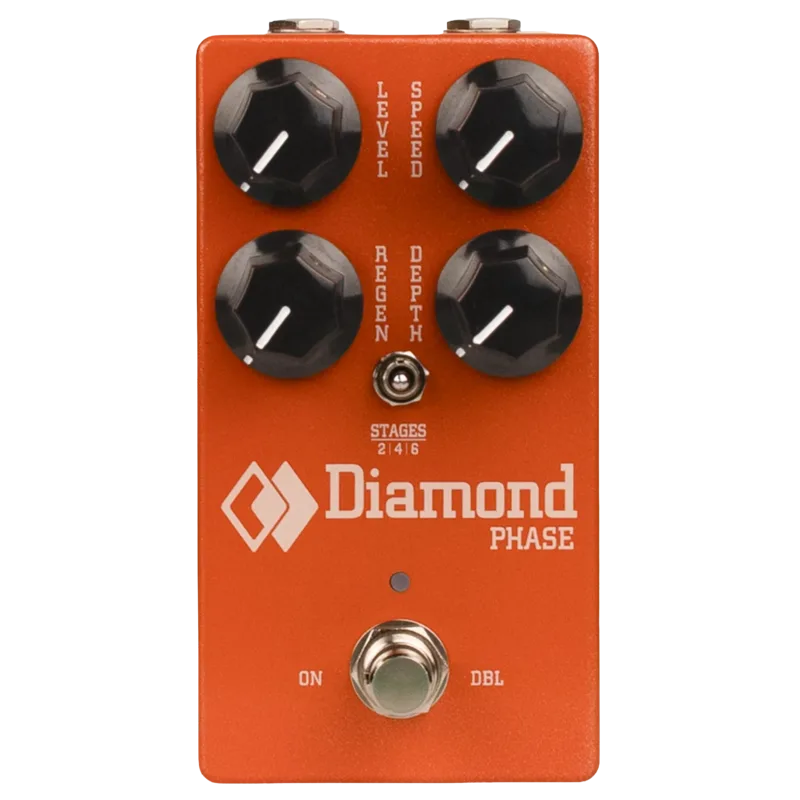


The Diamond Phase is a phaser pedal from Diamond Pedals, a modern revival of the company's original PSH-1 Phase, which was first introduced in 20081. It is a fully analog audio path built around six carefully selected and matched JFET transistors in every pedal1, and its main trick is a selectable 2-, 4-, or 6-stage architecture that gives you three distinct phaser voices in a single pedal1. It sits in an enclosure approximately half the size of the original PSH-1, with top-mounted jacks and true bypass switching1.
What it does: 2-, 4- or 6-stage JFET phasing
A phaser works by sweeping a series of frequency notches through your signal. More stages means more notches, and a deeper, more pronounced effect. The Diamond Phase uses a classic JFET-based phaser topology, where each stage is built around a voltage-controlled JFET acting as a variable resistor1. Gearnews notes the pedal is based on six carefully selected and matched JFET transistors2, which is what allows the three stage modes to be pulled from one circuit.
You select the modes via a mini toggle switch in the center of the pedal2. Each voice has its own character, as Diamond describes it:
| Mode | What Diamond says it does |
|---|---|
| 2-Stage | Light modulation and subtle movement, suited to gentle motion, tone enhancement, and always-on textures1 |
| 4-Stage | Classic, traditional phasing with a familiar, balanced sweep, a sound not previously available in the Diamond phaser1 |
| 6-Stage | A throatier, more colorful response, with deeper notches and increased harmonic complexity for bolder sounds1 |
The 4-stage position is the newcomer here. The original PSH-1 was a 6-stage design, so the 2- and 6-stage voices carry over its character while the 4-stage mode adds the more familiar four-notch sweep associated with classic phasers1. Speed is adjustable over a range of 0.1Hz to 10Hz1.
Diamond says this JFET approach delivers exceptionally smooth, musical phase shifting with depth, warmth, and clarity1. Gearnews attributes that same quality directly to the matched transistors:
"This is precisely what creates the exceptionally smooth, musical phase shift with depth, warmth, and clarity in the sound."2
Power and connections
The Diamond Phase runs on 9 to 15 VDC, negative tip, through a 2.1 mm barrel jack, and draws 80mA at 9 VDC1. There is no battery option in the stated power specification. Input impedance is greater than 1MΩ and output impedance is less than 10KΩ1.
The 80mA draw is on the higher side for a compact analog phaser, so check your power supply's per-output budget before daisy chaining it with several other pedals.
A Black Edition of the pedal is also listed by Diamond. It shares the same circuit description, power requirement and 80mA current draw3, and adds an internal voltage pump that boosts the circuit to 15V operation3. On the standard pedal, running more than 9V means feeding it more voltage externally, up to the 15V ceiling.
For comparison, the MXR Phase 100 runs on 9 volts DC per its Dunlop manual4, so the Diamond Phase's wider 9 to 15V window gives it more headroom in the power department than that classic.
Controls and switching
The control surface is minimal by design. The center mini toggle selects the stage mode2, and the speed control covers the 0.1Hz to 10Hz range1. The footswitch supports both Momentary and Latching functions2, which means you can set it to engage the effect only while your foot holds the switch down, useful for quick stabs of phasing, or leave it in standard latching mode.
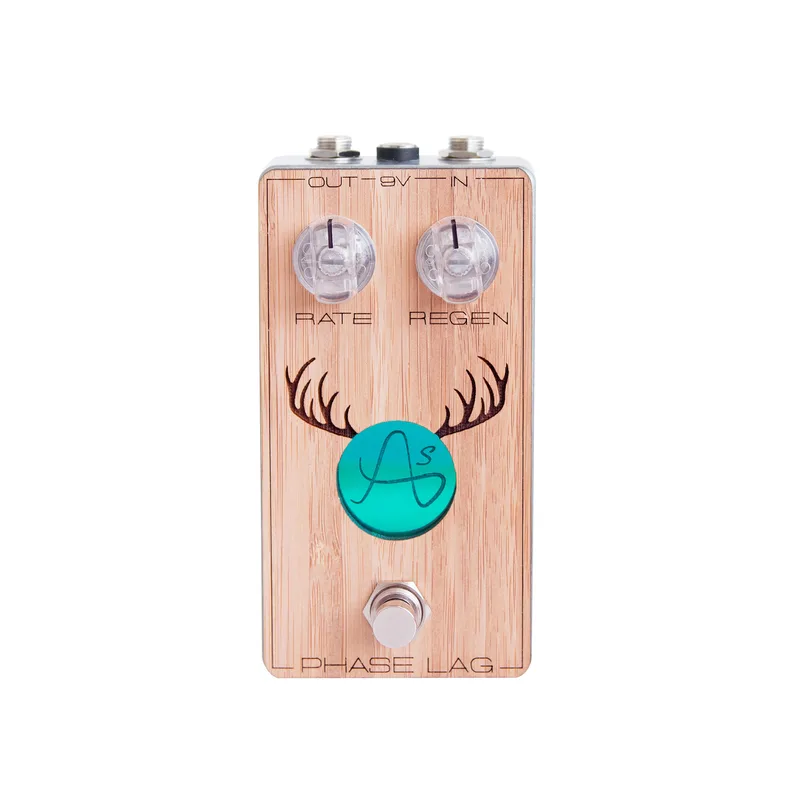
Switching is Relay True Bypass1, so the bypassed signal is routed by a relay rather than a mechanical footswitch contact. Among other compact phasers, the Anasounds Phase Lag uses gold true bypass switching5, a more conventional mechanical approach.
History: a compact revival of the PSH-1
The original Diamond PSH-1 Phase was first introduced in 20081. Guitar Pedal X describes the Diamond Phase as Diamond Pedals reissuing and shrinking its well loved 2008 PHS-1 6-Stage JFET Phase-Shifter into a compact edition6. The new enclosure is approximately half the size of the original1, with top-mounted jacks to save board space1.
One feature did not make the trip. The original version had a Phaser/Vibrato switch, which Guitar Pedal X reports has been felt surplus to requirements on this occasion6. So the PSH-1's vibrato option is gone, and the Diamond Phase is a phaser only.
The reissue arrived in April 2026, available widely at leading international dealers as the coverage went live6. Gearnews listed the European price at €279.00 at launch2, while Diamond's own page lists the regular price at $249.001.
What reviewers said
Gearnews reviewed the launch and was positive on value:
"The price is reasonable considering the sound quality and flawless workmanship."2
The pedal also caught the attention of That Pedal Show, which featured the Diamond Pedals Phase in its Five Fantastic Phasers episode, with a double/half speed segment at the 26:00 mark of the video7.
Warranty and build
All Diamond products purchased through the diamondpedals.com website or authorized dealers come with a three-year warranty against failure resulting from defective parts and/or faulty workmanship, for the original owner only and not transferable1. The pedals are designed and built entirely in Diamond's own shop in Montreal, Quebec1.
Videos
ProGuitarShopDemos
gearmanndude
R.J. Ronquillo
Questions
Can the Diamond Phase run at 18V?
No. Diamond Pedals specifies a power requirement of 9 to 15 VDC, negative tip, on a 2.1 mm barrel jack. Anything above 15V is outside the stated range. The Black Edition adds an internal voltage pump that boosts the circuit to 15V operation on its own.
Does the Diamond Phase have a vibrato mode like the PSH-1?
No. The original PSH-1 had a Phaser/Vibrato switch, but Guitar Pedal X reports that switch was removed for the compact reissue, as it was felt surplus to requirements. The Diamond Phase is a phaser only, with 2-, 4- and 6-stage modes.
Is the Diamond Phase true bypass?
Yes. Diamond Pedals lists the switching as Relay True Bypass, with top-mounted jacks. When the pedal is off, the signal path is bypassed by a relay rather than a mechanical switch.
Can the Diamond Phase footswitch work in momentary mode?
Yes. Gearnews reports that the footswitch supports both Momentary and Latching functions, so you can hold the effect on only while the switch is pressed, or have it latch on and off like a standard pedal.
Where is the Diamond Phase made?
In Canada. Diamond Pedals states that all its pedals are designed and built entirely in its own shop in Montreal, Quebec, and the product page lists the Diamond Phase as Made In Canada.
Sources (7)
- Phase - Diamond Pedals, Diamond Pedals
- Diamond Phase: Sweet Analog Phasing, gearnews.com, 2026-04-16
- Phase - Black Edition - Diamond Pedals, Diamond Pedals
- M107.pdf, Dunlop Manufacturing, Inc., 2019
- phase lag, Anasounds, 2022-07-05
- Guitar Pedal X, Guitar Pedal X, 2026-04-16
- Five Fantastic Phasers Plus Phaser Tips & Tricks, That Pedal Show, 2026-05-15