

The MXR Phase 100 is a phaser pedal made by MXR, now a Dunlop Manufacturing brand. Dunlop calls it the big brother of the Phase 90 with an even broader range of sounds, and the manual describes what it does in one line: "Spacey, psychedelic ambience for guitar solos or chords"1. Where the Phase 90 gives you a single knob, the Phase 100 adds a four-way Intensity switch that selects preset phase waveforms, so you can go from a barely-there shimmer to a deep, sweeping swirl without touching anything else.
MXR released the Phase 100 in the late 1970s2, and it carries the model number M1073. It lists at $159.994.
What the Phase 100 does to your sound
A phaser splits your guitar signal, shifts the phase of one path, and recombines the two, which creates moving notches across the frequency spectrum. The Phase 100 does this with ten stages, more than the Phase 90, and General Guitar Gadgets calls it "very versatile and unique sounding"53. The manual's own description of the result is "spacey, psychedelic ambience for guitar solos or chords"1.
The most famous documented use of the circuit is Keith Richards of the Rolling Stones, whose Phase 100 sound can be heard on the song "Shattered" from the Some Girls album5. That track is the reference point many players have in mind when they reach for this pedal.
The Phase 100's phase shift range is 180 degrees, with a maximum input level of +5 dB and a maximum output level of +8 dB1. Its noise floor is 95 dBV, A-weighted1.
The controls: Speed and a four-way Intensity switch
The Phase 100 keeps its control surface to two things, and the manual is explicit about what each does1:
| Control | What it does |
|---|---|
| SPEED knob | Controls the speed of the phase effect; clockwise is faster, counterclockwise is slower |
| INTENSITY knob | A four-position rotary switch that selects one of four preset phase waveforms |
| FOOTSWITCH | Toggles the effect on and bypass; a red LED indicates on |
MusicRadar's reviewer Trevor Curwen noted the same layout when comparing phasers, describing how "the MXR sets the intensity with a four-way rotary switch"6. That switch is the real difference from a one-knob phaser: instead of a single fixed character, you get four preset waveforms to choose from, then fine-tune the rate with the Speed knob.
For starting points, the manual names four sample settings1:
- SLOW AND DEEP
- SPINNING SPEAKER
- MEDIUM
- SUBTLE
Those four labels map onto the four Intensity positions, so a player can dial in a slow, deep sweep for chords, a spinning-speaker style wobble, a medium-rate phase, or a subtle movement that sits under the note without taking over13.
How it differs from the Phase 90
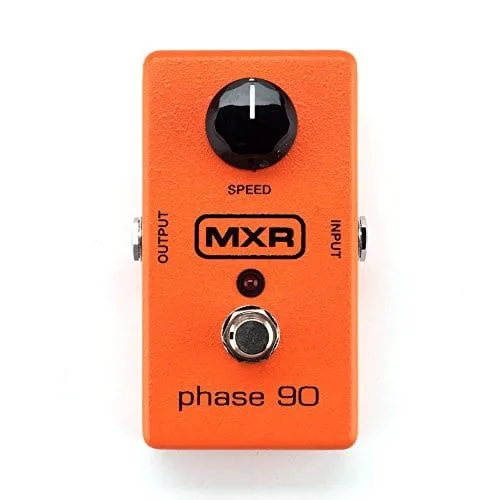
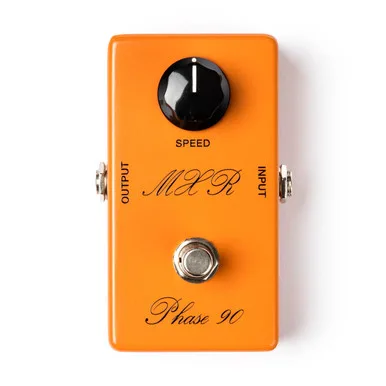
Dunlop positions the Phase 100 as the big brother of the Phase 90 with a broader range of sounds3. The practical differences are the ten-stage circuit versus the Phase 90's fewer stages, and the four-way Intensity switch, which the Phase 90 lacks entirely. GuitarPlayer's Dave Hunter has also described the Phase 100 as "the larger two-knob pedal" when set against the Phase 907, so it takes up more board real estate too.
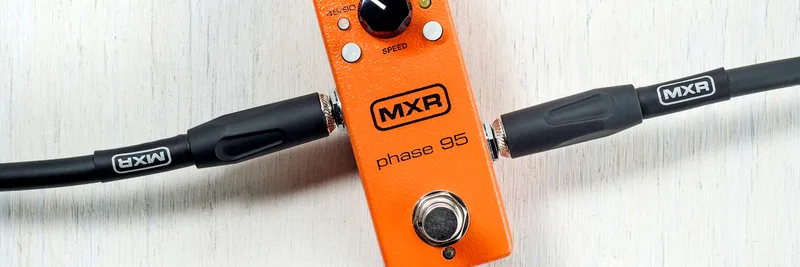
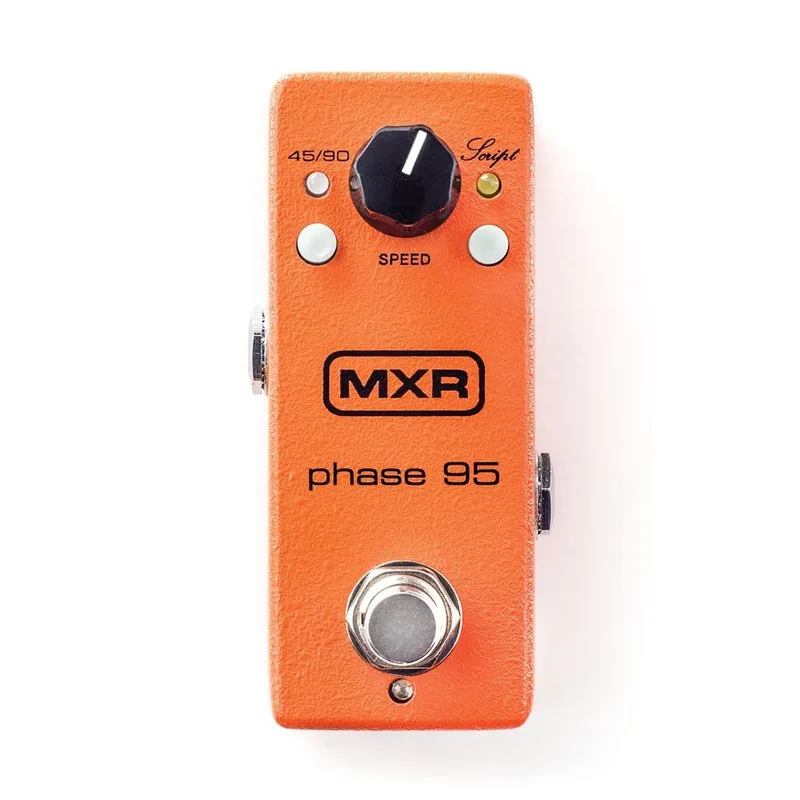
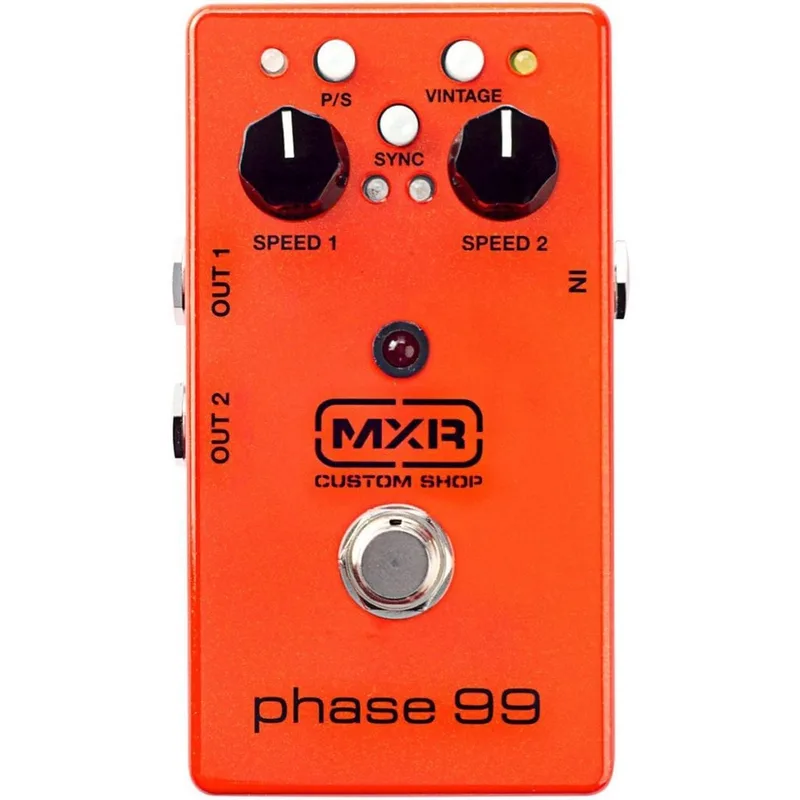
Within the modern MXR lineup, the Phase 100 sits alongside the Phase 95 and Phase 95 Mini, which combine Phase 45 and Phase 90 circuits with Script and Block voicings, and the Phase 99, which packs multiple phaser circuits into one box. The Phase 100 remains the only one of these with the four-position waveform switch16.
Power, connections, and reliability
The pedal runs on a 9-volt battery, a Dunlop ECB003 9-volt adapter, or Dunlop's DC Brick, Iso-Brick, and Mini Iso-Brick power supplies, none of which are included3. At 6 mA of current draw1, it is light on power. Input impedance is 500 kΩ and output impedance is 3 kΩ1. Setup is a straight line: a cable from the guitar to the input jack, and another from the output jack to the amplifier1.
The bypass is hardwire, not true bypass1. If you run long cable runs or many pedals, that is worth knowing when planning your signal chain.
On the subject of vintage units, an independent technical write-up on Tagboard Effects documented a 1997-built Phase 100 that made a periodic siren sound with or without an instrument connected; its board used TI TL062CP opamps and VTL5C3/2 photocouplers8. On That Pedal Show, Mick and Dan made the broader point about old MXR phasers while looking at a 1974 script logo Phase 90:
"the electrolytic capacities in these things will only last 25 30 years out of push and then they break down"9
That Pedal Show9
Their point was about vintage reliability: electrolytic capacitors age out after 25 to 30 years, so a 1970s original is a gamble, and a current production unit avoids that problem9.
Videos
ProGuitarShopDemos
jimdunlopusa
docSanchezFX
Questions
Does the MXR Phase 100 run on a battery?
Yes. Dunlop says the Phase 100 can be powered by a 9-volt battery, a Dunlop ECB003 9-volt adapter, or the DC Brick, Iso-Brick, and Mini Iso-Brick power supplies, none of which are included with the pedal. Current draw is 6 mA, so a battery lasts a long time at typical playing hours.
Is the MXR Phase 100 true bypass?
No. The Dunlop manual lists the bypass type as hardwire, not true bypass. When the effect is off, the signal still passes through the pedal's circuitry rather than a direct switch-to-output path, which is how the original MXR pedals of the late 1970s were built.
What is the difference between the MXR Phase 100 and Phase 90?
The Phase 100 is the big brother of the Phase 90 with a broader range of sounds. It is a 10-stage phase shifter where the Phase 90 uses fewer stages, and it adds a four-way Intensity switch for preset waveforms on top of the Speed control. GuitarPlayer has also described it as the larger two-knob pedal of the pair.
How many stages does the MXR Phase 100 have?
Ten. General Guitar Gadgets describes the Phase 100 circuit as a 10-stage phase shifter, which is more than the Phase 90 and part of why Dunlop positions it as the Phase 90's big brother with an even broader range of sounds.
What are good settings for the MXR Phase 100?
Dunlop's manual suggests four starting points: SLOW AND DEEP, SPINNING SPEAKER, MEDIUM, and SUBTLE. Set the Intensity switch to the waveform that suits the part, then rotate the Speed knob clockwise for a faster phase effect or counterclockwise for a slower one.
Sources (9)
- M107.pdf, Dunlop Manufacturing, Inc., 2019
- Enter the Next Phase, Dunlop (lifestyle.jimdunlop.com), 2017-02-15
- MXR® PHASE 100, Dunlop (jimdunlop.com)
- MXR® PHASE 99, Dunlop (jimdunlop.com)
- MXR™ Phase 100™ Clone: 10-Stage Phaser Schematic & Layout, General Guitar Gadgets, 2014-05-18
- Akai Phase Shifter review, MusicRadar, 2012-03-14
- A Favorite of Eddie Van Halen, the MXR Phase 90 Smeared Its Luscious Tones Over Countless Classic Recordings, GuitarPlayer (www.guitarplayer.com), 2023-08-01
- Guitar FX Layouts: MXR Phase 90 with Script Switch, tagboardeffects.blogspot.com (Guitar FX Layouts), 2023-02-08
- That Pedal Show, That Pedal Show (youtube.com), 2017-06-16
 Keith Richards